
Table of Contents
Getting Around Korea Without Guessing
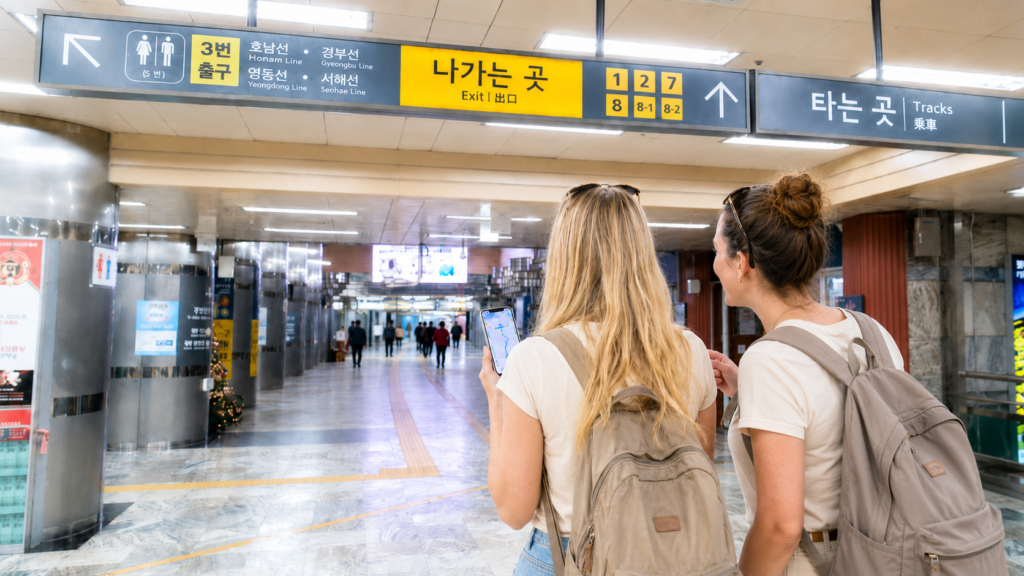
The map says you have arrived.
But you are standing outside a subway exit, looking at three streets, two bus stops, five signs, and one building that somehow does not look like the place you searched for.
This is one of the most common “Wait… where am I?” moments in Korea.
Korea is not difficult to travel around. In fact, the subway is excellent, buses run frequently, taxis are easy to find, and airport transportation is usually well organized.
But for first-time visitors, the confusing part often begins after the map says, “You have arrived.”
Choose the wrong subway exit, and a short walk can suddenly turn into a long detour. A bus stop may be correct, but on the wrong side of the road. A taxi may look available, but not actually be taking passengers. Your hotel may be easier to find by address than by name. And even when the sign is right there, the entrance may be hidden in a basement, upstairs, inside a mall, or around the side of the building.
Getting around Korea becomes much easier once you stop treating the route line as the whole trip. Before you start the final walk, check the subway exit, exact bus stop and direction, taxi pickup point, and the building entrance or floor.
A map app can bring you close. These last details are what usually get you to the correct door.
This guide focuses on what to check after you have already chosen your route. For a detailed comparison of Google Maps, Naver Map, and KakaoMap in Korea, see our separate Google Maps in Korea guide.
1. A Good Subway Route Starts with the Right Exit
In Korea, choosing the right subway station is only the beginning.
The exit number matters more than many visitors expect.
Some subway stations in Seoul, Busan, and other big cities have many exits. Coming out of the wrong one can put you on the opposite side of a wide road, near a different shopping street, or closer to office buildings instead of your actual destination.
For locals in Korea, an exit number often feels like part of the address itself. We use exits as meeting points without thinking much about it, but for a first-time visitor, choosing the wrong exit can turn a short walk into a surprisingly long detour.
Local map apps are helpful because they usually show which exit is closest to where you are actually going. That small number can save you from extra walking after you leave the station.
Why it matters: In Korea, choosing the right station is not always enough. If you use the wrong exit, you may end up farther from your destination than expected. Checking the exit number before you leave the subway area can save you time, walking, and stress.
Local tip: Before you pass through the ticket gate, check the recommended exit number in Naver Map or KakaoMap. Then follow the exit-number signs inside the station. If you check only after you are outside, you may have to cross a large road or walk back around the station.
2. Korean Buses Are Easier When You Check the Exact Stop
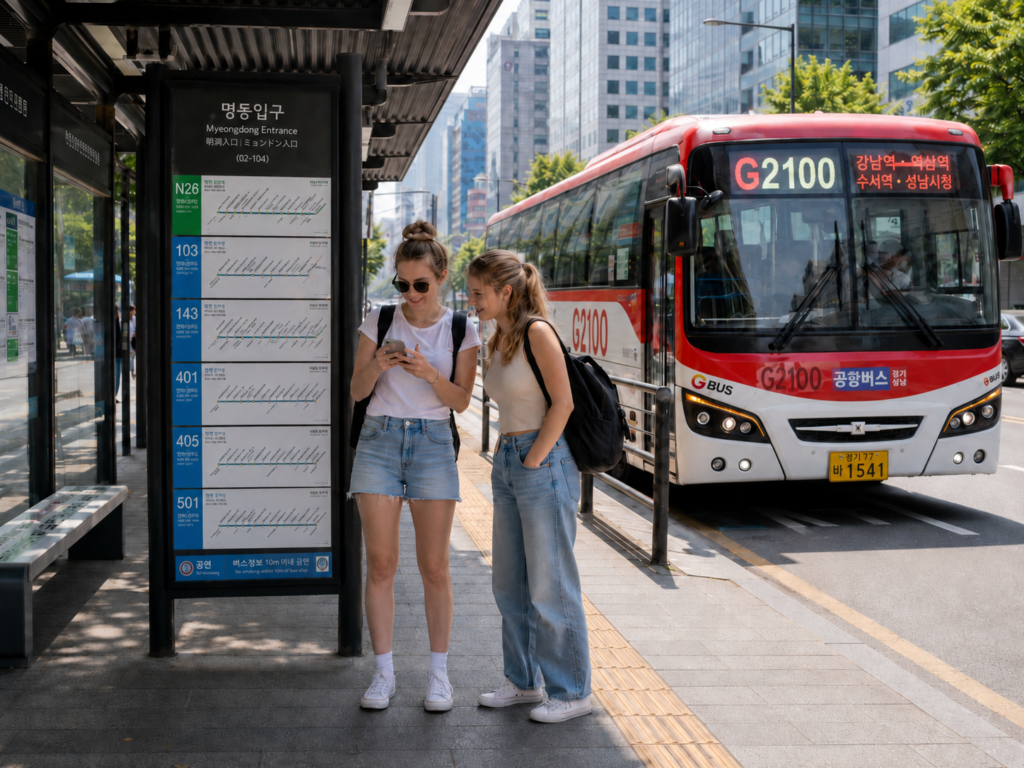
Korean buses are convenient, but the stop location matters.
In busy areas, several bus stops may be close to each other. A red metropolitan bus, a blue trunk bus, and a green branch or village bus may stop at different spots. One stop may be farther down the road, across the street, or on a central bus lane.
So even if you know the bus number, check the exact stop before you wait.
A Korean commuter usually does not stop at “that is my bus number.” The stop direction matters just as much. Checking the next one or two stops, along with real-time arrival information in Naver Map or KakaoMap, is a small habit that prevents many wrong-direction rides.
If you wait at the wrong stop, the bus may pass nearby without stopping for you.
Why it matters: In Korea, nearby bus stops may serve different bus types or directions. Checking only the bus number is not always enough.
Local tip: In Naver Map or KakaoMap, tap the bus stop for your route and check its exact location, direction, bus color, and next few stops.
3. An Empty Taxi Does Not Always Mean Available
In Korea, an empty-looking taxi may already be on its way to another passenger.
In busy areas, some taxis may be heading to pick up someone who requested a ride through an app.
That is one reason many Koreans use taxi apps like Kakao T instead of only trying to catch a taxi on the street.
With a taxi app, you can enter your destination first and request a nearby taxi. This is especially helpful if you do not speak Korean well, because you do not have to explain your hotel, restaurant, or address out loud.
But the pickup point still matters. If the driver cannot find you easily, they may call and ask where you are.
Why it matters: In Korea, a taxi that looks empty may already be heading to an app pickup. Using a taxi app such as Kakao T helps you find an available taxi and makes the destination easier to share.
Local tip: Choose an easy pickup point, such as a hotel entrance, convenience store, cafe, subway exit, or main road. Save your hotel name and address in Korean in case you need to show it to the driver.
For app choices, fares, night surcharges, payment, and airport taxi rules, see Taking a Taxi in Korea 2026: Apps, Fares & First-Time Tips.
When You’re Almost There but Still Lost
4. Your Hotel Name May Not Be Enough in Korea
Finding your hotel in Korea can be trickier than it sounds.
You may have the hotel name saved in English, but the local map app may show it in Korean. The building sign may also look different from the name on your booking app.
This can be confusing in busy areas like Myeongdong, Hongdae, Gangnam, or near major stations, where hotels, guesthouses, cafes, and office buildings may be close together.
Before leaving the airport or station, save four things:
- Korean place name
- Korean street address
- Nearest subway exit or obvious landmark
- A map screenshot
This is useful when you use a taxi app, show your destination to a driver, ask someone for help, or return to your hotel late at night.
Why it matters: In Korea, your map may bring you close to your hotel, but you may still need the exact building. Saving the Korean name, address, and map location helps you find your accommodation more smoothly.
Local tip: Save your hotel details in two places: your map app and your phone gallery. A screenshot can still help if your signal is weak or the app does not load quickly.
5. The Sign Is There, But Where Is the Door?
In Korea, the place you are looking for may not be on the first floor.
A cafe can be upstairs. A restaurant can be in the basement. A skin clinic, hair salon, optical shop, or nail salon may be inside a multi-floor building instead of facing the street.
This is common in busy areas like Hongdae, Gangnam, Myeongdong, Seongsu, and around large subway stations.
From the street, you may see the sign on the building, but the actual place may be inside the lobby, near the elevator, or on another floor.
From a Korean perspective, a restaurant or cafe being on the second floor, in a basement, or behind a shared building entrance does not feel unusual. That is why the map saying “you have arrived” does not always mean the storefront will be visible from the street.
When the map says you have arrived but you cannot see the entrance:
- Check the floor number.
- Look for the building entrance rather than the store door.
- Check the elevator or lobby directory.
- Compare recent place photos in your map app.
- If necessary, confirm the Korean business name on the building sign.
Why it matters: In Korea, many cafes, restaurants, clinics, salons, and shops are not directly visible from the street. Checking the floor number and building information can help you find the place more easily.
Local tip: In Naver Map or KakaoMap, check the floor number and photos before you visit. Once you arrive at the building, look for the floor guide near the entrance, elevator, or lobby.
Before You Drag Your Suitcase to the Subway
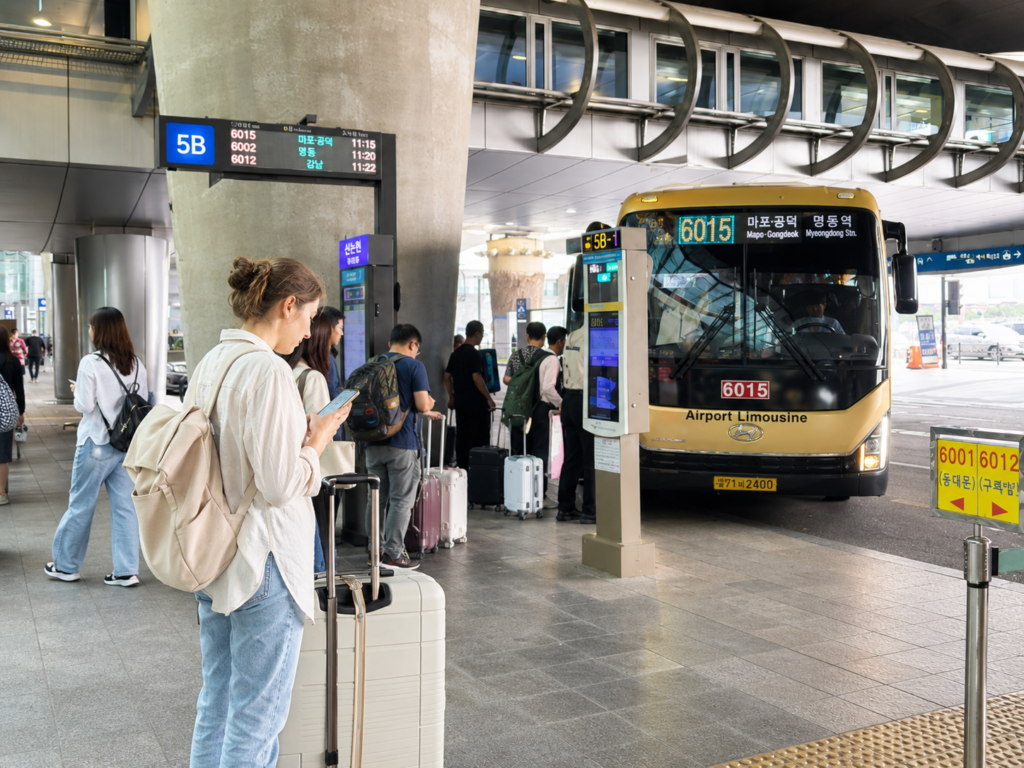
6. The Airport Bus May Be the Easier First Ride
After landing in Korea, many travelers think about taking the subway first.
That can work well, but if you are carrying luggage, the airport limousine bus may be more comfortable.
Airport buses connect Incheon Airport with many parts of Seoul. Some routes stop near major hotels, subway stations, and busy neighborhoods. In some cases, an airport bus stop may be closer to your hotel than the nearest subway station.
The subway is convenient, but transfers can feel tiring on your first day. You may have to walk through a large station, change lines, use stairs, or carry your suitcase farther than expected.
On an airport bus, you can sit down, store your luggage, and get closer to your hotel without making a subway transfer right after a long flight.
Airport bus ticketing depends on the route and operator. Do not assume that every Seoul airport limousine bus can be reserved online.
At Incheon Airport, check the official bus information for your terminal and route. Airport bus tickets are available at designated ticket counters or vending machines, and ticketing rules can differ by operator.
For Airport Limousine services from Terminal 2 to downtown Seoul, the operator has required passengers since March 5, 2026, to buy a ticket before boarding at the ticket counter or vending machine. Check the official Airport Limousine ticket notice.
Airport buses are seat-based. If a bus is full, you cannot stand as you would on a regular city bus and may need to wait for the next service.
Choose the airport transfer that fits your hotel location, luggage, arrival time, and traffic:
- Airport limousine bus: useful when it stops close to your hotel and you have large luggage.
- AREX or subway: useful when your accommodation is close to a convenient rail connection and you want to avoid road traffic.
Why it matters: The airport bus can be a comfortable first option when it stops near your hotel, but the best choice depends on the route rather than one transport mode always being easier.
Local tip: Before your flight, check your hotel in Naver Map or KakaoMap, then confirm the terminal, stop, and ticketing method on the official information for your specific route.
Final Thoughts
The route itself is usually not the hardest part. The last details matter: the subway exit, bus-stop direction, taxi pickup point, Korean place name and address, the floor or building entrance, and the airport transfer that makes sense with your luggage.
What feels obvious when you live in Korea — checking the exit number, the bus-stop direction, the Korean place name, or the floor of a building — can be exactly what makes a first trip confusing. Once you start checking those small details, getting around Korea feels much more predictable.
A local map app, reliable mobile data or an eSIM, and these small checks can help you reach the correct door with less guesswork.
Frequently Asked Questions
What is the easiest way to get around Korea?
For getting around Korea smoothly, it helps to use different transportation options depending on your route. The subway is useful for moving across major cities, buses can take you closer to smaller streets or neighborhoods, and taxis are helpful late at night or when you have luggage. For smoother travel, use Naver Map or KakaoMap instead of relying only on Google Maps.
Do I need Naver Map or KakaoMap in Korea?
Yes. Naver Map and KakaoMap are very useful for traveling in Korea because they show local details such as subway exits, bus stops, walking routes, and Korean place names. Google Maps can still help with general searches, but local map apps usually work better for everyday navigation in Korea. See our Google Maps in Korea guide for a detailed comparison.
Why are subway exits so important in Korea?
They matter because many Korean subway stations have several exits, and each one can lead to a very different street. In busy areas, choosing the wrong one can make you walk much farther than expected. That is why Koreans often use exit numbers as meeting points.
Is it better to take the airport bus or subway from Incheon Airport?
It depends on your hotel location, luggage, arrival time, and traffic. An airport limousine bus can be easier when it stops near your hotel, while AREX or the subway may be more predictable when your accommodation has a convenient rail connection. Airport bus ticketing varies by operator.
What should I prepare before traveling around Korea?
Before traveling around Korea, prepare a local map app, reliable mobile data or an eSIM, and your hotel information saved in Korean. It is also helpful to keep a screenshot of your hotel address and map location, especially in case your internet connection is slow or your app does not load quickly.
Related Guides
Want to feel more confident moving around Korea?
These guides will help you understand the apps, subway habits, and local travel clues that make Korea easier to navigate.
Google Maps in Korea 2026: Naver Map, KakaoMap & What Changed
Before you navigate Korea like a local, it helps to know why Google Maps works differently here and which apps Koreans actually use.
→ Read the Google Maps in Korea guide
Korean Subway Culture & Etiquette: 11 Practical Tips
Korean subways are clean, quiet, and efficient, but there are small habits first-time visitors often miss.
→ Read the Korean subway culture guide
Taking a Taxi in Korea 2026: Apps, Fares & First-Time Tips
Learn about taxi apps, fares, night surcharges, payment, and airport taxi rules.
→ Read the Korea taxi guide
Luggage Storage in Korea: 7 Easy Options Before Check-In or After Check-Out
Compare hotel storage, subway lockers, T-Luggage, airport storage, and other practical options.
→ Read the luggage storage in Korea guide
For official Korea travel information, you can also visit the Korea Tourism Organization website.