
Taking a Taxi in Korea: What Surprises First-Time Travelers
Taking a taxi in Korea is usually easier than first-time visitors expect. Taxis use meters, card payment is common, and tipping is not required. The confusing part is choosing an app, reading the windshield signs, understanding surcharges, and avoiding double payment.
Install a taxi app in advance, save your hotel address in Korean, and check the license plate before getting in.
Table of Contents
A Smooth Taxi Ride Starts Before You Get In
1. Which Taxi App Should First-Time Travelers Use?
For most international visitors, k.ride is the easiest place to start. It is operated by Kakao Mobility and uses the same taxi network as Kakao T, but it is designed specifically for international travelers.
The app is available in English, Japanese, Simplified Chinese, and Traditional Chinese. It also offers multilingual destination searches, translated driver messages, estimated fares, and in-app payment.
Install k.ride and add your preferred payment method in advance, preferably while you have a stable internet connection. This saves time when you need a taxi quickly, especially after the subway has stopped running.
2. How Do k.ride, Uber Taxi, and Kakao T Compare?
| App | Best for | Main advantage |
|---|---|---|
| k.ride | Most first-time visitors | Multilingual features and overseas card support |
| Uber Taxi | Existing Uber users | Familiar account and saved payment method |
| Kakao T | Residents and repeat visitors | Broad coverage and more vehicle options |
In Korea, Uber generally connects passengers with licensed local taxis rather than private rideshare vehicles. Kakao T is widely used by Koreans, but k.ride is usually simpler for a short visit.
An app keeps a record of the driver, license plate, route, estimated fare, and payment. This can help if you leave something behind or need to check the fare later.
3. What Do 빈차 and 예약 Mean?
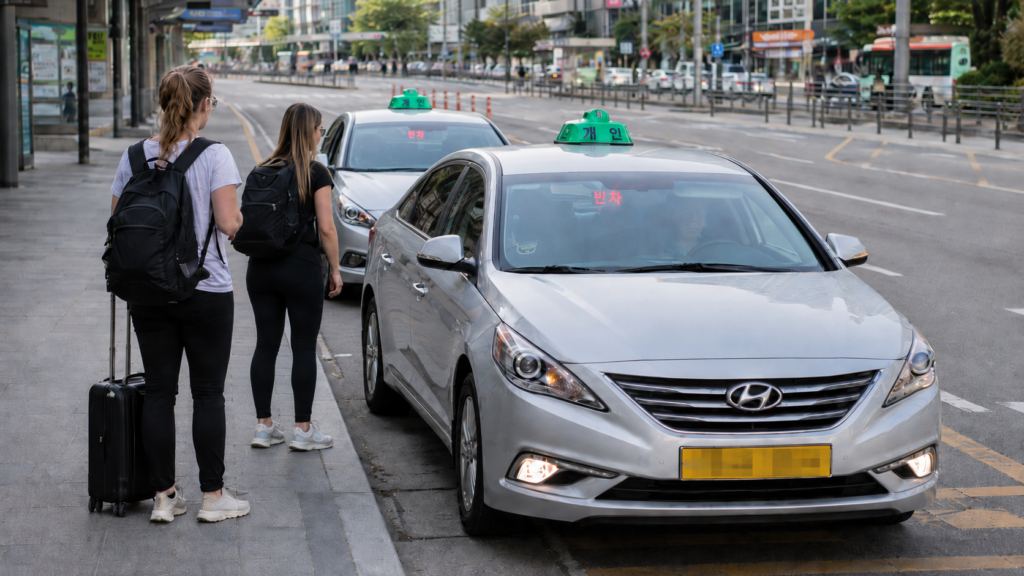
When hailing a taxi on the street, check the illuminated sign near the windshield.
빈차 (bincha) means the taxi is available. It is usually displayed in red, and you can raise your hand to stop the taxi.
예약 (yeyak) means the taxi has already been reserved. Even if no passenger is inside, the driver may be on the way to an app pickup.
At train stations, bus terminals, and airports, use the designated taxi stand. Late at night, booking through an app is often easier because many taxis may already be reserved.
4. Why Should You Save Your Destination in Korean?
English ability varies by driver, and the English name of your hotel or destination may not appear correctly in the navigation system.
Save the Korean name, full address, and phone number of your destination. A nearby subway station or well-known landmark in Korean can also help.
When using an app, check the pickup point carefully. On a wide road, placing the pin on the opposite side may force the driver to make a long detour. In Korea, the difficult part of taking a taxi is often not the ride itself but choosing the correct pickup point before the car arrives.
Large hotels, malls, and stations often have several entrances. An exact Korean address or entrance name can help the driver choose the most convenient drop-off point. At a large station or mall, people familiar with the area often think about which exit or side of the road to meet the taxi on—not just the destination itself.
Save a screenshot of the Korean address in case your mobile data stops working.
The Meter Counts More Than Distance
5. How Are Seoul Taxi Fares Calculated?
As of 2026, the daytime base fare for a standard taxi in Seoul is KRW 4,800, covering the first 1.6 kilometers. After that, the meter adds KRW 100 for every 131 meters.
When the taxi slows below 15.72 kilometers per hour, the meter also adds KRW 100 for every 30 seconds.
The estimates below are based on daytime distance only. They exclude slow traffic, waiting time, tolls, app fees, late-night surcharges, and travel outside Seoul.
| Distance | Approximate meter fare |
| Up to 1.6 km | KRW 4,800 |
| About 3 km | KRW 5,900 |
| About 5 km | KRW 7,400 |
| About 10 km | KRW 11,300 |
A short trip through heavy traffic may cost more than the same distance on a clear road.
Use these figures only as a general reference. Check the official Seoul taxi fare table.
6. Why Can the Same Trip Cost More at Night?
Regular taxis in Seoul apply a late-night surcharge of:
- 20% from 10 p.m. to 11 p.m.
- 40% from 11 p.m. to 2 a.m.
- 20% from 2 a.m. to 4 a.m.
A 20% out-of-city surcharge may apply when a Seoul taxi travels beyond the city limits. Expressway and bridge tolls are separate, and some app options may include a service fee.
The same route can cost more because of traffic, the time of night, travel outside Seoul, tolls, app fees, or the taxi type.
Before booking, check the taxi type, estimated meter fare, toll information, and any additional fee. Premium or larger vehicles may cost considerably more than a standard taxi on the same route.
Paying Is Easy—But Check the App First
7. Can You Pay by Card or T-money?
Most taxis accept cash, credit cards, and transportation cards such as T-money. Tipping is not required.
Many terminals accept Visa, Mastercard, UnionPay, JCB, and American Express. A foreign card may still be declined, so carry a backup card, some Korean won, or T-money.
If you stop a taxi on the street without using an app, pay after reaching your destination. For an app-booked taxi, check whether payment is automatic or made directly to the driver.
If the fare has already been charged through the app, do not tap your card or T-money inside the taxi.
8. How Can You Avoid Paying Twice?
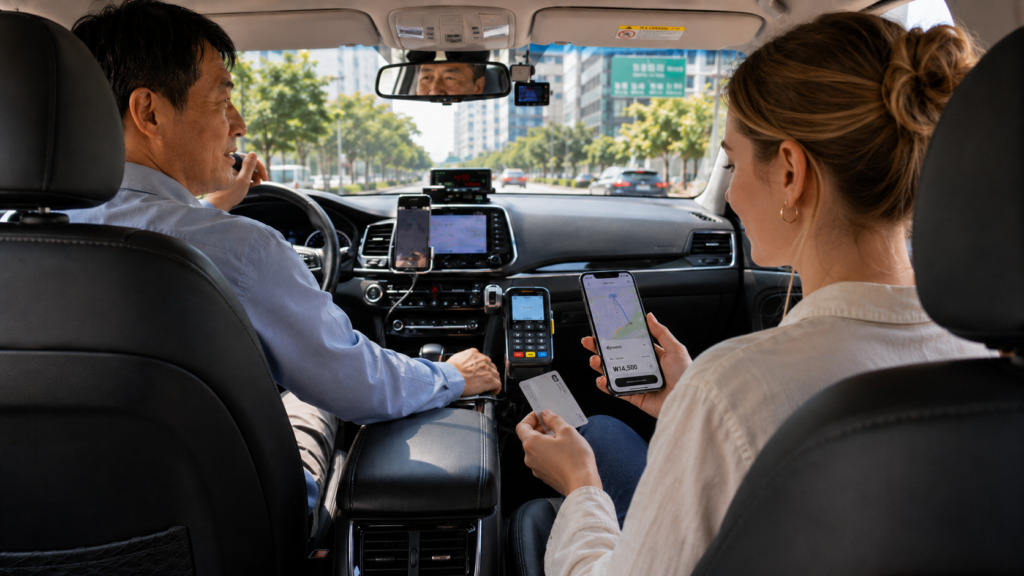
Double payment happens when the app charges the fare automatically, but the passenger does not realize it and pays again inside the taxi.
If you are unsure, show the app screen to the driver and ask, “결제됐어요?” (Gyeolje dwaesseoyo?), meaning, “Has it already been paid?”
The metered fare, tolls, and app service fees may appear as separate items, so several lines in the payment details do not always mean you paid twice.
If you suspect a double charge, save the app receipt and card transaction record before contacting customer support.
Your Group May Fit—But Your Luggage May Not
9. Which Taxi Type Should You Choose?
A regular taxi is usually the simplest and most affordable choice for solo travelers, couples, or small groups with ordinary luggage.
A deluxe taxi offers more space and comfort but generally costs about 40% to 50% more than a regular taxi in Seoul.
A jumbo taxi can accommodate up to eight passengers and is useful for larger groups or several suitcases. It uses the same fare system as a deluxe taxi in Seoul.
An international taxi offers assistance in English, Japanese, or Chinese. It can be useful for airport transfers but costs more and may require advance booking.
Vehicle names vary between apps, so check the passenger capacity, luggage space, estimated fare, and taxi type.
Four passengers may fit in a regular taxi, but four large suitcases probably will not. For an airport trip, consider a jumbo taxi or two regular taxis.
At Incheon Airport, Ignore the Offers and Follow the Taxi Signs
10. Where Should You Take a Taxi at Incheon Airport?
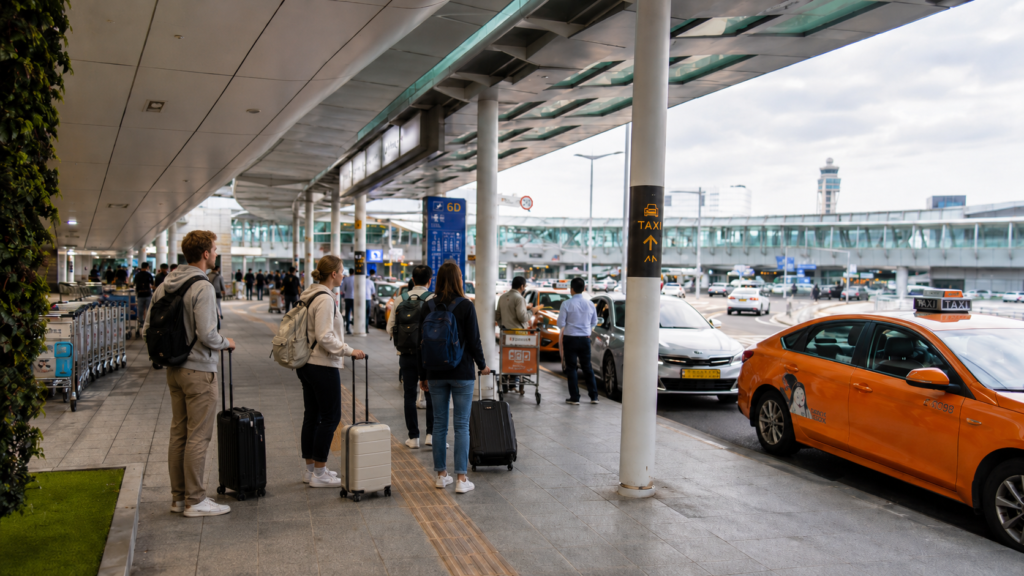
After collecting your luggage, follow the Taxi signs to the designated stands outside the first-floor arrivals hall.
Pickup areas differ by terminal and taxi type, including regular, deluxe, jumbo, international, and pre-booked taxis. Check whether you arrived at Terminal 1 or Terminal 2.
Do not accept a ride from anyone who approaches you inside the terminal. Incheon Airport warns about illegal call vans that may pose as licensed taxis and charge excessive fares.
Regular taxis to Seoul use the meter. Tolls and any late-night surcharge are added separately, but no out-of-city surcharge applies between Incheon Airport and Seoul.
International taxis offer foreign-language assistance and fixed-rate service between the airport and Seoul. You can book an International Taxi through the official website before arriving in Korea.
If the signs are confusing, ask an airport information desk instead of following someone offering a ride.
A Receipt Can Help You Find What You Lost
11. What Should You Do If You Leave Something in a Taxi?
For an app-booked taxi, check your ride history and use the lost-item or customer-support option.
Without an app, ask for a printed receipt after paying. Say, “영수증 주세요” (Yeongsujeung juseyo), meaning, “Please give me a receipt.” It may contain information that helps identify the taxi.
Without a receipt, a card or T-money transaction may still help the card issuer or payment operator trace the ride. You can also search Korea’s official LOST112 service.
Before getting out, check the seat, floor, and door pocket, and keep the receipt until you are sure nothing was left behind.
Which Taxi Option Is Best for Your Trip?
- First visit: Start with k.ride.
- Already use Uber: Keep Uber Taxi as a backup.
- Taking a street taxi: Look for 빈차, show the destination in Korean, and pay after arrival.
- Traveling late at night: Check the surcharge and app fee.
- Leaving Seoul: Expect a possible out-of-city surcharge and tolls.
- Arriving at Incheon: Use the official stand and choose enough luggage space.
- Large group or several suitcases: Compare a jumbo taxi with two regular taxis.
Final Thoughts
Taking a taxi in Korea is usually straightforward once you understand a few details that first-time visitors often miss.
Start with k.ride, save your destination in Korean, check the license plate, and confirm how the ride will be paid. Traffic, late-night surcharges, travel outside the city, tolls, app fees, and premium vehicles can all change the final fare.
Keep your receipt and use official airport taxi stands. With these basics in mind, taxis can be especially convenient late at night, with heavy luggage, or when public transportation does not reach your destination easily.
Frequently Asked Questions
Do Taxis in Korea Accept Foreign Credit Cards?
Many taxis accept major international cards, but a card may occasionally be declined. Carry a backup card, some Korean won, or T-money.
Is k.ride Better Than Uber Taxi in Korea?
k.ride is usually easier for first-time visitors because it is designed for international travelers. Uber Taxi is a useful backup for existing Uber users.
Do You Need to Tip Taxi Drivers in Korea?
No. Pay the fare shown on the meter or confirmed in the app.
Can You Take a Taxi Without Using an App?
Yes. Look for 빈차 (bincha, “available”) or wait at an official stand. 예약 (yeyak, “reserved”) means the taxi is already booked.
Do Taxis from Incheon Airport Charge a Fixed Fare?
Regular taxis use the meter, with tolls and any late-night surcharge added separately. International taxis between Incheon Airport and Seoul use fixed fares based on the destination area.
Related Guides
Getting Around Korea: 6 Easy Subway, Bus, Taxi & Airport Tips
Learn how Korea’s transportation options work together.
→ Read the guide
Google Maps in Korea 2026: Naver Map, KakaoMap & What Changed
Learn why local map apps matter for routes, addresses, and pickup points.
→ Read the guide
How to Pay in Korea in 2026: Cards, Cash & Transit
Prepare cards, T-money, cash, and a backup payment method.
→ Read the guide
Official Seoul Taxi Guide
Check current fares, surcharges, taxi types, and passenger information.
→ Visit the official guide