
Luggage storage in Korea is easy to find once you know which option fits your route. In Seoul, travelers can use hotel storage, subway lockers, staffed T-Luggage counters, and same-day luggage delivery. At Incheon Airport, luggage storage is also available for travelers who arrive before hotel check-in or reach the airport before their airline counter opens.
The best choice depends on where you are going next. A subway locker may be perfect for a few hours of sightseeing in Seoul, while airport storage or luggage delivery can make more sense before a flight. This guide compares seven practical options so you can leave your bags safely without adding an unnecessary trip across the city.
In Korea, luggage storage is usually easiest when you plan around your route rather than the storage service itself. A cheap locker is not very convenient if collecting the bag later forces you to cross a large station or travel back across the city.
This guide explains the main luggage-storage choices and how to decide between them. For locations where we have more detailed local guides, you will also find city-specific links below.
Table of Contents
Before Check-In: Start With Your Accommodation
1. Ask Your Hotel to Store Your Luggage
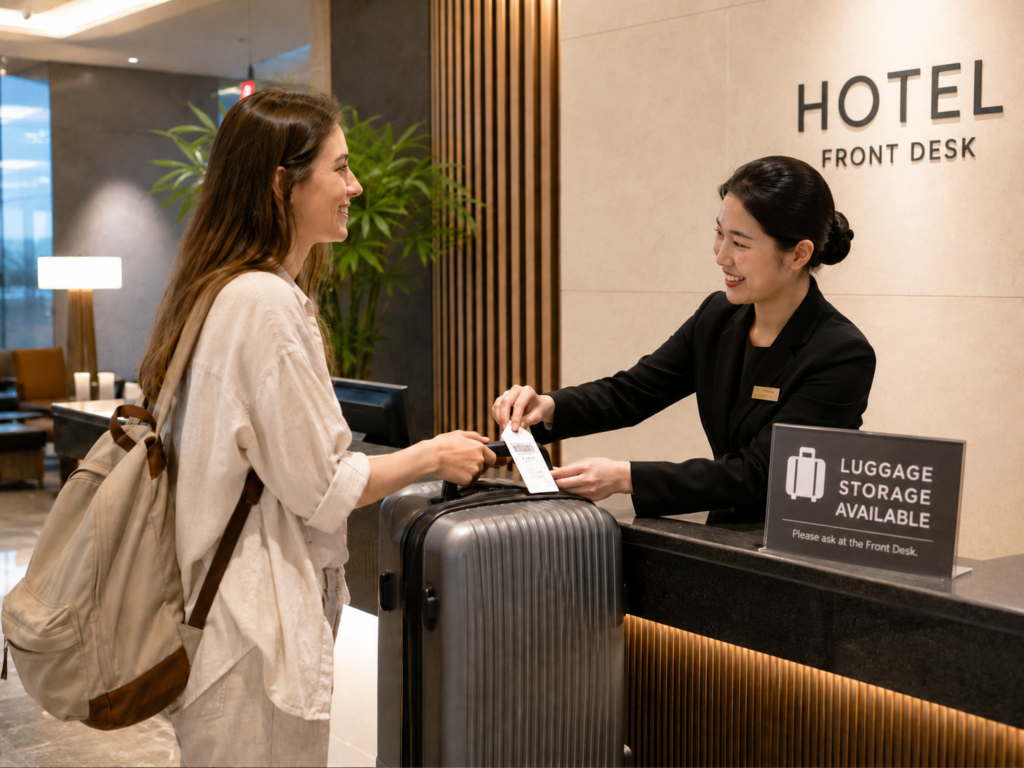
A staffed hotel should usually be your first choice. Many hotels in Korea will keep guests’ luggage before check-in or after check-out, often without an additional charge. This saves you from finding another storage location and returning there later.
However, luggage storage is a hotel service, not something guaranteed with every reservation. Ask before arrival if you are carrying oversized luggage, sports equipment, multiple suitcases, or anything valuable. You should also confirm how late the front desk remains open and whether you must show a baggage tag, reservation confirmation, or passport when collecting your belongings.
Local tip: A Korean traveler would usually think about the next station or neighborhood before thinking about the locker itself. If your first sightseeing stop is on the other side of Seoul, going to the hotel only to drop one bag may create an unnecessary round trip. A locker or staffed storage counter near the station you plan to use may save more time. If you are still choosing your accommodation, our guide to where to stay in Seoul explains why subway access, hills, airport connections, and traveling with luggage can make the right neighborhood more important than the hotel itself.
2. Check Whether an Unmanned Stay Can Store Luggage
Self-check-in hotels, guesthouses, residence-style properties, and short-term rentals may not have a front desk where you can leave luggage. Even when a building has staff, they may work limited hours or manage several properties from another location.
Some unmanned accommodations provide a shared storage room, entrance locker, or early baggage drop-off instructions. Others do not allow luggage to be left before the room is ready because there is no secure area or employee available to receive it. Never leave a suitcase in a hallway, lobby, or beside the entrance unless the host has clearly approved it.
Message the property before arrival and ask three things: whether luggage storage is available, what time you may drop it off, and how you will enter the building. Save the host’s instructions and door code somewhere you can access without Wi-Fi.
Why it matters: “Self-check-in” describes how you enter the room. It does not automatically mean that luggage storage is available.
Luggage Storage in Seoul When Your Hotel Cannot Hold Your Bags
For travelers already in Seoul, the two most practical alternatives are subway lockers and staffed T-Luggage counters. Subway lockers work best for short stops, while T-Luggage is usually more convenient for larger suitcases or multiple bags.
3. Use Seoul Subway Lockers for Short-Term Luggage Storage
Subway lockers are convenient when your sightseeing route passes through the same station twice. They are best for storing luggage for several hours while visiting nearby attractions, shopping, or waiting for check-in.
In Seoul, the Korean-only T-Locker app can show locker locations and current availability. If the Korean-only app is not practical for you, look for signs marked “Locker” or “물품보관함” inside the station, or ask station staff “물품보관함 어디예요?” (mulpum bogwanham eodiyeyo?), meaning “Where are the storage lockers?”
Do not assume that every station has an available compartment large enough for your suitcase. Seoul’s T-Lockers come in S, M, and L sizes, and the largest listed size is approximately 50 × 90 × 60 centimeters. The basic charge covers four hours, with additional fees added over time. Current operating hours are 05:00–24:00, so storage and retrieval are unavailable outside those hours.
See the official Seoul subway storage guide for current locations, sizes, fees, operating hours, and app links.
If you are specifically storing luggage at Seoul Station, do not rely on one locker bank. Our Seoul Station Luggage Storage: Lockers Full? Here’s What to Do guide compares T-Locker, T-Luggage, ZimCarry, 24-hour options, and the best choice depending on whether you are near KTX, AREX, or Subway Lines 1 and 4.
4. Use T-Luggage for Large Suitcases in Seoul
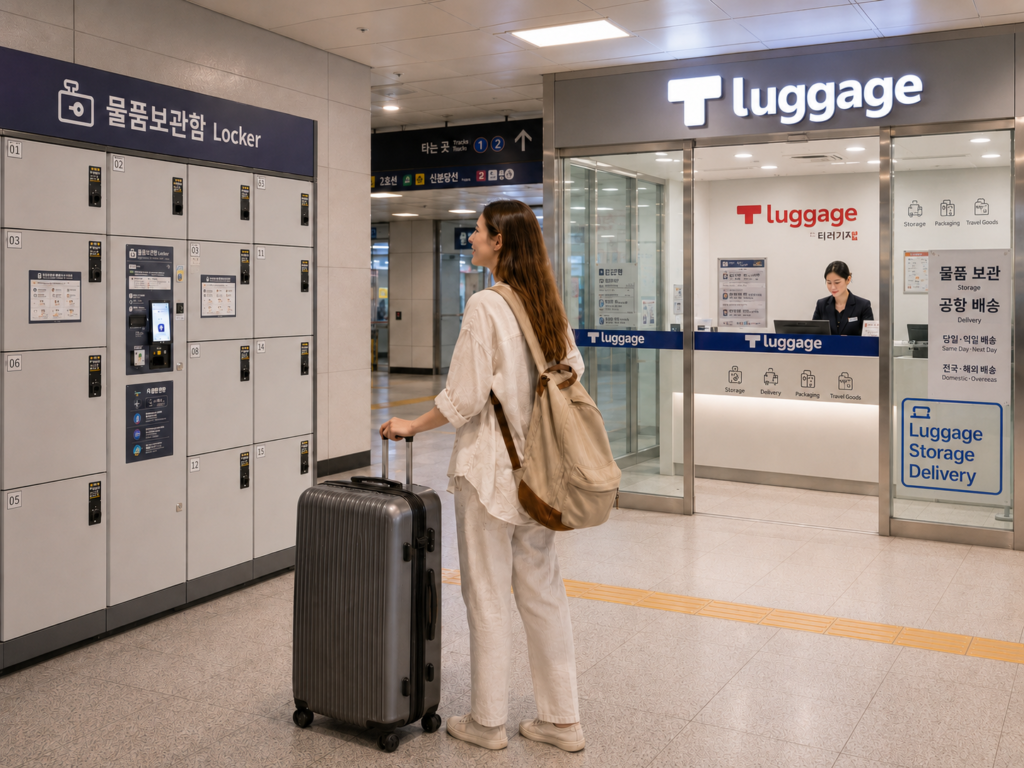
T-Luggage is a staffed luggage service available at selected major subway stations in Seoul. It is a better choice when your suitcase is too large for a locker, you are carrying several bags, or you prefer handing your luggage directly to a staff member.
T-Luggage operates staffed service centers at multiple major Seoul stations. Available branches and operating hours can change, and official pages may show different details as services are updated, so choose the location on the official website before building your day around it.
Storage prices are based on luggage size and time. Larger suitcases are accepted under separate size categories, but unusually large items or prohibited contents may still be refused. Keep valuables, passports, medication, electronics, and anything needed for your next reservation with you rather than placing them inside stored luggage.
Online reservations are available, but walk-in travelers should still check the branch location carefully. Major Korean stations can be large, and “inside Seoul Station” is not precise enough when you are pulling a heavy suitcase. If you plan to continue your trip by train, confirm your departure station before choosing where to store your bags. Our guide to booking KTX tickets in Korea explains how to choose between Seoul, Suseo, and other departure stations, use Korail+, and plan airport connections before you book.
If you plan to keep your suitcase with you instead, our guide to taking the KTX in Korea explains where large bags can go on board and what to do when the luggage areas are already full.
Check locations, current hours, prices, and reservations on the official T-Luggage English website.
Move Your Luggage Instead of Carrying It
5. Send Your Luggage Between Incheon Airport and Seoul
Storage works best when you can return to the same place. If your journey continues in one direction, same-day luggage delivery may be more convenient.
T-Luggage provides delivery between Incheon Airport and selected T-Luggage counters or T-Lockers in Seoul. After arriving in Korea, you can leave your suitcase at the airport, travel into Seoul with only your day bag, and collect the luggage later at the location chosen during booking. The service may also be used in the opposite direction when traveling from Seoul to the airport.
This is not instant delivery, hotel-to-hotel transport, or airline baggage check-in. Available routes, drop-off deadlines, and collection times vary according to the departure point and airport terminal. Confirm where and when your luggage will arrive before making a reservation.
Keep your passport, medication, valuables, electronics, and everything you may need that day with you. Once the suitcase has been accepted for delivery, you may not be able to access it until the scheduled collection time.
Check current routes and schedules on the official T-Luggage delivery page.
Local tip: Choose a collection point along your actual sightseeing or accommodation route. Sending your luggage to an inconvenient station may create more travel than it saves.
After Check-Out: Make Departure Day Easier
6. Use Incheon Airport Luggage Storage Before Airline Check-In Opens
After an early hotel check-out, you may reach Incheon Airport before your airline accepts checked baggage. In that situation, Incheon Airport luggage storage can let you eat, rest, or use airport facilities without carrying your suitcase around the terminal.
Current Incheon Airport facility listings show ZIMCARRY near Check-in Counter B in Terminal 1, plus a 24-hour ZIMCARRY location near Check-in Counter N. In Terminal 2, HANJIN EXPRESS is located near Gate 1 on the west side of the 3rd floor, and the airport lists a 24-hour counter. Other counters operate shorter hours, so always check the latest location and schedule before your trip.
Confirm your airline’s terminal first and choose a storage counter in the same terminal whenever possible. These services are in the public area before security, so you must collect your stored luggage before entering the departure area. Luggage storage is also different from airline baggage check-in—you will still need to take your suitcase to your airline counter when baggage drop opens.
Check the latest locations and operating hours on the official Incheon Airport Information & Services page before you travel.
Why it matters: Arriving at the airport early does not mean your airline baggage counter will already be open, but airport luggage storage can give you more flexibility while you wait.
7. Check In Your Bags Early at Seoul Station—If You Qualify
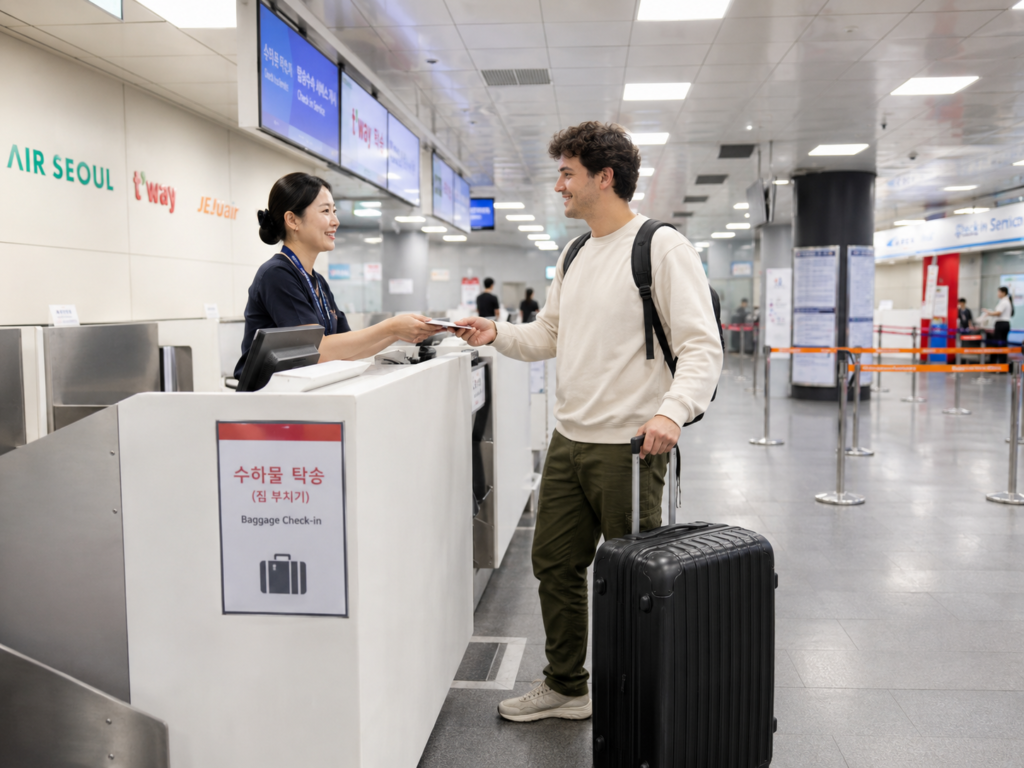
Travelers with an eligible same-day international flight can complete airline check-in and baggage drop at the Seoul Station City Airport Terminal before going to Incheon Airport. After your suitcase is accepted, it is transferred to the airport, allowing you to spend your remaining time in Seoul without carrying checked luggage.
Do not confuse the Seoul Station City Airport Terminal with Incheon Airport’s separate Easy Drop service. Easy Drop is now available at several off-airport locations, including the City Airport Terminal building near Samseong Station, but it has different airline, route, baggage, and service requirements.
This service is not available to every passenger. To use the Seoul Station City Airport Terminal, you must:
- Depart from Incheon Airport on an international flight that same day
- Travel with a participating airline on an eligible flight
- Hold a ticket for the AREX Express Train
Participating airlines, eligible routes, and flight rules are limited and can change. Confirm your exact flight eligibility on the official AREX page before traveling to Seoul Station.
The terminal is located on B2 in the Airport Railroad area. Check-in and baggage drop close according to your flight’s scheduled departure time:
- Terminal 1 flights: at least three hours before departure
- Terminal 2 flights: at least three hours and 20 minutes before departure
These are final cutoffs, not recommended arrival times. Arrive earlier to allow enough time to find the terminal, confirm your AREX Express ticket, wait in line, check your baggage, and complete departure immigration.
Eligible passengers can also complete departure immigration at Seoul Station. After finishing check-in, baggage drop, and immigration, you can use the remaining time before your reserved AREX train without carrying your suitcase.
Before using early baggage check-in, check whether your suitcase contains any purchases that still need an airport tax refund or customs confirmation. Once the bag is accepted at Seoul Station, you cannot access it again before your flight. Our guide to getting a tax refund at Incheon Airport explains which purchases may need to remain accessible until the refund checks are complete.
Keep the following items with you:
- Passport and boarding pass
- AREX Express ticket
- Medication
- Wallet and valuables
- Electronics and chargers
- Anything you may need during the day or on the flight
Return to Seoul Station with a generous time buffer. You must board your reserved AREX Express Train, travel to the correct airport terminal, and complete security screening at Incheon Airport. Missing your train may leave too little time to reach your flight, even though airline check-in and departure immigration have already been completed.
Check current participating airlines, eligible routes, operating hours, and passenger requirements on the official AREX City Airport Terminal guide and the official Incheon Airport guide.
Local tip: Complete airline check-in, baggage drop, and departure immigration during the same visit whenever possible. Returning to Seoul Station later only to complete immigration adds another deadline to your departure day.
Why it matters: This is not ordinary luggage storage. Once your suitcase is checked in, it is handled as airline baggage and cannot be collected again in Seoul.
Which Luggage Option Is Best for You?
Choose the option that best matches your route:
- Hotel storage: Best when you will return to the same hotel later.
- Subway locker: Best for a short stop near one station.
- T-Luggage storage: Best for large suitcases or multiple bags.
- Same-day luggage delivery: Best when your luggage needs to continue toward the airport or another designated location.
- Airport luggage storage: Best when you have already reached the terminal before airline check-in opens.
- Seoul Station City Airport Terminal: Best for eligible travelers who want to check in their bags early and continue exploring Seoul.
In Korea, a service being physically close on a map does not always mean it is convenient with luggage. Large stations have multiple levels, exits, and connected buildings, so the option on the same side of your actual route can be the better choice.
What Changes Outside Seoul?
Korea does not use one nationwide T-Locker or T-Luggage system. Outside Seoul, railway- and bus-station lockers, tourist facilities, staffed storage counters, and hotel storage vary by city.
Operating hours, luggage sizes, and payment methods can also differ by location. Check the exact station or tourist area before you travel rather than assuming the Seoul system exists everywhere.
Outside Seoul, luggage storage can actually be very simple, but it is less standardized. A small tourism area may have a surprisingly convenient locker or staffed counter, while another station may have only a few compartments.
For a regional example, our Luggage Storage in Jeonju: Where to Leave Your Bags Near Hanok Village guide explains the locker and staffed-storage options around Hanok Village.
Final Thoughts
The real challenge is not finding luggage storage in Korea—it is choosing a service that fits your route and timing. Check the details before you arrive, keep essential items with you, and avoid adding an unnecessary return trip just to collect a bag. With the right plan, the hours before check-in or after check-out can become part of your trip instead of lost time.
The most convenient option is often not the cheapest or the closest one on the map. It is the place that lets you keep moving in the direction your trip is already going.
Frequently Asked Questions
Is there luggage storage at Incheon Airport?
Yes. Incheon Airport currently lists luggage storage services in both passenger terminals. Terminal 1 has ZIMCARRY counters, including a 24-hour location near Check-in Counter N on the 3rd floor. Terminal 2 has HANJIN EXPRESS, including a 24-hour counter near Gate 1 on the west side of the 3rd floor.
Locations and operating hours can change, so check the official Incheon Airport facilities page before your trip and confirm which terminal your airline uses.
Can I leave luggage in a Seoul subway locker overnight?
Yes. However, you cannot store or retrieve luggage outside the locker’s operating hours. Seoul’s T-Lockers currently operate from 5 a.m. to midnight, and additional fees apply after the basic four-hour period. Check the retrieval time before leaving your bag.
Can T-Luggage deliver my suitcase directly to any hotel?
No, not as a standard service. T-Luggage delivery operates only between the locations and routes shown in its reservation system, such as selected T-Luggage counters, T-Lockers, and Incheon Airport. Confirm both the departure and collection point before paying.
Can every international traveler use the Seoul Station City Airport Terminal?
No. You must have an eligible same-day flight departing from Incheon Airport, travel with a participating airline, and use the AREX Express Train. Participating airlines and route restrictions can change, so check your flight on the official AREX guide before visiting Seoul Station.
Should I put my passport and valuables inside stored luggage?
No. Keep your passport, medication, wallet, electronics, valuables, and anything needed that day with you. Stored, delivered, or checked luggage may be inaccessible until the scheduled pickup time or your final destination.
Related Guides
Seoul Station Luggage Storage: Lockers Full? Here’s What to Do
Compare lockers, staffed counters, 24-hour options, and locations near KTX, AREX, and Subway Lines 1 and 4.
→ Read the Seoul Station luggage guide
Luggage Storage in Jeonju: Where to Leave Your Bags Near Hanok Village
Find locker and staffed-storage choices around Jeonju Hanok Village.
→ Read the Jeonju luggage guide
Getting Around Korea: 6 Easy Subway, Bus, Taxi & Airport Tips
Learn how Korea’s transportation options work together when you are traveling with luggage.
Google Maps in Korea 2026: Naver Map, KakaoMap & What Changed
Learn why Korean map apps are more useful for finding station exits, luggage counters, addresses, and pickup points.
Official T-Luggage Guide
Check current storage locations, delivery routes, operating hours, prices, and reservation options.