
Booking KTX tickets in Korea became simpler on September 1, 2026, when KTX and SRT high-speed rail services moved into one integrated system.
Travelers no longer need to search separate KORAIL and SRT reservation systems for new journeys. High-speed trains departing from or arriving at Suseo are now booked as KTX services through Korail+, the official KORAIL website, or railway station counters.
The integration makes searching easier, but one important decision has not changed: the station you choose can matter as much as the train itself. Seoul Station may be convenient for one itinerary, while Suseo can save significant cross-city travel for someone staying in Gangnam, Jamsil, or southeastern Seoul.
This guide explains how to book KTX tickets in Korea after the integration, use Korail+, choose the right Seoul-area station, handle foreign-card payment problems, and plan around luggage or an airport connection.
Table of Contents
What to Know Before Booking KTX Tickets in Korea
1. Has Booking Opened for Your Travel Date?
One of the most common KTX booking mistakes is searching too early and assuming that every train is sold out.
For regular KORAIL tickets, sales normally open at 7:00 a.m. one month before the departure date. If your journey is more than a month away, trains may not appear in the search results because reservations have not opened yet.
For example, tickets for a train departing on October 20 would normally become available around September 20. Searching in August may show no bookable schedule.
Major Korean holidays are different. During Seollal, Korea’s Lunar New Year, and Chuseok, the Korean harvest holiday, millions of people travel to their hometowns. KORAIL may announce a separate holiday reservation period, and popular trains can sell out very quickly.
Why it matters: “No trains found” can mean that sales have not opened, not that every seat has been taken.
Local tip: For a normal trip, set a reminder for 7:00 a.m. one month before departure. For Seollal or Chuseok travel, check KORAIL’s separate holiday booking notice instead.
2. What Changed on September 1, 2026?

On September 1, 2026, Korea’s KTX and SRT high-speed rail operations were integrated.
For travelers, the practical changes are straightforward:
- former SRT routes are now booked as KTX services;
- high-speed trains using Suseo Station appear in the KORAIL system;
- new bookings are made through Korail+, the official KORAIL website, railway station counters, or supported external ticketing channels;
- you no longer need a separate SRT search for a new journey.
The SRT app and SR website ended their high-speed rail booking service for the former separate system on August 31.
The official SR integration notice explains the change to the current integrated booking system.
The integration also changed fares and service capacity. According to Korea’s Ministry of Land, Infrastructure and Transport, high-speed rail fares were adjusted to approximately the former SRT level, averaging about 10% below previous KTX fares.
For travelers, however, the biggest practical change is simpler: if you want to travel from Suseo, search for KTX in the same integrated booking system.
Local tip: If an older blog post or video tells you to open the SRT app for a Suseo departure, check the travel date. For current journeys after September 1, use Korail+ or the KORAIL website instead.
Choose the Station Before You Choose the Train
3. Should You Leave from Seoul Station or Suseo Station?
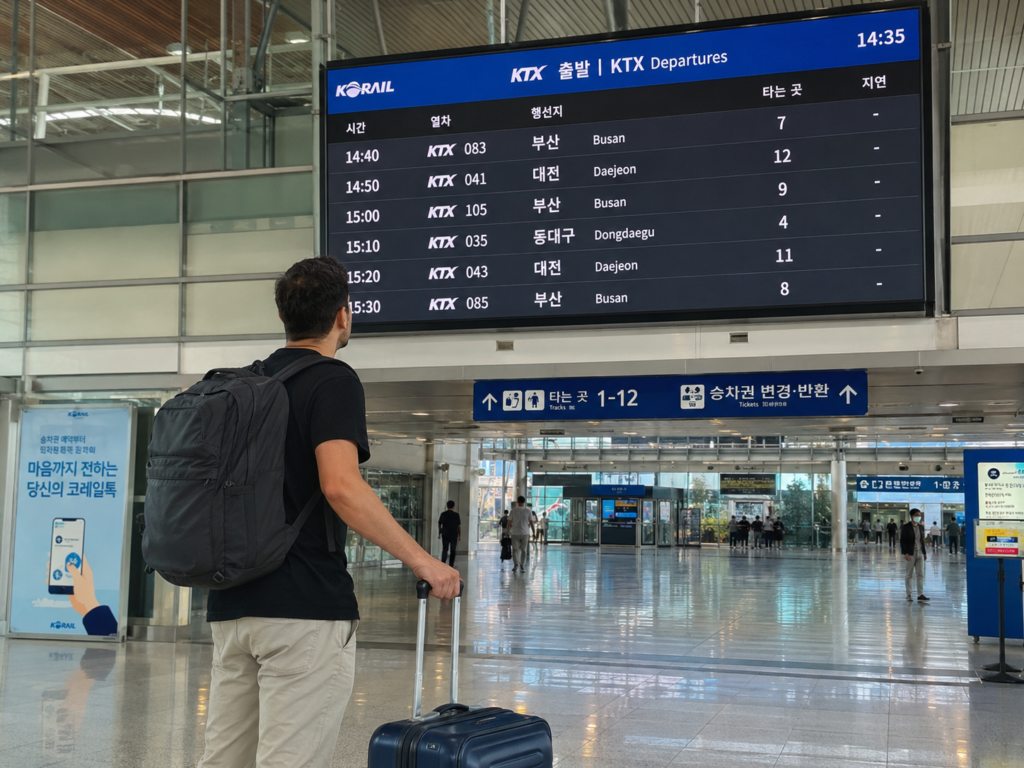
“Seoul” is a city, not a single railway departure point.
Many first-time visitors automatically search Seoul Station. That works well for some itineraries, but it can create a long and unnecessary trip across the city for travelers staying in southern Seoul.
Seoul Station is usually convenient for:
- Myeongdong;
- Hongdae;
- central Seoul;
- areas along the Airport Railroad;
- travelers transferring from Incheon Airport by AREX.
Suseo Station is often more convenient for:
- Gangnam;
- Jamsil;
- Songpa;
- southeastern Seoul;
- travelers using Subway Line 3, the Suin–Bundang Line, or GTX-A.
After the integration, Suseo remains an important high-speed railway station. What changes is the ticket system and service name—not the station’s location.
For current journeys, search for a KTX departure from Suseo rather than opening a separate SRT booking system.
Why it matters: A train that takes 15 minutes longer can still produce a faster journey if its departure station is much closer to your hotel.
Local tip: Koreans usually compare the door-to-door journey, not just the time printed beside the train. Check your hotel-to-station route in Naver Map or KakaoMap before paying.
4. What About Yongsan, Cheongnyangni, and Gwangmyeong?
Seoul Station and Suseo are not the only useful choices.
Yongsan Station serves many trains traveling toward southwestern Korea, including destinations on the Honam and Jeolla routes.
Cheongnyangni Station is important for trains heading toward Gangneung, the east coast, and destinations along parts of the Jungang Line.
Gwangmyeong Station is outside central Seoul but may be useful for travelers staying in southwestern parts of the metropolitan area or connecting from Incheon Airport.
The best station depends on your destination, hotel location, departure time, and luggage.
The most important word on your KTX ticket may not be “KTX.” It may be the station name.
5. Can Korean Station Names Be Confusing?
Yes. A station named after a city is not always beside that city’s main tourist area.
Some KTX stations were built outside historic centers because high-speed rail requires different tracks, curves, and station space. After arriving, you may still need a local bus, subway, or taxi.
Gyeongju is a useful example. Current railway searches may display Gyeongju Station, while older travel guides may call it Sin Gyeongju or Singyeongju Station.
Before booking, check:
- The exact station name shown in Korail+.
- The station location in Naver Map or KakaoMap.
- The travel time from the station to your hotel.
- Whether public transportation will still be operating when you arrive.
Local tip: Search the station’s Korean name as well as its English name. Korean navigation apps often provide more complete exits, bus stops, and walking routes.
Book Through the Official KORAIL System
6. Where Should Foreign Travelers Buy KTX Tickets?
For most international travelers, the best place to start is the official KORAIL website or Korail+, the official KORAIL mobile app that replaced KorailTalk in August 2026.
Korail+ provides multilingual support for international travelers.
Official booking channels generally provide the original fare and direct access to reservation information. You can also buy tickets from railway station counters and compatible ticket machines.
Third-party platforms may offer a more familiar interface, additional languages, travel packages, or payment processing that works better with some foreign cards. They can be useful, but check:
- the total price after service fees;
- whether the ticket is issued immediately;
- refund and cancellation conditions;
- whether changes must be requested through the seller;
- how customer service can be reached from outside Korea.
A third-party KTX ticket is not automatically unreliable, but it may cost more or have less flexible refund conditions.
Why it matters: When a journey changes, the seller—not KORAIL—may control the refund.
Local tip: Take a screenshot of the completed ticket, but also keep the original app, email, or booking page available. The live reservation is more useful than a screenshot if the train number or schedule changes.
7. How Do You Book a KTX Ticket Step by Step?
The exact screen design may change, but the booking process generally follows this order:
- Open Korail+ or the official KORAIL reservation website.
- Select the available language option you prefer.
- Choose a one-way or round-trip journey.
- Enter the departure and arrival stations.
- Select the travel date and approximate departure time.
- Confirm the number of adults and children.
- Review the available trains.
- Check the departure station, arrival station, train number, and travel time.
- Choose the seat class or available seat option.
- Enter the passenger and contact information requested.
- Pay with an accepted credit or debit card.
- Save the ticket and booking details.
Do not rush through the station names. “Seoul” and “Yongsan,” or “Seoul” and “Suseo,” are not interchangeable on the day of travel.
The time entered in the search menu may be the beginning of a search range. Your selected train may leave later than that time. Follow the departure time printed on the final ticket.
8. Why Might a Foreign Credit Card Fail?
Korean railway websites can accept card payments, but approval still depends on the card issuer, overseas payment settings, online security verification, browser configuration, and authentication windows.
If payment fails:
- Check whether your bank blocked an overseas online transaction.
- Allow pop-ups and card-verification windows.
- Try another browser or device.
- Check whether the app is fully updated.
- Try a different international card.
- Buy the ticket at a station counter after arriving in Korea.
A frozen screen does not always mean that payment failed.
Before submitting the payment again, check whether a reservation was already issued. Repeated attempts can result in duplicate transactions or multiple tickets.
Local tip: Save the email address, passenger name, password, and any other booking details exactly as entered. These details may be needed to retrieve a non-member reservation later.
Check the Ticket Before Travel Day
9. Which Details Should You Confirm?
Before closing the booking screen, confirm:
- travel date;
- exact departure time;
- departure station;
- arrival station;
- train number;
- car number;
- seat number;
- passenger count;
- payment status.
Also calculate how long it will take to reach the station.
KTX boarding is simpler than airport boarding, and passengers do not normally go through a long security or check-in process. However, the train will not wait because you entered the wrong station or subway exit.
For a first journey, arriving about 20 to 30 minutes early gives you time to find the departure board, platform, convenience store, restroom, and correct car position.
10. Can You Take the KTX Directly from Incheon Airport?
Most international travelers should not plan on boarding a provincial KTX directly at an Incheon Airport terminal.
A common route is:
Incheon Airport → AREX → Seoul Station → KTX

AREX offers all-stop and Express Train services. They use different tickets and have different travel times, so compare them before arriving.
Another option is Airport Bus No. 6770 between Incheon Airport and Gwangmyeong Station. This may reduce backtracking for certain southbound journeys.
Avoid booking a tight KTX connection immediately after landing. Immigration, baggage claim, customs, terminal walking time, eSIM activation, ATM visits, and the wait for airport transportation can all take longer than expected.
Why it matters: A discounted train ticket is not a bargain if a delayed flight forces you to buy another one.
Local tip: Give yourself a generous buffer after an international arrival. Travel insurance may cover certain delays, but the exact benefit depends on your policy and documentation.
When Your Preferred KTX Is Unavailable
11. What Can You Do When the Train Is Sold Out?
If your preferred train is sold out, check:
- an earlier or later departure;
- Suseo instead of Seoul Station;
- Yongsan or Gwangmyeong where appropriate;
- another arrival station near your destination;
- regular trains such as ITX services;
- an intercity or express bus;
- the official reservation-waiting option, if available.
There is no need to open a separate SRT search for current journeys. Check Suseo departures directly within the integrated KTX results.
Be careful when dividing one journey into separately booked segments. You may need to change seats, and a delay on the first segment could affect the next ticket.
Standard KTX fares do not usually rise continuously like airline fares. The main benefit of booking early is securing the departure time and seat you want.
12. Should Luggage Change Your Booking Decision?
Yes. Luggage can turn a theoretically fast route into an exhausting travel day.
Imagine checking out of a Seoul hotel at 11:00 a.m. and booking a 5:00 p.m. train. Carrying a large suitcase through a market, restaurant, and several subway transfers is rarely enjoyable.
Before choosing your train, check:
- whether your hotel stores luggage after check-out;
- whether the departure station has lockers or luggage storage;
- how many subway transfers are required;
- whether elevators are available along the route;
- whether your destination hotel accepts luggage before check-in.
A hotel near Seoul Station or Suseo can be worth considering for an early departure, late arrival, or itinerary involving several large suitcases.
Local tip: If carrying luggage through a full sightseeing day would be inconvenient, consider leaving it at your hotel or station, using a luggage-storage service, or sending it ahead when an appropriate service is available.
Final Thoughts
The 2026 KTX–SRT integration has made high-speed rail booking in Korea simpler.
For current journeys, use Korail+ or the official KORAIL website and search KTX services from the Seoul-area station that best fits your itinerary—including Suseo.
Before paying, confirm three things:
- Has booking opened for your travel date?
- Is this the most convenient departure station for your hotel?
- Does the full journey still make sense after airport transfers, local transportation, and luggage are included?
The biggest mistake is rarely choosing the wrong seat. It is booking the right train from the wrong station.
Once the station, date, and booking channel are correct, KTX is one of the simplest ways to travel between major destinations in Korea.
Frequently Asked Questions
How Far in Advance Can You Book KTX Tickets?
Regular KORAIL ticket sales normally open at 7:00 a.m. one month before the departure date. Separate reservation schedules may apply during Seollal, Chuseok, or special timetable changes.
Do I Still Need the SRT App in 2026?
Not for new high-speed rail bookings. Since September 1, former SRT routes—including high-speed trains using Suseo Station—are booked as KTX services through Korail+, the KORAIL website, or station counters.
If you need information about an older SRT booking from August 31 or earlier, keep the original booking details. High-speed rail customer service is now handled through KORAIL’s railway customer center at 1588-7788.
Can Foreign Travelers Book KTX Without a Korean Phone Number?
KORAIL’s foreign-language website supports non-member ticket booking, so travelers do not need to create a Korean railway membership account just to reserve a standard ticket. Follow the current booking fields carefully and save the email, password, and reservation details you enter. Korail+ app registration or verification requirements can differ, so the official website or a station counter is a useful fallback if the app creates a verification problem.
Can You Pay for KTX With a T-Money Card?
No. You cannot tap a T-money card and board a KTX as you would a subway or city bus. KTX requires a separate ticket for a specific train and normally includes an assigned seat.
Is a KORAIL Pass Worth Buying?
It depends on your itinerary. Compare the pass price with the total cost of individual tickets for the exact trains you plan to take. A pass may be useful for several long-distance journeys within a short period, but individual tickets are often simpler for one or two trips. Always confirm that your selected service and seat reservation are eligible under the current pass rules.
Related Guides
The KTX Won’t Wait: What to Know Before You Board in Korea
Learn when to arrive, how to find your platform and car, where to store luggage, and what to do if you miss your train.
Too Early to Check In? Here’s Where to Leave Your Luggage in Korea
Find practical luggage storage options before check-in, after check-out, and between train journeys.
Why Korean Buses Confuse First-Time Travelers
Understand bus stops, route directions, payment methods, and the differences between city and intercity buses.
Lost in Korea? Why Google Maps Feels Different Here and What Locals Use Instead
Choose a more reliable Korean navigation app before traveling to an unfamiliar railway station.