
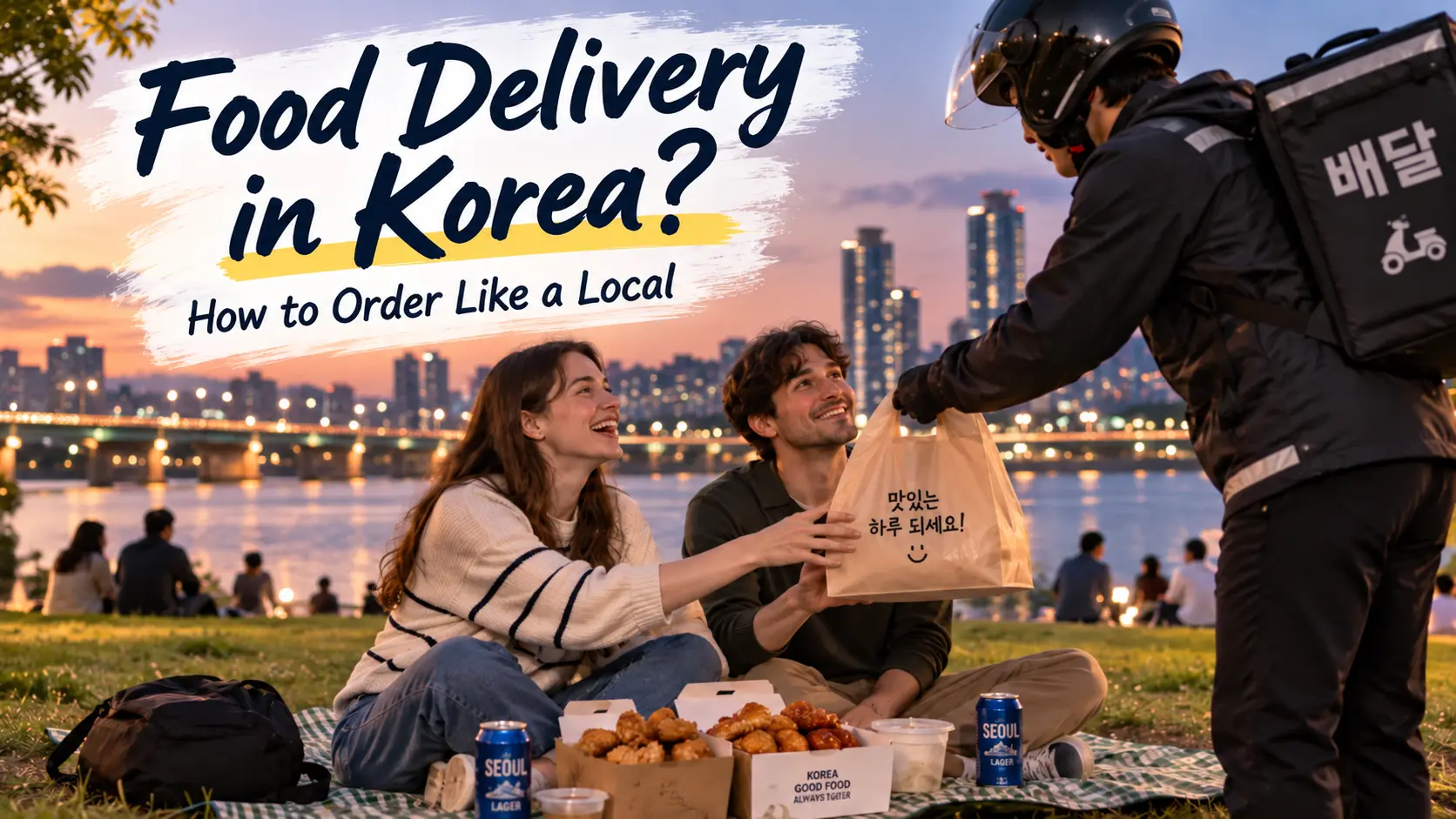
Maybe you have seen it in a Korean drama.
Friends are sitting beside the Hangang River on a warm summer evening. Someone orders fried chicken, cans of cold beer appear, the city lights begin to come on, and dinner somehow becomes part of the night.
Or maybe it is a cool autumn afternoon. You have walked more than you expected, found a spot on the grass, and suddenly the idea of eating chicken beside the river sounds much better than searching for another restaurant.
There is also the less glamorous version.
You have finally returned to your hotel after a long day in Seoul, taken off your shoes, and realized you really do not want to go outside again just to find dinner.
This is when Korean delivery culture starts to look very appealing.
For Koreans, ordering food is not a special event. We order chicken while watching TV, tteokbokki when friends visit, coffee when nobody wants to go outside, and dinner when cooking feels like too much work.
That ordinary part of Korean life is something many travelers want to try too.
The only problem is that your first order can look much more complicated than it really is.
Do you need a Korean phone number?
Will your foreign card work?
Which app should you use?
Can a delivery driver really find you at a hotel or beside the Hangang River?
The good news is that food delivery in Korea has become much easier for international visitors.
You do not need to master every Korean delivery app.
You just need to know which option fits your situation.
And once you have ordered successfully one time, the whole thing usually feels surprisingly simple.
Can Tourists Really Order Food Delivery in Korea?
1. Yes — and it is much easier than it used to be
A few years ago, Korean food delivery could be frustrating for short-term visitors.
Many apps were designed almost entirely for people living in Korea. Korean-language menus, local phone verification, domestic payment systems, and unfamiliar address formats could turn a simple chicken order into a small technical project.
That is changing.
Baemin, Korea’s best-known delivery app, now provides multilingual support including English, and its official service for international users specifically promotes delivery to hotels, Airbnbs, and even the Hangang River.
There are also services such as Shuttle Delivery that were built with international users in mind.
So the question is no longer really, “Can tourists order delivery in Korea?”
The better question is:
“Which method will be easiest for me?”
That distinction matters.
You came to Korea to enjoy dinner, not to spend your evening testing five different verification screens.
Which Food Delivery App Should a Tourist Use in Korea?
2. Baemin, Coupang Eats, Yogiyo — and the simpler option for travelers
Ask Koreans about food delivery and you will hear three familiar names:
Baemin, Coupang Eats, and Yogiyo.
For someone who lives in Korea, choosing between them usually is not a big decision. People use whichever app they already have, compare restaurants, check delivery fees, and order.
For a short-term visitor, I would look at things differently.
Baemin is the first Korean app I would try.
Its multilingual service now covers the main ordering flow, and Baemin has been actively making the service easier for international travelers.
You will also see Coupang Eats and Yogiyo everywhere in Korea.
They are major local delivery services and perfectly normal choices for Korean residents.
But if you are in Korea for only a few days, there is little reason to install every delivery app just to prove you can use them.
Account, phone, language, and payment conditions can vary depending on your setup.
If Coupang Eats or Yogiyo works easily for you, there is nothing wrong with using it.
But I would not make your first Korean delivery experience a competition to see how many apps you can get working.
A simple approach is better:
Try Baemin if you want an experience closer to what many Koreans use.
If that starts feeling complicated, use Shuttle Delivery instead.
That is usually enough.
Should You Try Baemin First?
3. Use Baemin if you want the everyday Korean delivery experience
There is something fun about using the same app you keep seeing on Korean phones and delivery motorcycles.
Baemin is not a tourist attraction.
That is exactly why using it can feel like part of the trip.
Koreans open a delivery app without thinking much about it.
Chicken during a football game.
Jjajangmyeon on a lazy weekend.
Tteokbokki on a rainy evening.
Coffee and dessert in the afternoon.
Late-night food when somebody suddenly says, “Are you hungry?”
Baemin has become much easier for international users, with English and other language support covering restaurant searches, menus, ordering, payment, and delivery tracking.
Its official international page even encourages visitors to experience delivery at a hotel, Airbnb, or beside the Hangang River.
So if your phone and payment method work smoothly, use it.
But do not force yourself to use Baemin simply because Koreans do.
The whole point of Korean delivery culture is convenience.
If your “local experience” turns into 40 minutes of account setup, the experience has stopped being very Korean.
What If You Just Want the Easiest First Order?
4. Shuttle is useful when you do not want to deal with Korean account setup
Shuttle Delivery is the easier fallback for many short-term visitors.
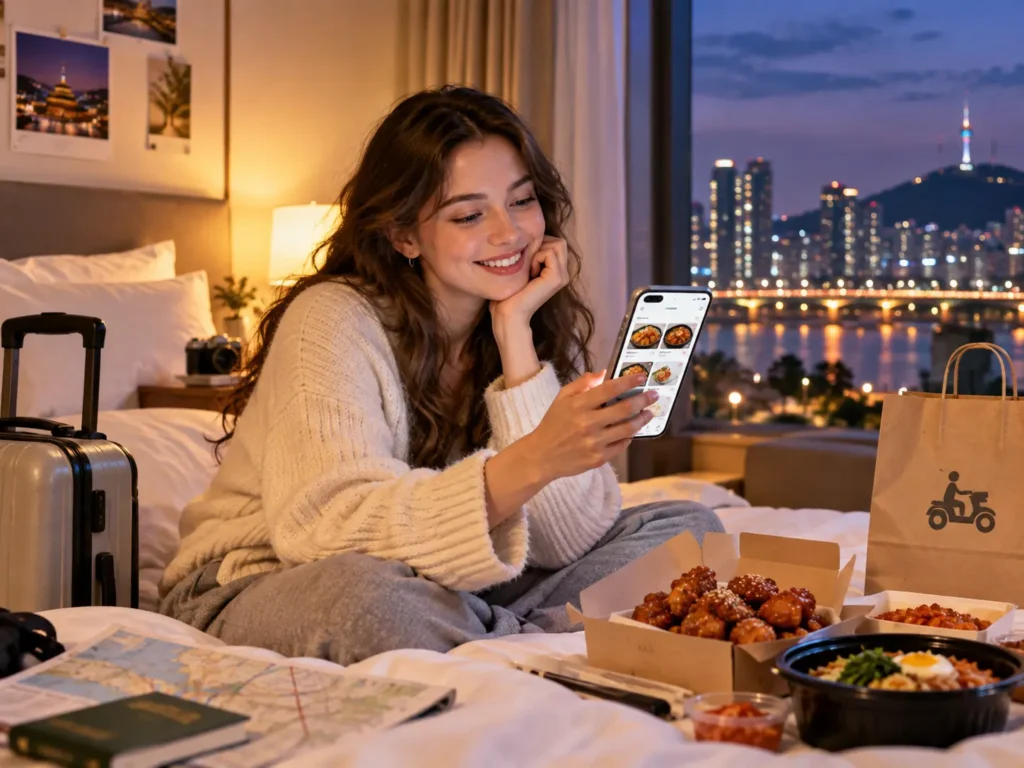
It is designed for international users and allows people to sign up without a Korean phone number.
International credit cards are supported, and PayPal is also available.
That removes several of the things that make tourists nervous before their first delivery order.
You can choose your address, see restaurants available in that area, order, pay, and wait for your food.
Coverage still depends on where you are staying, so always enter your actual address and check what is available.
You may not see exactly the same restaurant selection that a Korean friend sees on another delivery app.
For your first order, that may not matter.
You probably do not need every chicken shop in Seoul.
You just need one good dinner to arrive while it is still hot.
Can You Order Food to a Hotel or Airbnb?
5. Yes — but the lobby is usually the easiest meeting point
Ordering delivery to a hotel is one of the simplest ways to try this part of Korean life.
First, use the hotel’s exact address.
Do not enter something vague like “hotel near Myeongdong Station.”
Copy the official address from your hotel booking, hotel website, or Korean map listing.
Then check the hotel’s delivery policy.
In many Korean hotels, delivery riders do not go directly to guest-room floors.
Guests usually go down to the lobby or entrance and collect the food there.

Some accommodations allow different arrangements, so if you are unsure, ask reception before placing the order.
It takes about ten seconds:
“Can I order delivery food here?”
Once the staff tells you where to meet the rider, the rest is simple.
For an Airbnb or serviced apartment, check the building entrance carefully.
Large Korean apartment and officetel buildings may have several entrances, security doors, or separate vehicle access.
If your host has given you delivery instructions, use them.
The rider does not need your life story.
They just need to know where you are.
Can You Really Order Chicken to the Hangang River?
6. Yes — this is the K-drama delivery experience many visitors want to try
This is probably the scene you imagined before coming to Korea.
A picnic mat.
The river.
Chicken.
Beer.
Friends talking while the sun goes down.
Maybe convenience-store ramyeon later because apparently nobody was as full as they claimed.
It is absolutely possible to order food while spending time at a Hangang park.
The important thing is understanding one small Korean rule.
The rider usually does not search through the entire park for your exact picnic mat.
Major Hangang parks use designated delivery meeting points, commonly called baedal zones, or delivery zones.
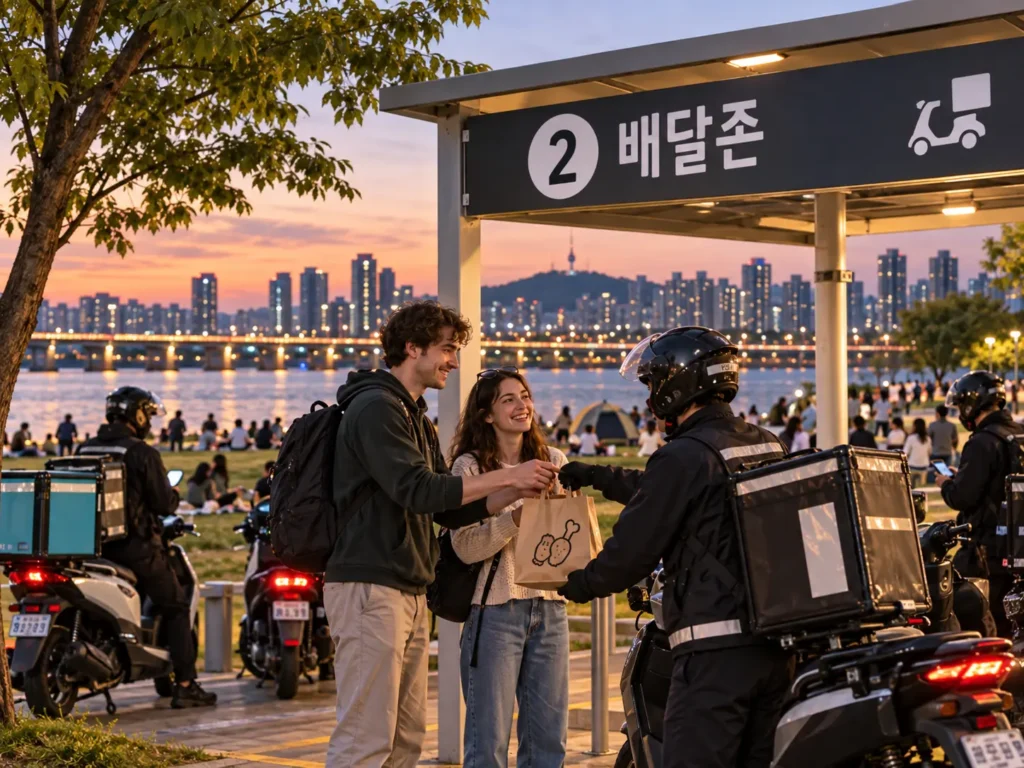
You choose the appropriate delivery zone when ordering and meet the rider there.
Yeouido Hangang Park and Ttukseom Hangang Park are two well-known examples where delivery zones are used.
So do not write:
“We are near a tree next to the river.”
That may feel very specific when you are sitting there.
To a delivery rider, it describes half the park.
Find the nearest delivery zone first.
Then order.
When the rider is getting close, walk over, collect your food, and return to your spot.
That is really all there is to it.
Order.
Walk to the delivery zone.
Pick up the food.
Go back to your picnic.
The first time, it may feel like you are learning a complicated Korean ritual.
The second time, it feels completely ordinary.
What Should You Order for Your First Korean Delivery?
7. Chicken is the classic choice, but Koreans deliver almost everything
For a first Hangang delivery, fried chicken is an easy choice.
There is even a Korean word that combines chicken with beer:
chimaek.
“Chi” comes from chicken and “maek” comes from maekju, the Korean word for beer.
But Korean delivery culture goes far beyond fried chicken.
Tteokbokki and fried snacks are common.
So are jokbal, bossam, jjajangmyeon, pizza, gimbap, noodles, soups, coffee, cake, and late-night snacks.
You can even order from convenience stores through some delivery platforms.
One thing worth checking is portion size.
Korean delivery menus are often designed for sharing.
A full chicken order can easily be enough for more than one person, and sets such as bossam or jokbal may be much larger than a solo traveler expects.
If you are traveling alone, look at portion information before ordering several things simply because the photographs look good.
It is very easy to become ambitious when scrolling through a Korean delivery app.
What Happens If the Delivery Rider Calls You?
8. You do not need fluent Korean to get your dinner
This is the moment some travelers worry about most.
The food is almost there.
Then your phone rings.
Someone begins speaking Korean very quickly.
Do not panic.
Many deliveries require little or no conversation because the app already provides address information, tracking, and delivery instructions.
If you are meeting the rider in a hotel lobby or at a delivery zone, simply stay close to the agreed meeting point and keep an eye on the app.
Two Korean phrases are useful:
잠시만요.
Jamsimanyo.
“One moment, please.”
지금 내려갈게요.
Jigeum naeryeogalgeyo.
“I’ll come down now.”
That may be all you need.
With a foreigner-friendly service, in-app support can also make communication easier.
The first delivery feels complicated because every small step is unfamiliar.
Koreans already know which address to use.
We know where the apartment entrance is.
We know that the rider may call.
We know where the Hangang delivery zone is.
You are simply learning those tiny rules for the first time.
Once you know them, food delivery becomes what it is supposed to be:
easy.
Final Thoughts
There are famous things to do in Korea that you plan weeks before your trip.
Palaces.
Markets.
Museums.
Day trips.
And then there are much smaller moments that somehow make you feel closer to everyday Korean life.
Ordering chicken to the Hangang on a warm summer night.
Having tteokbokki delivered to your hotel because rain has ruined your evening plans.
Sitting on the grass on a cool autumn afternoon while waiting for the notification that your food has arrived.
These are not extraordinary experiences to Koreans.
That is part of their charm.
For a first order, you do not need to understand every Korean delivery platform.
Try Baemin if you want a more familiar local app experience.
Use Shuttle if you want a simpler option designed for international users.
Enter the exact address.
Stay available when the rider arrives.
If you are at the Hangang, use the designated delivery zone.
And then stop thinking about the app.
Eat your chicken.
Look at the river.
Enjoy the evening.
After you do it once, you may wonder why it seemed so complicated before.
FAQ
Can tourists order food delivery in Korea without a Korean phone number?
Yes.
Shuttle Delivery allows international users to sign up and order without a Korean phone number.
Baemin has also become much more accessible to international travelers, with multilingual support and overseas payment options.
The exact setup can vary by service, so a short-term traveler does not need to depend on only one app.
Can I pay for Korean food delivery with a foreign credit card?
Yes, on supported services.
Shuttle accepts international credit cards and PayPal.
Baemin has also expanded overseas payment support for international users.
Payment options can change, so check the payment methods shown in the app before completing your order.
Can I have food delivered to my hotel in Seoul?
Usually, yes.
Hotel guests commonly order through an app and collect the food in the lobby.
Some hotels may have different rules, so check with reception before ordering.
Use the hotel’s exact address and be ready to go downstairs when the rider arrives.
Can I order food to a Hangang River park?
Yes.
Do not use your picnic mat as the delivery location.
Major Hangang parks use designated delivery zones where you can meet the rider.
Find the nearest delivery zone before placing your order, then go there when your food arrives.
Do I need to tip the delivery driver in Korea?
No.
Tipping delivery drivers is not normally part of Korean delivery culture.
Pay the amount shown in the app unless the service specifically tells you otherwise.
Related Guides
How to Order Food in Korea Like a Local: 11 Essential Tips
Restaurant ordering can feel just as unfamiliar as delivery the first time. Learn how menus, kiosks, table orders, payment, and tipping work in everyday Korean restaurants.
→ Read the Korea food ordering guide
Korean Cafe Culture: Why Cafes Are More Than Coffee
Delivery is one part of Korean everyday life. Cafes are another. Learn why Koreans often move to a cafe after a meal and how different types of Korean cafes are actually used.
→ Read the Korean cafe culture guide
How to Pay in Korea in 2026: Cards, Cash & Transit
Not sure when your foreign card will work during the rest of your trip? This guide explains the payment setup that is most practical for international travelers.