
Ordering food in Korea is usually easier than it looks—but the system can change from one restaurant to the next.
At one place, a staff member may take your order at the table. At another, you may use a tablet, QR code, counter, or self-ordering kiosk. Some tables have a call bell, while smaller restaurants may simply expect you to get a staff member’s attention when you are ready.
The easiest approach is not to memorize one “Korean way” to order. Take a few seconds to look around, identify the system, and then follow the steps the restaurant is already showing you.
There are also a few details that can surprise first-time visitors: some shared dishes require two servings, banchan may arrive without being ordered, and payment often happens at the cashier rather than at the table.
This guide walks you through the process from sitting down to ordering, eating, and paying—while keeping the useful cultural details that help Korean restaurants make more sense.
Table of Contents
Before You Order: Read the Restaurant First
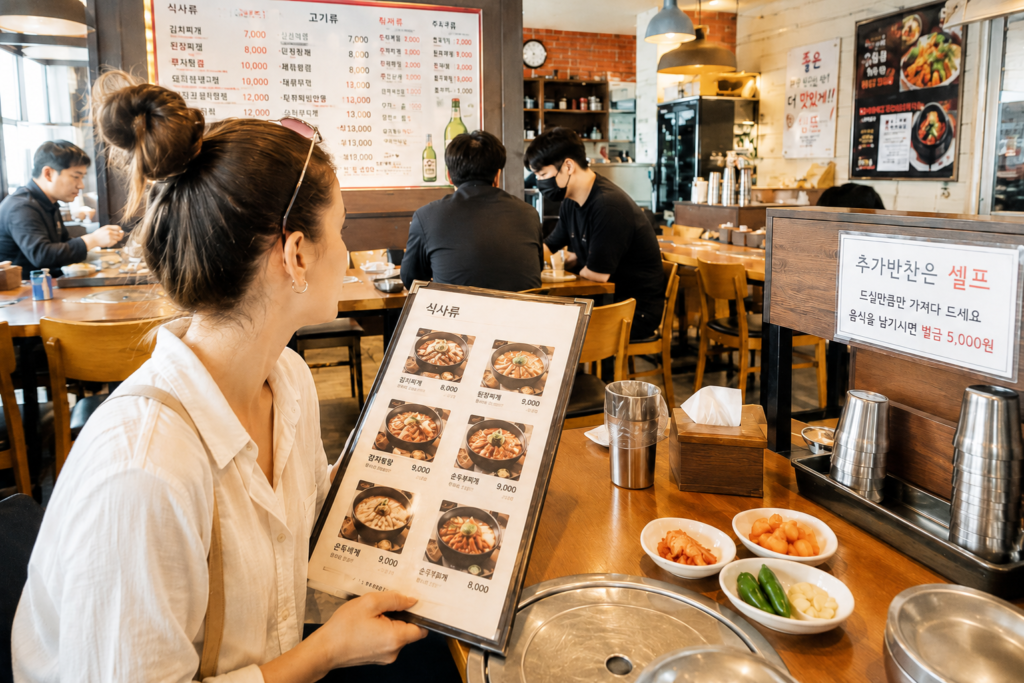
One Korean word worth knowing is sikdang (식당), a general word for a restaurant or eatery. In this guide, “local restaurant” often refers to the casual neighborhood places where people stop for an everyday meal.
1. First, Identify How This Restaurant Takes Orders
Look for the ordering system before waiting for someone to come to your table.
Common setups include:
- a staff member taking the order
- a tablet at the table
- a QR code
- ordering at the counter
- a self-ordering kiosk
- a call bell when you are ready
There is no single system used by every Korean restaurant, so checking first is usually faster than waiting and wondering what to do.
2. Check the Menu Before You Call Anyone
Before calling a staff member, check whether the menu is on paper, on a wall, on a tablet, or inside a QR ordering page.
Some digital menus offer English or other languages, especially at larger or newer restaurants, but not every restaurant has a multilingual menu.
If the menu is only in Korean, a translation app can help you identify the dish name. You can also point to the item you want and say:
“Igeo juseyo (이거 주세요).”
“This one, please.”
Papago can also be useful for checking a Korean menu or dish name before you order.
3. Use the Call Bell—or Say “Jeogiyo”
If your table has a call bell, press it once when you are ready to order or need help. There is no need to press it several times in a row.
If there is no bell, say “Jeogiyo (저기요)” to get a staff member’s attention.
Cultural note: In some older or very informal restaurants, you may hear Korean customers call an older female staff member “imo (이모),” literally “aunt.” Visitors do not need to copy this. “Jeogiyo” is the safer and more generally appropriate way to get a staff member’s attention.
4. Pointing Is Fine When You Don’t Speak Korean
You do not need fluent Korean to place a simple restaurant order.
If the menu has photos or numbers, point to the item and say:
“Igeo juseyo (이거 주세요).”
“This one, please.”
If you want two, you can show two fingers or confirm the quantity on the screen.
For tablets, kiosks, and QR menus, check whether a language button is available. If you are unsure whether the order actually went through, look for an order-confirmation screen or ask a staff member before submitting it again.
Ordering the Right Amount of Food
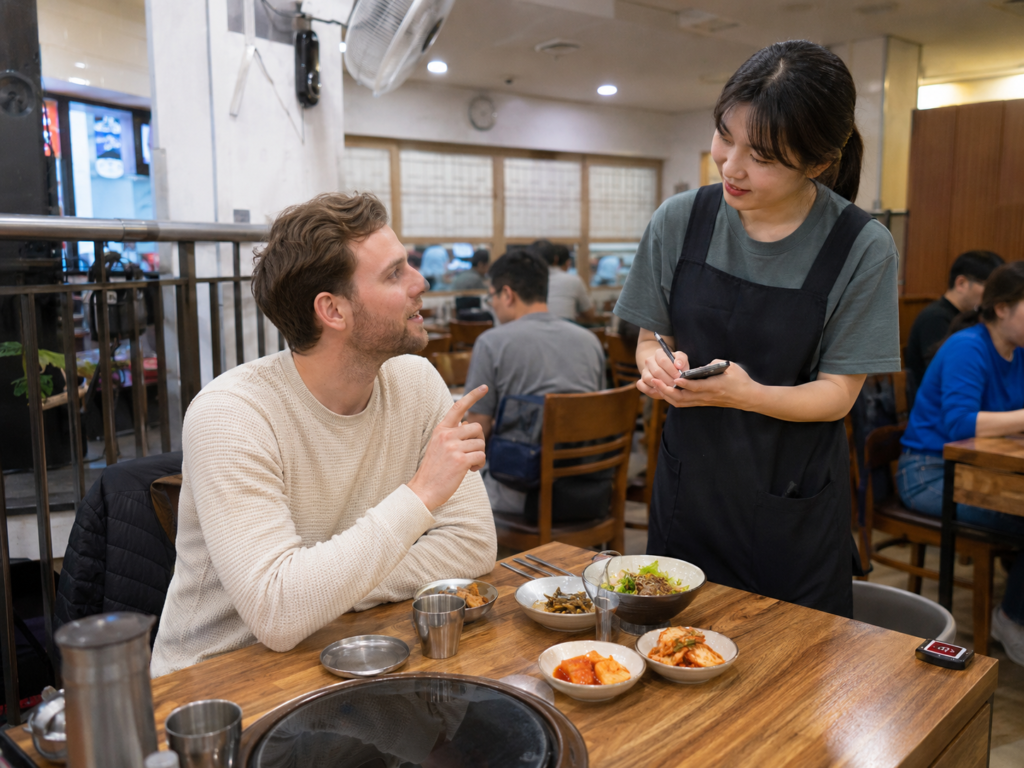
5. Check the Serving Minimum Before You Order
Before confirming the order, look for serving requirements such as “2인분” or a minimum quantity.
This matters most with dishes designed to be cooked or shared at the table. Korean BBQ, dakgalbi, some hot pots, and other shared dishes may require two or more servings even if only one person is eating.
A restaurant that allows one person to enter does not necessarily sell every shared menu item as a single serving.
If you are dining alone, check the minimum before sitting down or choose an individual dish such as bibimbap, seolleongtang, or a single-serving jjigae when available.
6. Check Whether the Dish Is Individual or Shared
A menu price does not always tell you how the food will arrive.
Some Korean dishes are individual meals, while others come in one pot, pan, or grill for the table to share.
Before ordering, check whether the price is:
- for one serving
- per person
- for a small / medium / large shared dish
- or for a set menu
This is especially useful when ordering Korean BBQ, hot pots, dakgalbi, or other dishes designed for several people.
If the menu is unclear, show the item to a staff member and confirm the quantity before ordering.
7. Banchan May Arrive Without You Ordering It
At many Korean restaurants, banchan (반찬) may arrive with the main meal even if you did not order it separately.
Receiving banchan without ordering it does not generally mean an automatic extra charge.
Some basic side dishes may be available for refill by request or from a self-service station, but practices vary. Not every side dish is unlimited or free at every restaurant.
Special side dishes or add-on menu items may cost extra, so check the restaurant’s signs or menu.
8. Add-Ons Often Come Later
At some Korean restaurants, you do not need to order every part of the meal at the beginning.
Extra noodles, rice, fried rice, or other add-ons may be ordered after the main dish is partly finished.
If you see words such as sari (사리) or bokkeumbap (볶음밥), they may refer to extras added later rather than a separate main dish.
The exact options depend on the restaurant, so check the menu instead of assuming every meal includes a final fried rice course.
How to Pay and Leave
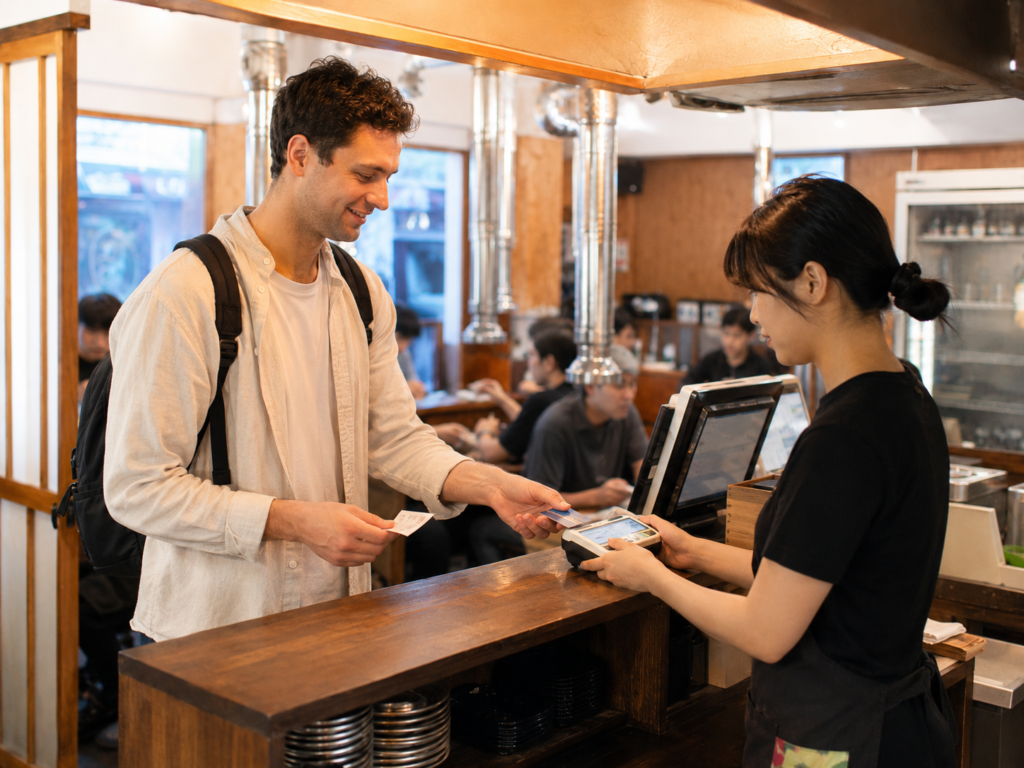
9. Check Where You’re Supposed to Pay
At many Korean restaurants, you pay at a cashier near the entrance when you are finished.
But this is not universal. Some places use a kiosk, a tablet, counter payment, or another system.
If a receipt or table number is on your table, take it with you if that appears to be how the restaurant identifies your order.
When you are unsure, look for a payment counter or simply ask a staff member before waiting for a bill to be brought to the table.
10. Tipping Is Generally Not Expected
In Korea, tipping is generally not expected for a regular restaurant meal.
You can usually pay the listed amount without adding a tip. If a restaurant has a specific service policy, follow the information it provides.
11. Check for Self-Service Before You Leave
Some restaurants have self-service water or banchan stations. If you see one, use it directly and take only what you can eat.
If the restaurant has a tray-return sign, return your tray or dishes to the indicated area before you leave.
Systems vary, so check nearby signs and follow the flow of other customers.
Final Thoughts
You do not need to memorize every Korean dining custom before your first meal.
Start with the restaurant in front of you: check whether you order at the table, on a screen, or at the counter; confirm the serving minimum; and look for the payment system before you leave.
A call bell, shared dish, unexpected plate of banchan, or cashier near the door can feel unfamiliar the first time, but each one becomes easy once you know what it means.
If you remember only three things, remember these: look around before ordering, confirm the quantity for shared dishes, and check where to pay when you are finished.
Frequently Asked Questions
How can I order food in Korea if I don’t speak Korean?
Point to the menu item or photo and say “Igeo juseyo (이거 주세요),” meaning “This one, please.” On a tablet or kiosk, look for a language option. Papago can also help you check a Korean dish name.
Is it rude to press the call bell?
No. If there is a call bell on the table, press it once when you are ready to order or need help. There is no need to press it repeatedly.
Do I pay at the table or at the cashier in Korea?
Many Korean restaurants take payment at a cashier near the entrance, but not all do. Some use kiosks, tablets, or counter payment. Check the restaurant’s setup rather than waiting automatically for a bill at the table.
Do I need to leave a tip in Korea?
Tipping is generally not expected at Korean restaurants. Pay the listed amount unless the restaurant provides a specific service policy.
Can I get free refills on side dishes?
Many restaurants refill basic banchan or provide a self-service side-dish station, but practices vary and some items may cost extra. Check the restaurant’s signs or ask before assuming every side dish is unlimited.
Related Guides
Want to feel more confident when eating out in Korea?
These guides will help you understand local habits before and after you order.
20 Everyday Korean Habits That Can Make Your Trip Easier
Before you order food, it helps to understand the everyday habits Koreans use in public places, restaurants, and cafés.
→ Read the local habits guide
13 Things That Surprise Tourists at Korean BBQ Restaurants
Korean BBQ has its own rhythm, from table grills and side dishes to ssam, raw garlic, and the final fried rice.
→ Read the Korean BBQ guide
For official information about Korean food and travel, you can also visit the Korea Tourism Organization website.
→ Visit the official Korean food guide