

Korean cafe culture makes more sense once you stop thinking of every cafe as the same kind of place.
One cafe is where someone opens a laptop and works for two hours.
Another is where two friends meet after lunch and keep talking long after the meal is over.
A third is mostly about the interior, dessert, and photos.
Then, half a block away, there may be a tiny low-cost shop where almost everyone orders a large iced coffee and leaves.
They all say “cafe,” but they are not asking customers to use the space in the same way.
That is the part locals tend to read quickly.
Before settling in, people look at the tables, the crowd, the outlets, the signs, and what everyone else is doing.
You usually do not need a long list of cafe rules.
You need to understand what kind of cafe you just walked into.
The First Thing to Notice Is What People Are Doing
Walk into an unfamiliar cafe in Korea and look around before choosing a seat.
Are several people working on laptops?
Are most tables occupied by couples talking over cake?
Is there a line waiting for seats?
Are customers picking up drinks and leaving almost immediately?
Are there power outlets and wide tables, or tiny two-person tables designed for a short visit?
Those details tell you more than the word “cafe” on the sign.
A spacious chain branch near an office district may feel completely normal for laptop work.
A small independent cafe with six tables and a waiting line may feel very different.
A low-cost takeout cafe may technically have a few seats, but that does not mean people come there to spend an afternoon.
Korean cafe culture is easier when you read the space before deciding how long to stay.
An Empty Table May Not Actually Be Empty
One scene still surprises some visitors.
A cafe table looks empty, but there is a laptop, bag, jacket, book, or charging cable sitting on it.
In most cases, someone is coming back.
People may choose a seat first and then order, or leave an ordinary belonging at the table while going to the restroom or counter.
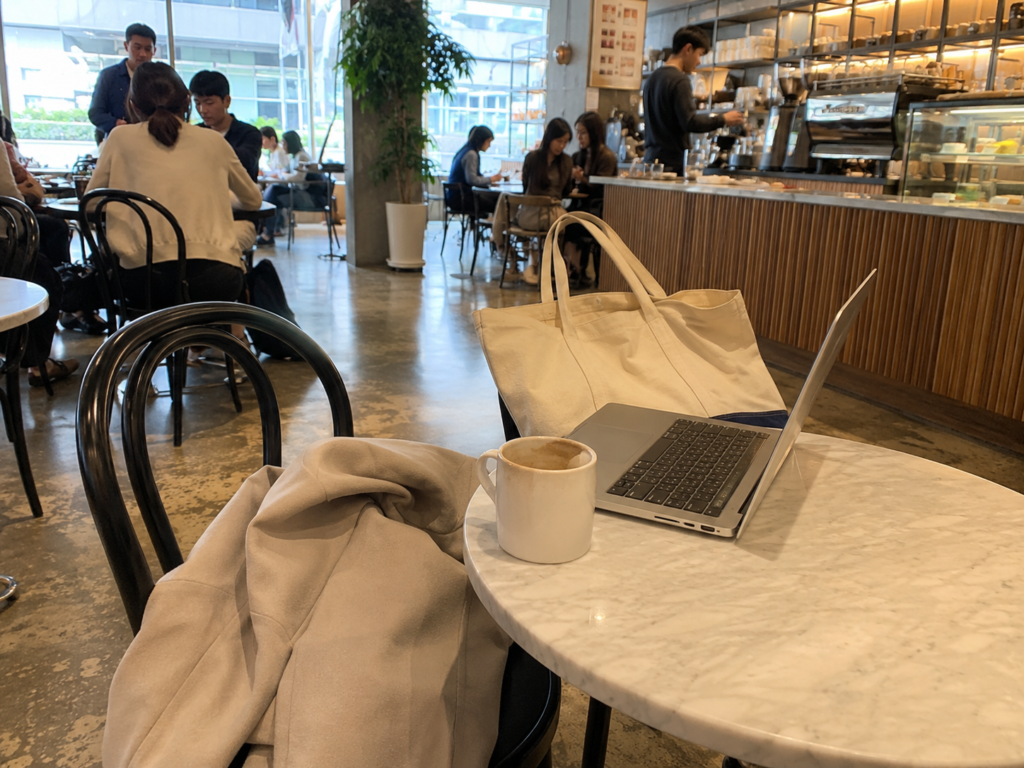
That does not mean every Korean leaves valuables unattended, and it is not a promise that theft cannot happen.
It simply means that a personal item on a table is commonly understood as a sign that the seat is already taken.
So if a table looks empty but someone’s belongings are there, do not move them to make space for yourself.
And even if you see locals leaving bags or laptops for a short time, keep your passport, wallet, phone, and other important valuables with you.
The useful cultural clue is not “Korea is so safe that you can leave anything anywhere.”
It is much simpler:
A table can be occupied even when the person is temporarily gone.
A Laptop Is Normal in Many Cafes, but Not Every Cafe Wants a Long Stay
Working or studying in a cafe is common enough in Korea that there is even a familiar word for people who do it: 카공족 — cagongjok, people who study or work in cafes.
In a large cafe with wide tables, Wi-Fi, outlets, and several other laptops already open, using your computer usually does not feel unusual.
But that does not make every cafe an unofficial coworking space.
Small independent cafes may have limited seating.
Some post a one-drink-per-person rule.
Some limit seating time.
Some restrict laptops during busy hours.
You do not need to guess if there is a sign.
Read it.
If there is no sign, the room still gives you clues.
A nearly empty cafe with big tables and outlets feels different from a tiny place where people are waiting outside for a seat.
For several hours of focused work, a study cafe may be a better fit. A study cafe is closer to a paid study space than a normal coffee shop, so the expectation is different from the start.
The important habit is not “laptops are always okay in Korea.”
It is matching your stay to the kind of space you are using.
One Drink Per Person Is Often a House Rule, Not a Universal Korean Rule
Visitors sometimes ask whether every Korean cafe requires each person to order a drink.
There is no single rule for every cafe.
Many independent cafes do have a one-order-per-person policy, especially when seating is limited.
Other places may be more flexible.
A dessert order may count at one cafe and not at another.
The easiest answer is usually written on the menu, counter, tablet, or small sign near the entrance.
This is another situation where trying to memorize one “Korean cafe rule” is less useful than reading what that particular business is asking customers to do.
If four people want to occupy a small table during a busy period, ordering one Americano for the entire group is unlikely to feel reasonable even before you find the sign.
Some Cafes Are Destinations, Not Just Coffee Stops
There are Korean cafes people visit because they want coffee.
And there are cafes people visit because they want that cafe.
The building may be a renovated hanok, warehouse, factory, large garden space, rooftop, or carefully designed interior.
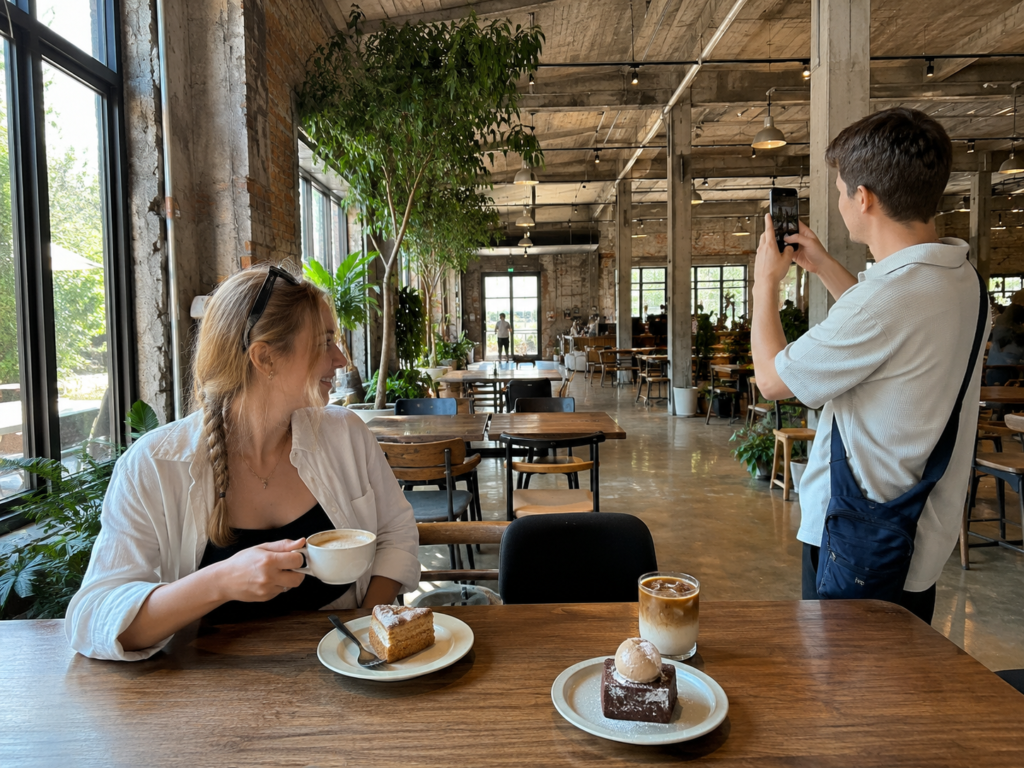
The dessert may be part of the attraction.
A particular window, staircase, view, or seasonal decoration may be what people came to photograph.
In places like Seongsu, cafes can be part of the reason people visit the neighborhood at all.
That changes how the space feels.
Customers may spend time looking around before sitting down.
They may photograph the drinks before touching them.
A cafe visit can become a small outing rather than a quick caffeine stop.
But a photogenic cafe is still a shared public space.
Do not block a staircase or doorway for a photo.
Avoid putting strangers clearly into your pictures.
And check recent visitor photos rather than judging the entire experience from polished promotional images.
A beautiful cafe can still be crowded, noisy, expensive, or uncomfortable.
The Cafe After a Meal Is About More Than Coffee
For many social gatherings in Korea, leaving the restaurant does not necessarily mean everyone is ready to go home.
Someone may simply ask whether the group wants to go to a cafe.
The purpose can be more conversation than caffeine.
Restaurants are for eating.
A cafe often gives the group another place to sit, talk, have dessert, or stay together without occupying the restaurant table after the meal is finished.
This pattern is common enough that it deserves its own explanation, so we cover it separately in Why Koreans Move to a Cafe After Eating.
For this guide, the useful point is that a cafe in Korea may function as a second social space, not merely the place where someone buys coffee.
Unmanned Cafes Expect You to Figure Out More on Your Own
An unmanned cafe can feel very normal in Korea and slightly strange the first time you enter one as a visitor.
There may be no staff member behind a counter.
You order from a kiosk or machine.
You collect your drink yourself.
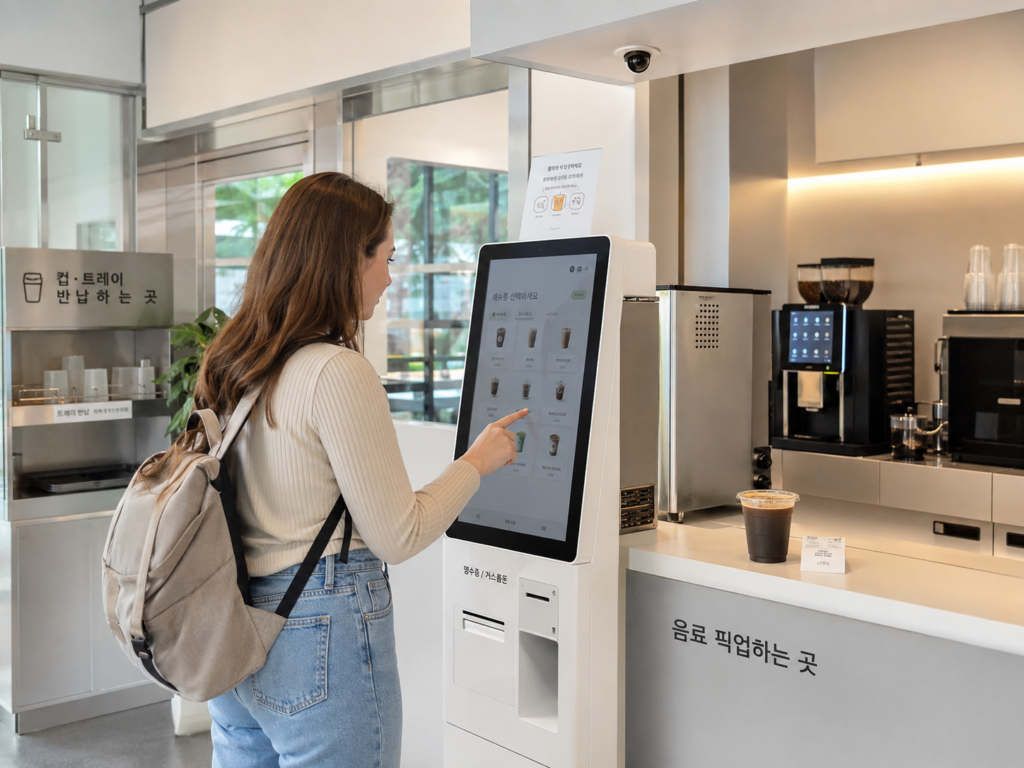
And when you are finished, you may need to return cups, sort trash, or clean the table according to the posted instructions.
The convenience comes with a tradeoff.
If your payment fails, the machine stops, or you do not understand the instructions, there may be nobody nearby to ask immediately.
Before paying, look for a contact number, refund instructions, opening hours, and signs explaining where used cups and trash should go.
Do not assume “unmanned” automatically means 24 hours.
Some are open late or around the clock, but others are not.
The system works best when customers notice the instructions before something goes wrong.
You Can Usually Tell What Kind of Cafe It Is Within a Minute
You do not need to know every type of Korean cafe before your trip.
You can usually understand the place you are standing in by looking at a few things.
If people are working quietly with laptops, the tables are wide, and outlets are easy to find, a longer stay may fit naturally.
If the tables are small, the cafe is packed, and people are waiting, a shorter visit makes more sense.
If everyone is taking photos and the desserts look almost architectural, the space itself is probably part of the product.
If people are ordering huge iced drinks and walking straight back outside, you are probably in a fast takeout-oriented shop.
If there is no staff member at all, slow down and read the instructions before ordering.
That is the real shortcut to Korean cafe culture.
Not memorizing rules.
Reading the room.
Once you can do that, cafes in Korea stop feeling like one mysterious culture with dozens of hidden rules.
They become what they really are: many different kinds of spaces that happen to sell coffee.