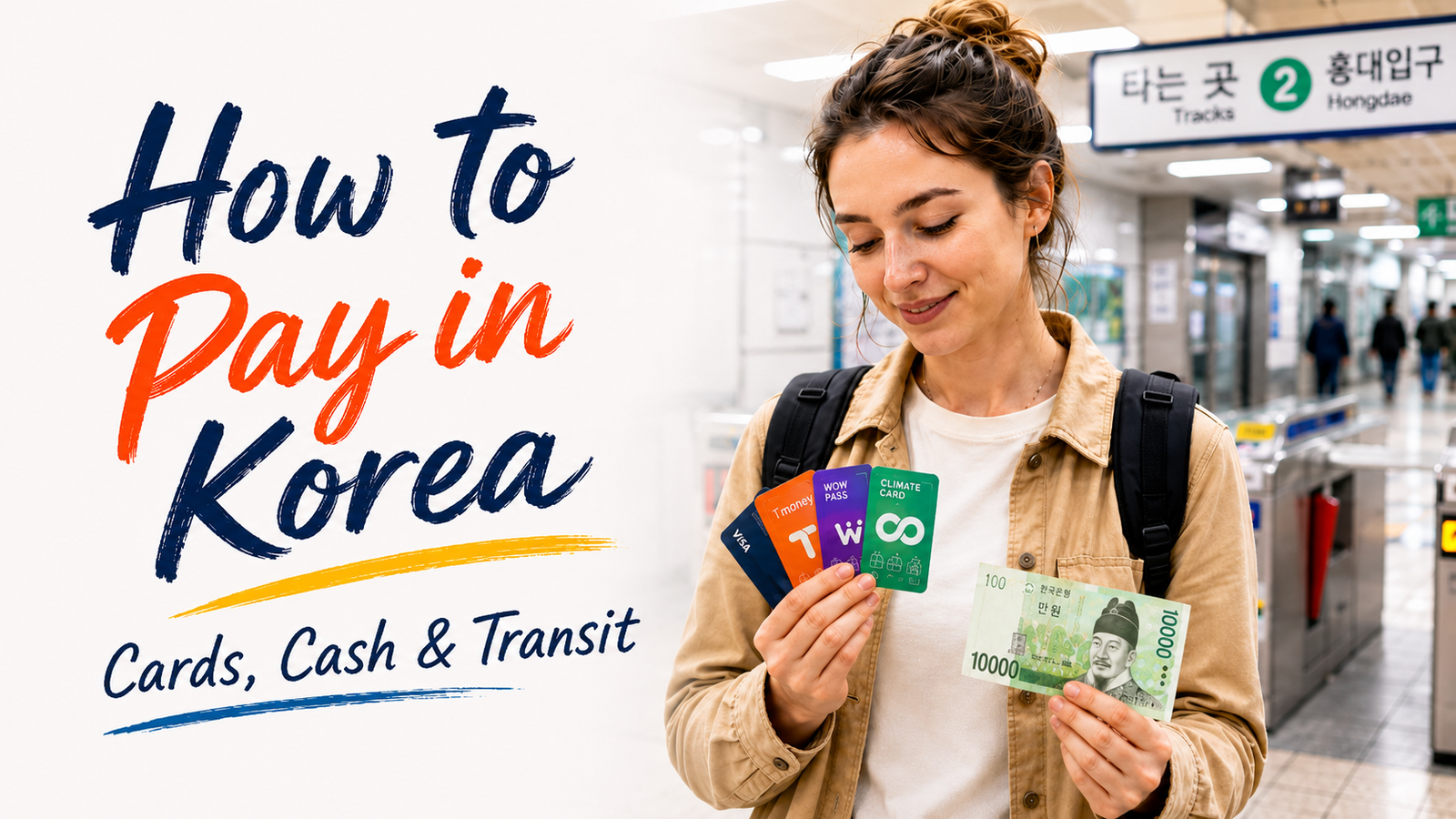
If you are wondering how to pay in Korea, the answer is simple: bring a main payment card, a backup physical card, a transit card, and a small amount of Korean won.
Paying in Korea is usually easy, but one card is not always enough.
This is a setup guide: what to bring, which transit card to choose, and what backup payment method to keep ready.
If your main question is whether you actually need cash — and where cards can still fail — see our separate Do You Need Cash in Korea? When Cards Work & When They Fail guide.
Table of Contents
Prepare Your Cards Before You Fly
1. Why You Should Bring More Than One Physical Card
Foreign credit cards are widely accepted in Korea, but they may not work at every kiosk or unattended payment machine.
In everyday Korea, card payment is so normal that locals rarely think about carrying a second payment method for a café or convenience store. The difference for a traveler is that an internationally issued card can fail at a machine even when the same card works perfectly at a staffed counter.
Bring at least two physical cards, preferably from different banks or card networks. Before departure, enable overseas payments and check your foreign transaction fees.
A mobile wallet is convenient, but some machines may require a physical card. If you plan to withdraw cash from an ATM, make sure you know your card’s PIN.
Local tip: Keep your backup card separate from your main wallet so it is still available if your wallet is lost or your main card is declined.
Choose the Right Transit and Travel Card
2. T-money or EZL: Which One Should You Buy?
You may see both T-money and EZL at convenience stores. EZL is the current name for the card that travel guides published before 2024 may still call Cashbee.
For most travelers, either card is a practical choice. Both can be used on buses and subways in many parts of Korea, so you only need one.
You can buy them at major convenience stores such as CU, GS25, 7-Eleven, and Emart24. Card prices vary by design and retailer, and special character or K-pop designs may cost more than standard cards.
The card is sold without any money on it, so you need to add money before using it. Ask the cashier for the card, then tell them how much Korean won you want to add.
Standard physical T-money or EZL top-ups at convenience stores and many station machines still commonly rely on Korean won in cash.
This is separate from Seoul’s newer vending machines that accept internationally issued cards for Climate Card short-term passes and single-journey tickets. Do not assume that every Korean transit card can now be topped up with a foreign card.
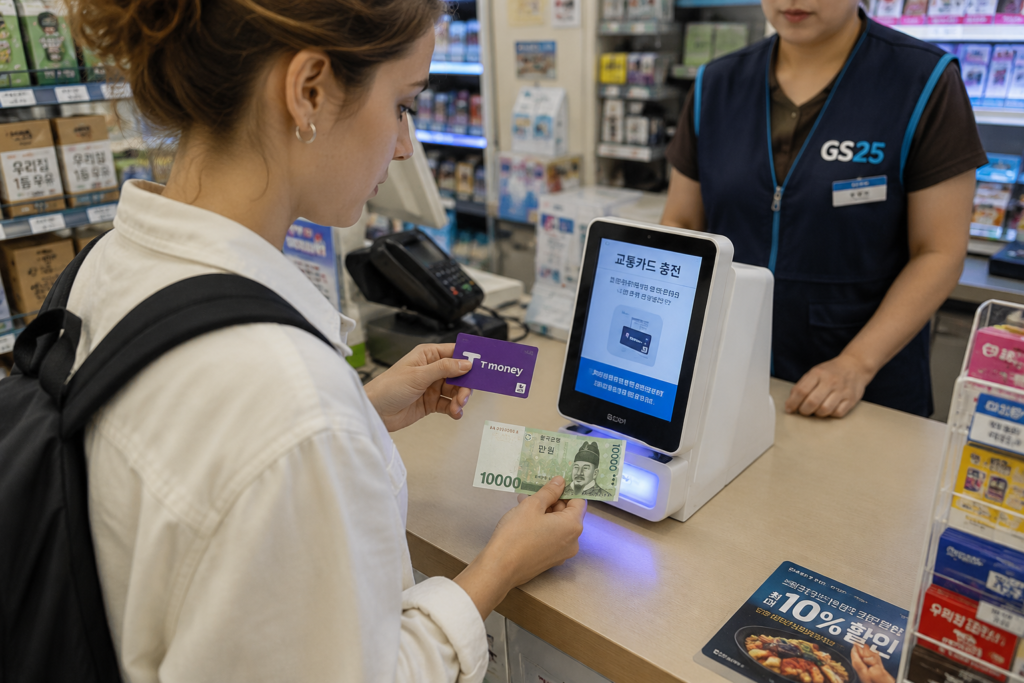
Local tip: Choose whichever card is easiest to find and keep small Korean won notes ready for top-ups.
3. Is the Climate Card Actually Worth It for Your Seoul Trip?
The Climate Card is a fixed-price transit pass for unlimited rides within its covered area. Short-term passes are available for 1, 2, 3, 5, or 7 days.
The physical card costs KRW 3,000. You then add a pass:
- 1 day: KRW 5,000
- 2 days: KRW 8,000
- 3 days: KRW 10,000
- 5 days: KRW 15,000
- 7 days: KRW 20,000
The pass begins on the day you add it, so you cannot buy it in advance for a later starting date.
Important 2026 update: Seoul discontinued recharging the old 30-day prepaid Climate Card after August 31, 2026 and introduced a new resident-focused Climate Pass. This does not remove the short-term tourist passes — the 1-, 2-, 3-, 5-, and 7-day Climate Card options remain available.
You can get the card from designated vending machines inside Seoul subway stations or from participating convenience stores near stations. Since March 17, 2026, internationally issued credit and debit cards can be used at designated new Seoul subway vending machines to purchase Climate Card short-term passes and single-journey tickets. A service fee may apply.
It may be a good choice if:
- Most of your itinerary stays within Seoul.
- You expect to take buses and subways several times a day.
- Your hotel and main attractions are within the covered area.
It may not be the best choice if:
- You plan several day trips outside Seoul.
- You often use the Sinbundang Line, GTX, or airport buses.
- You need to board the Airport Railroad at Incheon Airport.
For these trips, T-money or EZL is usually simpler.
A pass can look cheaper on paper, but in Seoul the route matters more than the number of rides. If your hotel or day-trip route repeatedly crosses outside the Climate Card coverage, a normal transit card is often the simpler travel choice.
Local tip: Check the detailed coverage on the official Seoul Climate Card guide before buying the pass.
4. Do You Need a Prepaid Card in Korea? (WOWPASS)
Think of WOWPASS as two cards combined into one:
- A prepaid card for restaurants, cafés, shops, and everyday purchases
- A T-money card for buses and subways
The two functions use separate balances. Money added to your WOWPASS payment balance cannot be used for transportation. The T-money balance must be topped up separately, usually with Korean won in cash.
You can reserve the card through the WOWPASS app or official website and collect it from a WOWPASS kiosk. Kiosks are available at selected subway stations, hotels, convenience stores, and tourist areas. Check the app for the nearest current location before your trip.
WOWPASS can be useful if you want a Korean prepaid card, prefer to manage your travel budget in advance, or need a backup when your foreign card is not accepted.
However, it is not essential. If your regular travel card works well in Korea and has low foreign transaction fees, you may not need another payment card.
Local tip: Check the official WOWPASS guide before getting one, and decide whether you need the prepaid payment function—not just the built-in T-money feature.
Set Up Your Money After Landing
5. How Much Cash Should You Carry in Korea?
For one traveler on a short trip, KRW 50,000–100,000 is a practical amount to have ready when you arrive. It is a starting amount, not your entire travel budget.
You can use it to top up a T-money or EZL card, make small purchases, or pay when a foreign card is not accepted.
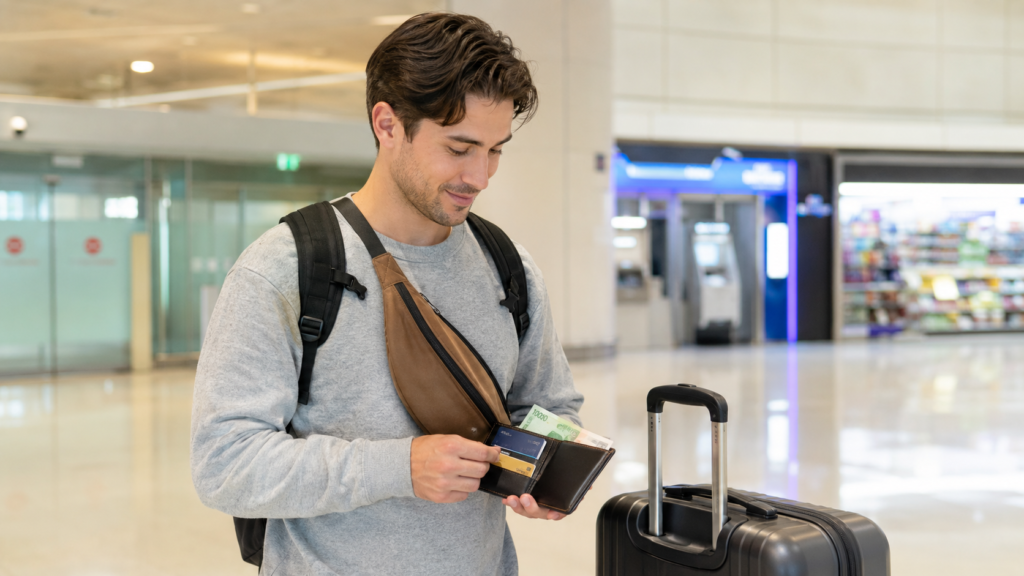
Try to carry KRW 1,000, 5,000, and 10,000 notes rather than only KRW 50,000 notes. Smaller notes are more convenient for transit card top-ups and everyday payments.
Why it matters: Korea is highly card-friendly, so carrying a large amount of cash is usually unnecessary. A small cash reserve is mainly there to cover the situations your cards cannot.
Local tip: Keep at least KRW 20,000–30,000 in smaller notes for transit card top-ups, and use the rest only as backup cash.
When Your Foreign Card Does Not Work
6. What Should You Do If a Self-Service Machine Rejects Your Card?
Your card may work in most places but be rejected by a self-service ordering or ticket machine.
One failed kiosk is usually a machine problem or payment-network compatibility problem, not a sign that Korea has suddenly become “cash only.” At a staffed counter, the same purchase may be much easier.
Try these steps:
- Insert your physical card instead of tapping your phone.
- Try your backup card.
- Ask a staff member if you can pay at the counter.
- Use cash or a prepaid card if you have one.
- Check your banking app to see if the payment was blocked.
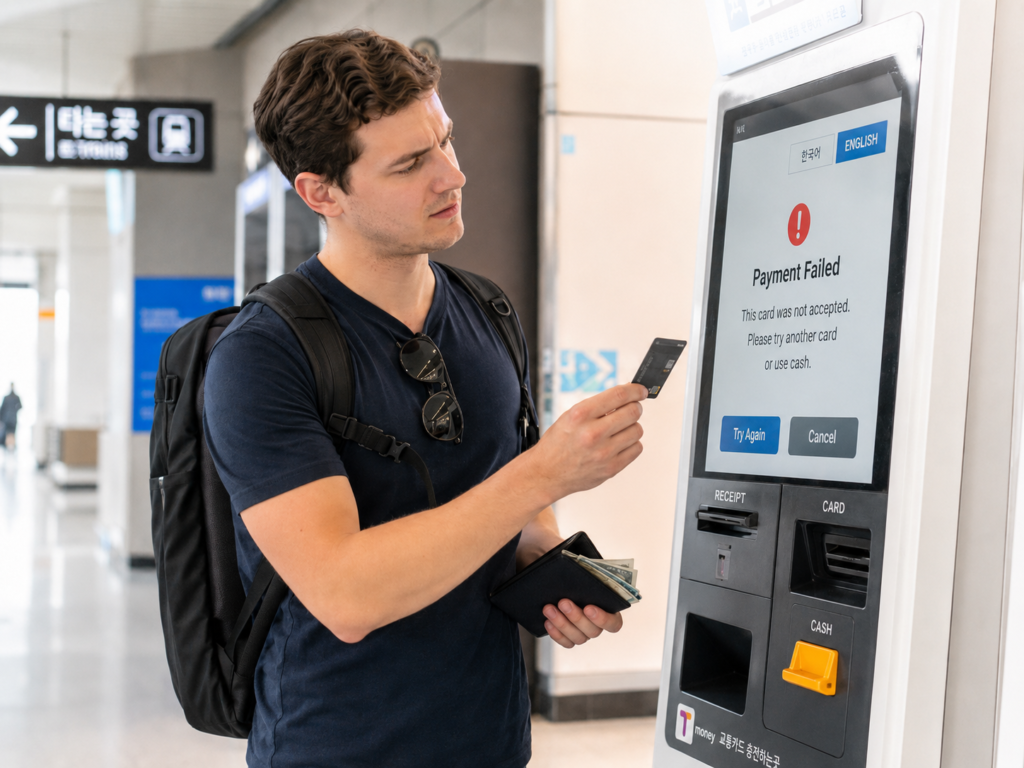
Why it matters: One rejected payment does not mean your card cannot be used elsewhere in Korea. Some self-service machines are simply not set up to process every foreign card.
Local tip: Do not keep trying the same card. Switch to your backup card or ask to pay at the counter.
Before You Leave Korea
7. What Should You Do with Money Left on Your Cards?
Each card has a different refund process.
- T-money or EZL: Small balances can usually be refunded in cash at participating convenience stores. Refund limits and fees may vary by store.
- WOWPASS payment balance: Withdraw the remaining money in Korean won at a WOWPASS kiosk.
- WOWPASS T-money balance: This must be refunded separately at a convenience store or an official T-money refund location.
- Climate Card: You must request a refund before the pass expires. For travelers without a Korean bank account, refunds can be less convenient, so check the current Tmoney and Seoul instructions before loading more than you expect to use.
Why it matters: Adding only what you expect to use helps you avoid a complicated refund before leaving Korea.
Local tip: Check your transit card balance before your final travel day and add only enough for your remaining rides.
What Is the Best Way to Pay in Korea?
The best payment setup depends on where you are going and how you prefer to pay.
The Safe Default
This is the simplest choice for most first-time visitors:
- Your main credit or debit card
- A second card as backup
- A T-money or EZL card
- KRW 50,000–100,000 in cash
This combination works well if you are visiting both Seoul and other parts of Korea.
The Seoul-Focused Setup
Choose this option if most of your trip stays within Seoul and you plan to use public transportation often:
- Your main credit or debit card
- A second card as backup
- A Climate Card
- A small amount of cash
- A T-money or EZL card for routes not covered by the Climate Card
Check your hotel, airport transfer, and main routes before choosing this setup.
The Prepaid Setup
This option may suit travelers who want to set their spending budget in advance:
- A WOWPASS card for shops, cafés, and restaurants
- A separate T-money balance on the WOWPASS card for buses and subways
- A credit or debit card as backup
- A small amount of cash
Remember that the WOWPASS payment balance and T-money balance must be topped up separately.
Final Thoughts
Knowing how to pay in Korea is mostly about having a simple backup plan.
You don’t need every payment option in Korea.
For most travelers, one main card, one backup card, a T-money or EZL card, and a bit of cash cover everything you’ll actually run into.
Add the Climate Card only if your Seoul routes fit its coverage. Add WOWPASS only if you actually want a prepaid payment option.
What often surprises visitors is that Korea can be extremely card-friendly and still have a few payment systems that work by different rules. Once you separate everyday purchases, transit payments, and backup cash, the system becomes much easier to understand.
The best payment setup is the one that fits your trip, not the one with the most cards.
Frequently Asked Questions
Can I Use My Foreign Credit or Debit Card in Korea?
Yes. Foreign cards are accepted at most hotels, restaurants, cafés, and shops. However, some self-service machines may reject them, so bring a second card and some cash.
When shopping at a participating store, card payment and a tourist tax refund are separate steps. Check for a Tax Refund sign and show your passport before completing the payment. Our guide to tax refunds in Korea explains the store requirements, immediate refunds, and refund vouchers.
Should I Buy T-money or EZL?
Either one is fine for most travelers. Both work on buses and subways in many parts of Korea, so you only need one.
Can I Add Money to T-money or EZL with a Foreign Card?
Standard T-money or EZL top-ups still commonly require Korean won in cash at convenience stores and many station machines. Do not confuse this with the newer Seoul vending machines that accept international cards for Climate Card short-term passes and single-journey tickets.
Do I Need WOWPASS in Korea?
No. WOWPASS is optional. It may be useful if you want a Korean prepaid card or prefer to set your travel budget in advance.
Is the Climate Card Better Than T-money?
Not for every trip. The Climate Card may save money if you travel often within its covered area, while T-money or EZL is usually simpler for trips that include other cities or several day trips outside Seoul.
Related Guides
Do You Need Cash in Korea? When Cards Work & When They Fail
Learn where cards usually work, when cash is still useful, and what to do when an internationally issued card fails.
→ Read the cash in Korea guide
Tax Refund in Korea: How Much Do You Actually Get Back?
Understand participating stores, immediate refunds, refund vouchers, and how much you may actually receive.
→ Read the Korea tax refund guide
Getting Around Korea: 6 Easy Subway, Bus, Taxi & Airport Tips
Plan subway, bus, taxi, and airport travel with the right payment and navigation setup.