
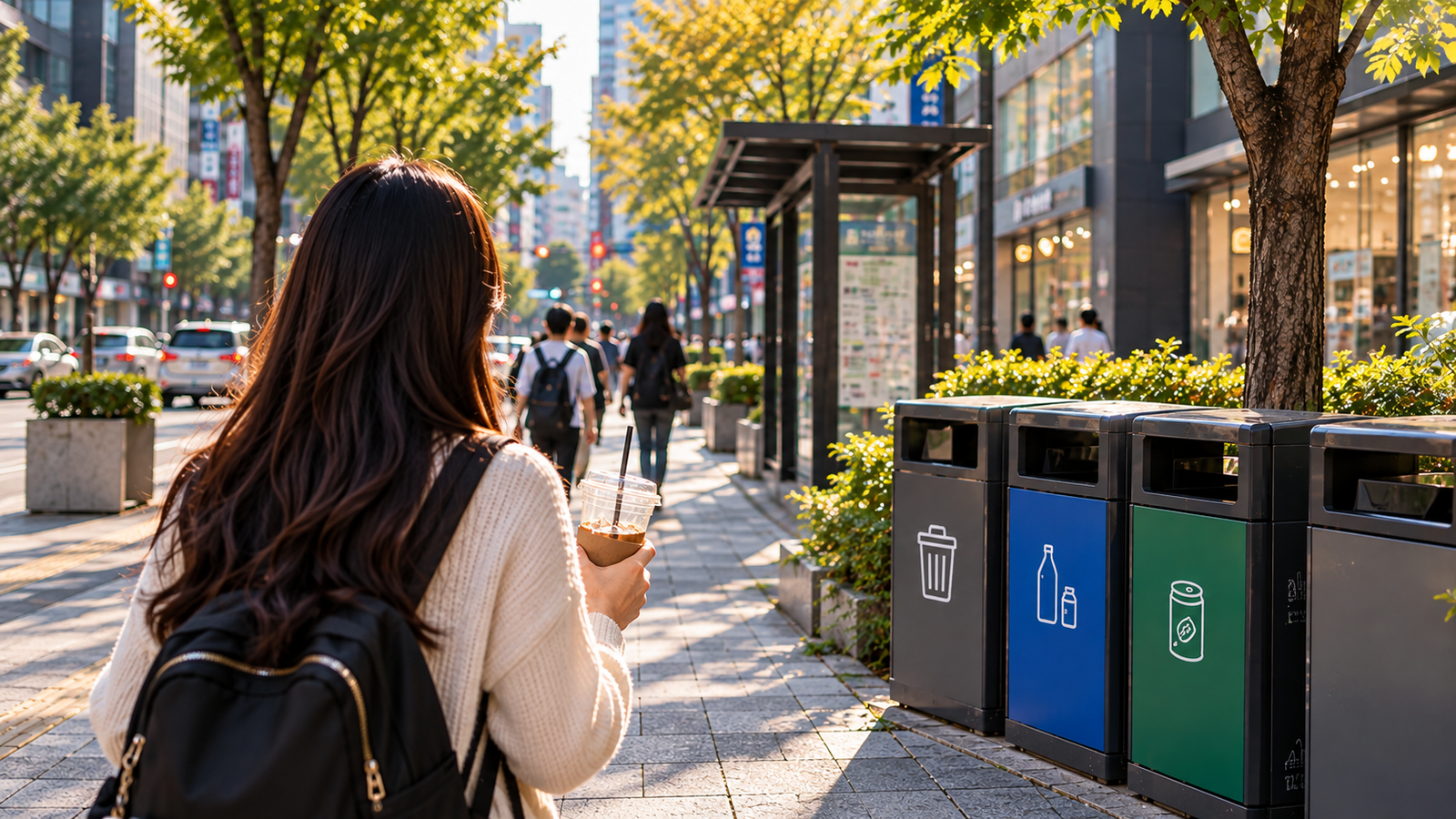
Foreign visitors sometimes ask why trash cans in Korea seem so hard to find.
As a Korean, I find that question interesting because I have never really thought of trash cans as especially difficult to find.
That does not mean there is one on every corner. There isn’t.
I just do not usually feel that I need one immediately.
If I have a clean receipt, a small wrapper, or something else that will not leak or make a mess, I normally put it in my bag and throw it away later. Sometimes I find a trash can after walking for a while. Sometimes I take it home.
Neither feels unusual.
What does feel unusual is throwing it on the ground.
If I see someone casually drop trash on the street, I notice. I may even catch myself looking at them.
So when someone asks, “Where are all the trash cans in Korea?” part of the answer is surprisingly ordinary:
We are used to keeping our own trash for a little while.
Maybe the Difference Is Simply When You Expect to Throw Something Away
For me, something becoming “trash” does not automatically create an urgent need to find a bin.
A receipt can stay in my bag.
A dry snack wrapper can wait.
A small piece of clean packaging can come home with me.
I do not consciously think, I am doing something responsible now.
It is just normal.
That is why some descriptions of Korea make me smile a little. You sometimes hear that visitors have to “carry their garbage around all day” because Korea has no public bins.
That sounds far more dramatic than my everyday experience.
Usually, you are just holding onto one small thing until you happen to find somewhere appropriate to put it.
And if you walk a little farther, a bin often appears.
The important distinction is that not seeing a trash can immediately does not make the street itself an acceptable alternative.
Seoul Really Did Get Rid of Many Street Trash Cans
There is, however, a real reason this reputation exists.
Korea introduced its nationwide volume-based waste fee system in 1995. Households began paying for ordinary garbage through designated disposal bags, with the broader aim of reducing waste and encouraging recycling. Korea’s Ministry of Environment confirms that the system has operated nationwide since 1995.
At that time, Seoul had 7,607 street trash cans.
By 2007, that number had fallen to 3,707.
One reason was that household and business waste was sometimes being dumped into public street bins instead of being disposed of through the proper system. Seoul therefore reduced many street bins over time and later began increasing them again where demand was high.
That is where a lot of the “Korea has no trash cans” story comes from.
But the story did not stop in 2007.
Seoul later began adding bins again where they were actually needed, especially in places with heavy foot traffic and large amounts of street waste.
So yes, Seoul deliberately reduced the number of public bins.
No, it did not decide that public trash cans should disappear forever.
The Annoying One Is Not a Wrapper. It Is an Iced Americano Cup.
Small dry trash is easy.
Coffee is different.
Takeout coffee is everywhere in Korea, so an empty plastic cup is probably one of the most realistic pieces of trash a traveler will end up carrying.
Except it is often not actually empty.
There is melted ice at the bottom.
A little coffee is still left.
Maybe you are tired of carrying it and finally spot a bin.
This is where I would ask you to wait another few seconds.
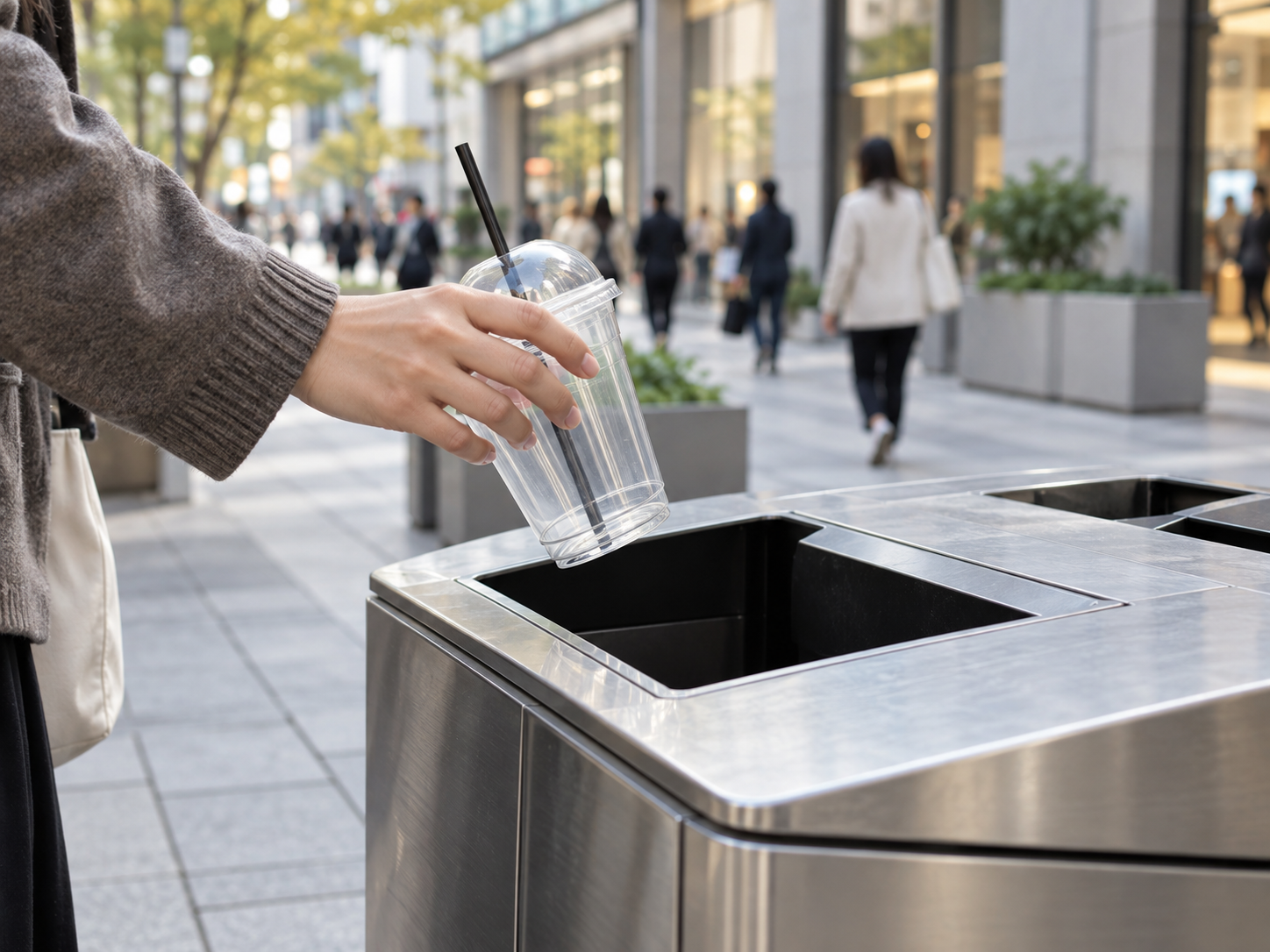
Do not throw a cup containing leftover drink straight into a trash or recycling bin.
If there is a proper place for disposing of liquids, use it. Otherwise, finish the drink or deal with the remaining liquid appropriately before throwing away the cup.
The point is simple:
The cup that goes into the bin should be empty.
This sounds like a tiny travel tip until you imagine someone having to empty a garbage bag full of cups with coffee and melted ice sloshing around inside.
Then it feels less tiny.
What About Convenience Stores?
Convenience stores can help, but I would not treat them as guaranteed public trash stations.
If I see a clearly provided trash or recycling area outside a convenience store, using it feels completely natural.
If I bought something at the store and there is a customer disposal area, naturally I would use that too.
But if there is nothing visible outside, I personally would not walk deep inside a store just to dispose of random trash I brought from somewhere else.
That is not a strict Korean rule.
It is simply how I behave.
And branches differ.
One convenience store may have tables, microwaves, a large eating area, and separated bins.
Another can be tiny.
So rather than remembering:
“Convenience stores in Korea have trash cans.”
Remember:
“Use the customer disposal area when the store clearly provides one.”
That works much better.
If You Cannot Read Korean, Look at the Bin Before You Throw
This is another area where travelers can make Korean recycling sound much more intimidating than it needs to be.
You do not need to memorize Korea’s entire waste system just to dispose of one bottle.
Look at what is actually in front of you.
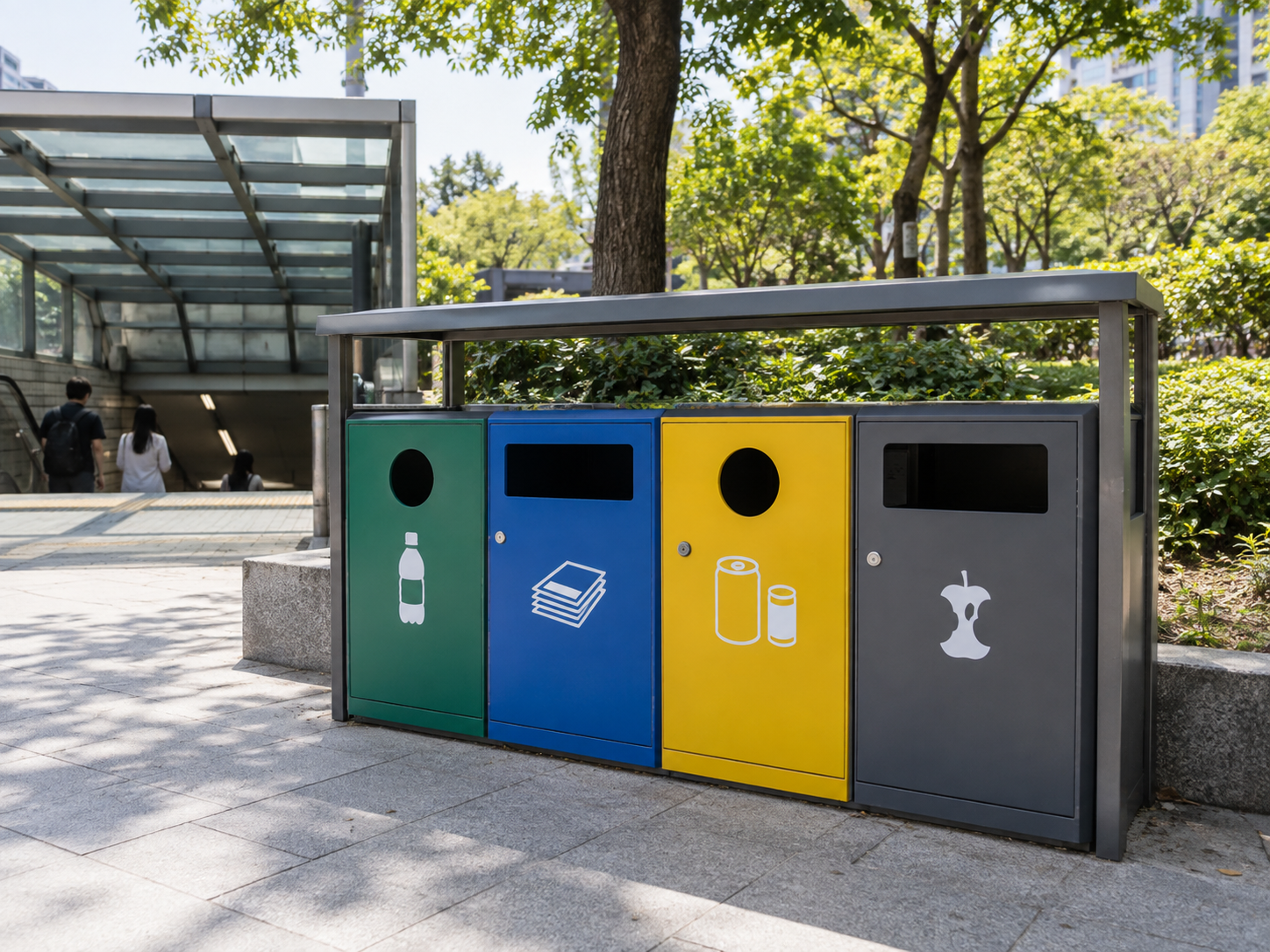
Public bins may show pictures or labels for general waste, cans, bottles, plastics, or recyclables.
The categories can differ depending on the facility.
So my practical advice is:
Look at the picture.
Take five seconds.
If you have a drink container, make sure it is empty.
If something is heavily contaminated with food or other residue, do not assume it belongs in recycling simply because the container itself is plastic.
The sign on the bin in front of you is often more useful than trying to memorize every recycling category before arriving in Korea.
Why Are the Streets Still Relatively Clean If There Aren’t That Many Trash Cans?
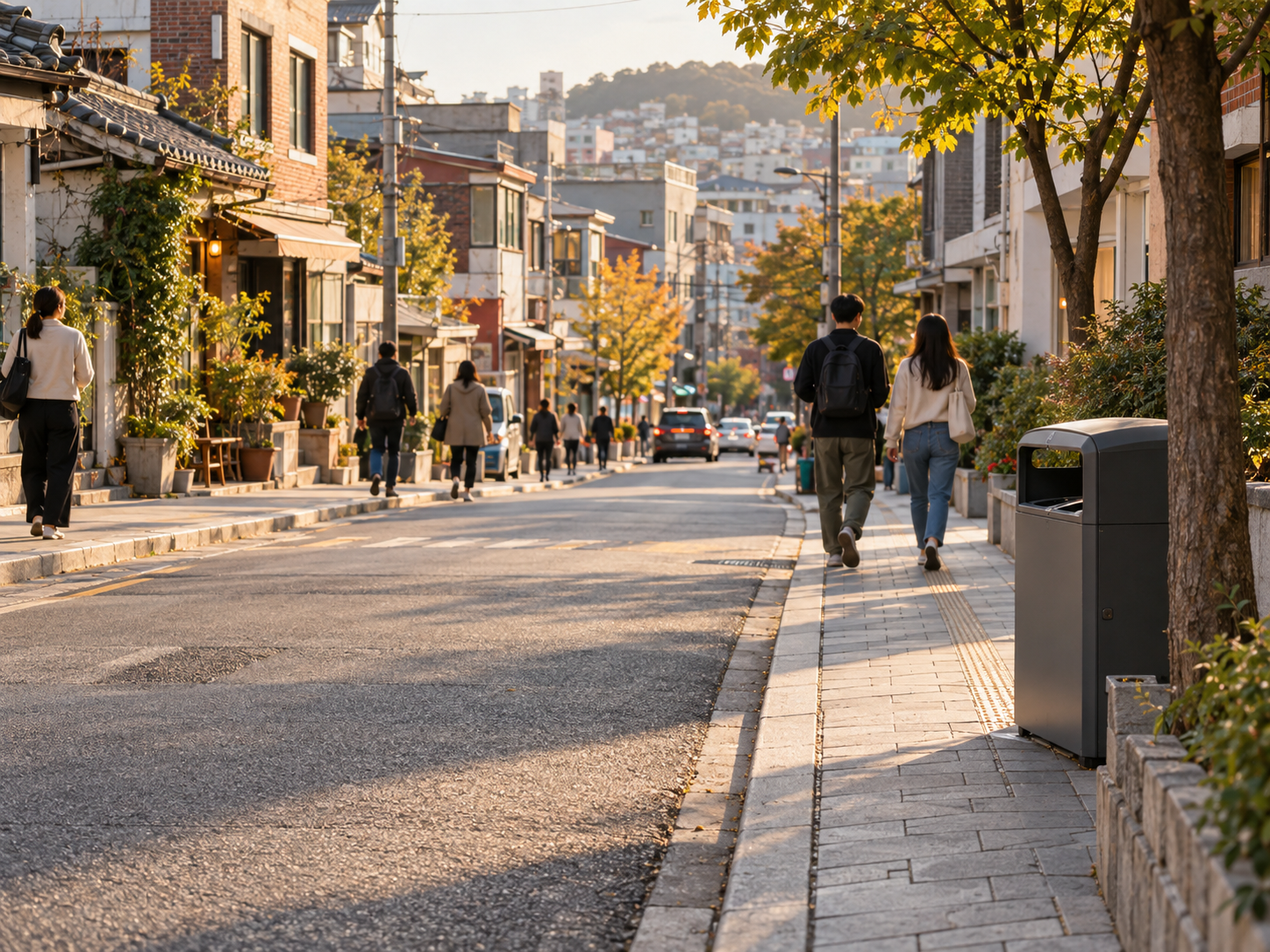
Everyday habits definitely play a part.
As I mentioned, if I see someone casually throw trash onto the road, I notice. Keeping a small piece of my own trash until I can dispose of it properly feels normal to me.
But clean streets are not maintained by civic awareness alone.
Someone has to clean them.
Trash has to be collected.
Bins have to be emptied.
Busy areas need more frequent attention.
So the relative cleanliness visitors notice in parts of Seoul is better understood as everyday habits and actual street maintenance working together.
And Korea is not spotless.
Walk through a nightlife district late at night or visit a crowded area immediately after a major event and you can certainly find litter.
The everyday expectation is much simpler:
If I made the trash, I generally keep it with me until I find somewhere to put it.
Most people are probably not thinking of that as some grand act of civic responsibility.
It is just familiar behavior.
The Funny Part Is That Seoul Is Making Trash Cans Easier to See Again
The city itself seems to recognize the inconvenience.
In 2024, Seoul tested newly designed street trash cans at 15 busy locations, including areas around Seoul City Hall, DDP, and Marronnier Park.
Thirty bins were installed as part of the pilot, with designs intended to make them easier to notice, use, empty, and maintain. The project was part of Seoul’s effort to improve the visibility and usability of street bins.
I find that interesting because it shows how misleading a simple rule can be.
The story is not:
Korea does not need trash cans because everyone carries their garbage home.
Nor is it:
Korea made a mistake by removing them and now wants bins everywhere again.
The reality is more practical.
Too few bins can be inconvenient.
Poorly managed bins can create their own problems.
So Seoul continues adjusting the number, design, and location.
That is probably how most city systems work in real life: less like a grand cultural philosophy and more like constant tweaking.
What I Would Actually Tell a Friend Coming to Korea
I would not warn them that Korea is a country with nowhere to throw anything away.
I would say this instead:
Leave a little empty space in your bag.
If you have a clean wrapper and there is no bin nearby, put it there.
You may find a trash can five minutes later.
If you do not, throw it away properly when you get back to your hotel.
For coffee cups, make sure the drink is gone before putting the cup into a bin.
When there are separate openings, look at the pictures instead of guessing.
If a convenience store clearly has a customer trash area, use it appropriately.
And if a trash can is already overflowing, do not place your cup neatly on the ground beside it and convince yourself that this somehow does not count as littering.
That last one is worth remembering.
After a few days in Korea, you may also notice that carrying a small wrapper around for ten minutes no longer feels strange.
You put it in your bag.
You forget about it.
Eventually you see a bin.
You throw it away.
And that is probably why my reaction to the original question has not changed much.
Where are all the trash cans in Korea?
They are around.
I just never expected one to appear the second I needed it.
FAQ
Why are trash cans in Korea hard to find?
Public trash cans do exist, but they may be less frequent or located differently from what some travelers expect. Seoul also removed many street bins after Korea introduced its volume-based waste fee system in 1995 because household and business waste was sometimes being dumped into public bins. The city later began adding bins again.
Where should tourists throw away trash in Seoul?
Use clearly marked public trash cans when you find them. If you have a small, clean piece of trash and there is no bin nearby, keeping it in your bag until you find an appropriate place—or until you return to your accommodation—is perfectly reasonable.
Can I throw trash away at a convenience store in Korea?
If the store clearly provides a trash or recycling area for customers, use it as intended. Facilities vary by branch, so do not assume every convenience store provides a public trash can.
What should I do with a takeout coffee cup?
Finish the drink or properly deal with any remaining liquid first, so that only the empty cup goes into the bin. Then follow the pictures or labels on the available waste and recycling containers.
Do Koreans really carry their trash home?
Sometimes. Small, clean items such as receipts or wrappers may simply stay in a pocket or bag until a bin appears. If one does not, taking the item home to dispose of it is not unusual.
Related Guides
Korean Convenience Store Guide
Korean convenience stores are part snack shop, part quick meal stop, and part everyday service hub. What they offer—and even how much space they have—can vary significantly by branch.
→ Read the Korean Convenience Store Guide
Korean Subway Culture: 11 Etiquette Tips for Travelers
Holding onto your own trash is only one small example of how shared public spaces work in Korea. The subway reveals many more everyday habits that locals barely think about.