
If you think Korean convenience stores are just places to grab a drink or a quick snack, think again.
In Korea, convenience stores are part of everyday life. They’re where people pick up a late-night meal, meet friends, discover the newest snacks before anyone else, create surprisingly good meals using convenience store ingredients, and even enjoy instant noodles with an ocean view.
As a Korean, I never realized how unusual this was until I started talking to travelers. Many visitors are surprised that convenience stores here feel more like community hubs than simple corner shops.
Before your trip, here are 17 things worth knowing about Korean convenience stores—from food and promotions to small everyday habits that can make your visit easier.
Table of Contents
Why Korean Convenience Stores Are Unlike Anywhere Else
Most travelers don’t expect a convenience store to become one of their favorite memories of Korea.
Yet that’s exactly what happens to many first-time visitors.
In Korea, convenience stores are much more than places to buy snacks or drinks. They’re part of everyday life—where people discover newly released foods, meet friends, enjoy a quick meal, and even relax with instant noodles while overlooking the Han River or the beach.
What surprises visitors most isn’t how many convenience stores there are, but how Koreans use them. They’re neighborhood gathering spots, trendsetters for new products, and sometimes even tourist attractions.
Here are 17 practical details that can help you understand what to expect—and how Koreans actually use convenience stores in everyday life.
The Secret Life of Korean Convenience Stores

1. Koreans Use Convenience Stores Like a Second Refrigerator
In Korea, convenience stores are often close to homes, offices, and transit stops, making it easy to stop by when you need only one or two things.
People use them for small purchases such as drinks, snacks, a simple meal, or everyday supplies instead of making a larger shopping trip.
For that reason, many people regularly use the convenience store near their home or workplace. The “second refrigerator” idea is a useful description of that convenience—not a phrase that every Korean commonly uses.
2. Every Convenience Store Brand Has Its Own Personality
At first glance, Korean convenience stores may look similar. The differences are less about fixed personalities than the products and promotions each chain is running at the time.
CU, GS25, 7-Eleven, and emart24 each offer exclusive products, collaborations, and promotions that change over time. If a particular snack or meal interests you, check which chain is selling it.
3. Some Korean Convenience Stores Have Become Tourist Attractions
Not every convenience store in Korea is just a place to shop.
Some have become popular destinations because of their incredible views. Along the Han River in Seoul, people enjoy instant ramyun cooked in the store’s self-service ramyun machines while watching the sunset. In Gangneung, convenience stores overlooking the East Sea are famous for ocean views, coffee, and instant ramyun. In Busan, stores near Gwangalli Beach offer spectacular nighttime views of the illuminated Gwangan Bridge.
Sometimes, the best view of your trip isn’t from a café—it’s from a convenience store.
4. Convenience Stores Often Work as Easy Meeting Landmarks
If someone says, “Let’s meet in front of the CU,” they may simply be using the store as an easy-to-recognize landmark.
Because signs for chains such as CU and GS25 are easy to spot, a nearby branch can be a convenient meeting reference. Phrases such as “Meet in front of the GS25” or “I’ll wait at the CU” can sound natural in the right situation.
Whether people use a convenience store this way depends on the area and the situation, but the wording is common enough that travelers may hear it.
5. Korean Convenience Stores Change With the Seasons
One of the easiest ways to know what season it is in Korea is to step inside a convenience store.
In spring, the shelves fill with cherry blossom-themed drinks, snacks, and desserts. Summer brings ice cups, iced coffee, and refreshing beverages. In autumn, you’ll find sweet potato, chestnut, and pumpkin-flavored snacks everywhere. Winter welcomes warm comfort foods like steamed buns, fish cakes, and hot drinks.
For many Koreans, convenience stores are more than just places to buy snacks—they’re like small seasonal calendars. Sometimes, you can tell a new season has arrived in Korea not because of the weather, but because your neighborhood convenience store has already changed its shelves.
Food & Drink Secrets Hidden Inside Korean Convenience Stores
6. Try the Ice-Cup Coffee Setup
Many stores sell cups prefilled with ice separately from bottled or pouched coffee. Choose an ice cup that matches your drink, pay for both, then open the cup and pour in the coffee.
Some branches also have coffee machines, so you can pair an ice cup with store-brewed coffee when that setup is available.
It is a quick, practical option when you want an inexpensive iced coffee on the go.
7. Don’t Open Triangle Kimbap Like a Sandwich
Triangle kimbap may look simple, but many first-time visitors open it the wrong way.
The wrapper is specially designed to keep the seaweed crispy until you’re ready to eat. Just follow the numbers printed on the package, and the plastic will slide off neatly without tearing the seaweed.
It’s a small detail, but mastering the triangle kimbap wrapper feels like a rite of passage for anyone visiting Korea.
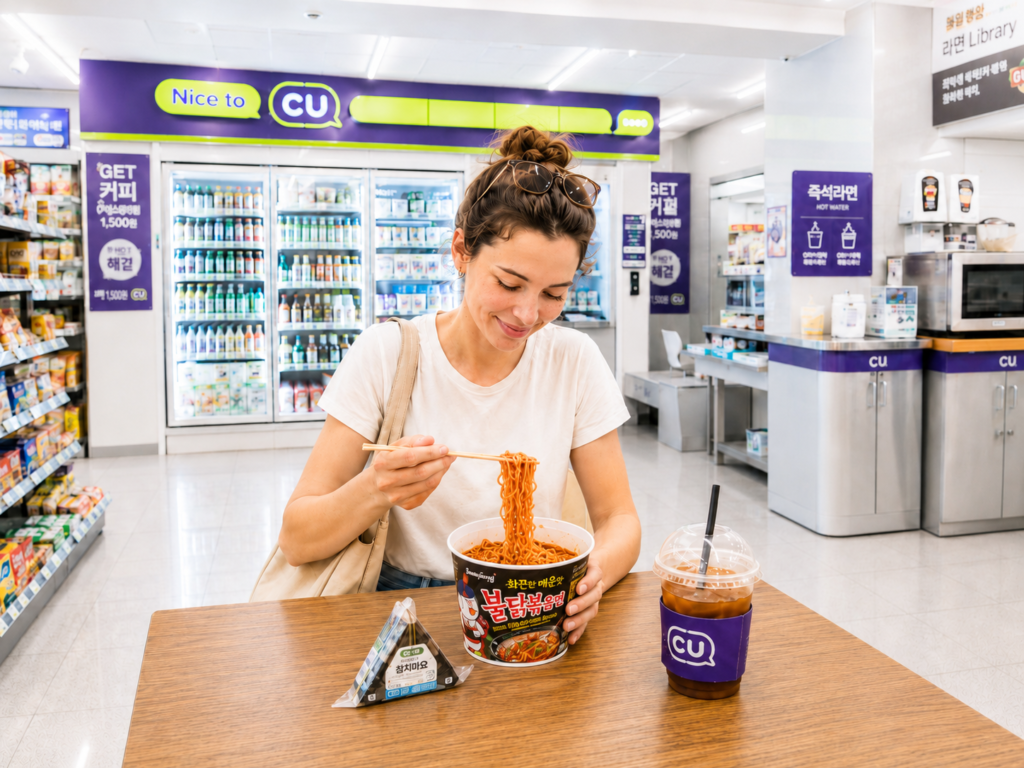
8. Instant Ramyun Tastes Better Inside the Store
Many Korean convenience stores have hot water dispensers, microwaves, and small dining areas, so it’s completely normal to prepare and eat your meal right there.
Some people keep it simple, while others add cheese, sausages, or soft-boiled eggs to create their own version of the perfect convenience store meal. In fact, you’ll find countless YouTube videos sharing creative Korean convenience store ramyun recipes.
It may sound simple, but for many travelers, eating instant ramyun inside a Korean convenience store becomes one of the most memorable experiences of their trip.
9. Limited Editions and Collaborations Move Fast
Seasonal products, limited editions, and brand collaborations regularly appear on convenience store shelves.
Because some are sold for only a short period, popular items can move quickly. Availability depends on the chain, branch, and timing.
Even when you are not looking for a specific product, browsing the latest snacks, drinks, and desserts can be part of the fun.
10. Different Chains—and Even Different Branches—Can Stock Different Things
CU, GS25, 7-Eleven, and emart24 each have chain-exclusive products, so an item sold by one chain may not be available at another.
Stock can also vary between branches of the same chain depending on the store size, neighborhood, and available shelf space.
If you cannot find a product at one store, do not assume it is unavailable throughout Korea. Another branch—or another chain—may have something different.
Practical Korean Convenience Store Tips
11. Save Your Free Item for Another Day
Some convenience store chains offer app-based features that let eligible members save promotional items for later, but the exact rules depend on the chain, promotion, account, and app.
This does not mean every 1+1 or 2+1 item can be stored digitally. Check the conditions of the specific promotion before relying on the feature.
For short-term travelers, it may not be practical because a Korean phone number, membership account, and an eligible promotion may be required.
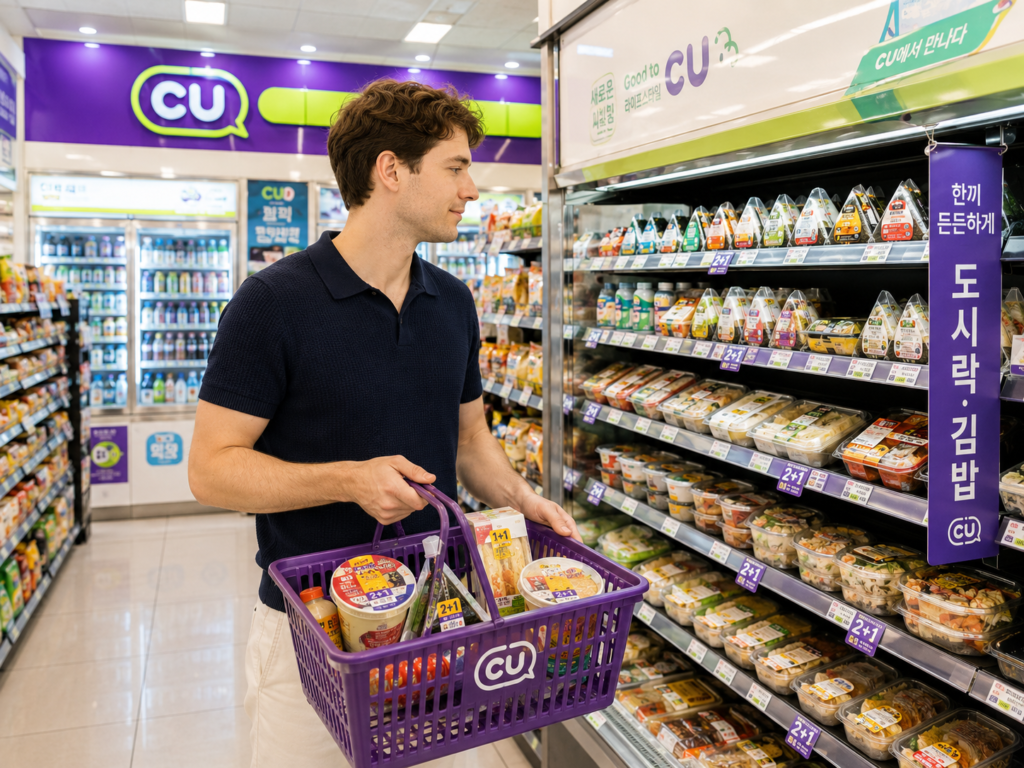
12. Check the Shelf Tags Before You Choose
Before choosing between similar items, check the small shelf labels beneath them.
These tags can show 1+1, 2+1, member-only discounts, or limited-time promotions. Two similar drinks may cost nearly the same, while one comes with an additional item.
Spending a few seconds reading the tags can help you compare the actual deal before you buy.
13. Convenience Stores Are Useful for Small Everyday Problems
Convenience stores can be useful when you suddenly need an umbrella, a phone charger, a small everyday item, a drink, or a snack.
They can also be a practical place to find a simple meal late in the day, although opening hours and product selection vary by branch.
For a small, immediate need, checking the nearest convenience store can save an extra trip to a larger shop.
14. Extra Services Depend on the Branch
Some branches offer extra services such as parcel drop-off, printing, or pickup features for online orders. These services are not available in the same way at every store.
Services vary by chain and location, so check the signs in the store or the chain’s official app or website if you need a specific service.
15. Convenience Store Food Combinations Are Part of the Fun
Mixing ready-to-eat items is an easy way to build a quick convenience store meal or snack.
Popular examples include Buldak Ramyun + cheese, triangle kimbap + cup ramyun, sausage + instant ramyun, or vanilla ice cream + espresso for a quick affogato-style dessert.
You can use these as starting points or simply combine products that appeal to you. Availability varies, so the options will depend on what that branch has in stock.
Convenience Store Mistakes Travelers Can Avoid
16. Not Every Trash Bin Is Public
After enjoying a snack or a cup of ramyun, many first-time visitors naturally look for the nearest trash bin.
However, not every convenience store allows anyone to use its bins. Some stores provide trash cans only for customers who purchased and consumed items there, while others do not have accessible bins.
If you eat food purchased at the store in a designated eating area, follow that branch’s signs and use the bins it provides. Seating and waste-disposal arrangements vary by location. Do not bring in or leave trash from elsewhere.
Following the store’s instructions shows consideration for both staff and other customers.
17. Why Is the Cashier Giving Me Another One?
You pay for a promotional item, and just as you are about to leave, the cashier may tell you to take another one.
Convenience stores regularly run 1+1 and 2+1 promotions. Depending on how the items are displayed, you may need to bring the qualifying extra item to the counter yourself, so the cashier may point it out before you leave.
Check the shelf tag and make sure you have the correct number of eligible items before paying.
Final Thoughts
At first glance, Korean convenience stores may look just like the ones you’ve seen back home. But after spending a few days in Korea, you’ll realize they’re something entirely different.
They’re not just places to buy snacks. They’re part of everyday life—where people grab breakfast on the way to work, enjoy a late-night meal, discover new food trends, meet friends, or simply stop by because it’s on the way home.
That’s what makes them so interesting. They aren’t tourist attractions, yet they offer one of the easiest ways to experience everyday Korean culture.
Korean convenience stores are easy places to notice small parts of everyday life—from promotion tags and instant meals to branch-specific services and seasonal products.
You do not need to treat them as a tourist attraction. Just slow down, check the shelf labels, try something that interests you, and pay attention to how the store is actually being used around you.
Frequently Asked Questions
Which Korean convenience store chain is the best?
There isn’t a single “best” chain. CU, GS25, 7-Eleven, and emart24 each have their own exclusive products, promotions, and specialties. If you have time, try visiting more than one.
Can I use a credit card at Korean convenience stores?
Yes. International credit cards are widely accepted, and many stores also accept mobile payments. But it is still useful to keep a little cash in Korea for transportation, markets, or card-payment problems.
For a fuller guide, read this guide to how cash and card payments work in Korea.
Are Korean convenience stores open 24 hours?
Many are open 24 hours, especially in cities. However, some smaller locations may have shorter business hours depending on the location.
Can I eat my food even if there aren’t any chairs?
Only eat inside if the store has a designated eating area, counter, or seating space. Facilities vary by branch. Many stores provide microwaves or hot-water dispensers for purchased food, but do not assume every location has the same setup.
Follow the branch’s signs for sorting and disposing of waste.
What’s one thing every visitor should try?
Make your own convenience store meal. Try pairing triangle kimbap + cup ramyun, Buldak Ramyun + cheese, or make an iced coffee using an ice cup and bottled coffee—the way many Koreans do every day.
Related Guides
Want to experience more everyday Korea like a local?
These guides will help you understand the small habits behind Korean food, cafés, restaurants, and daily travel.
20 Everyday Korean Habits That Can Make Your Trip Easier
Korean convenience stores are just one part of everyday life in Korea. This guide shows you more local habits visitors often miss.
→ Read the local habits guide
How to Order Food in Korea Like a Local: 11 Essential Tips for First-Time Visitors
From kiosks to table bells, ordering food in Korea can feel different at first. This guide helps you order with confidence.
→ Read the food ordering guide
For official Korea travel information, you can also visit the Korea Tourism Organization website.
→ Visit Korea Tourism Organization