
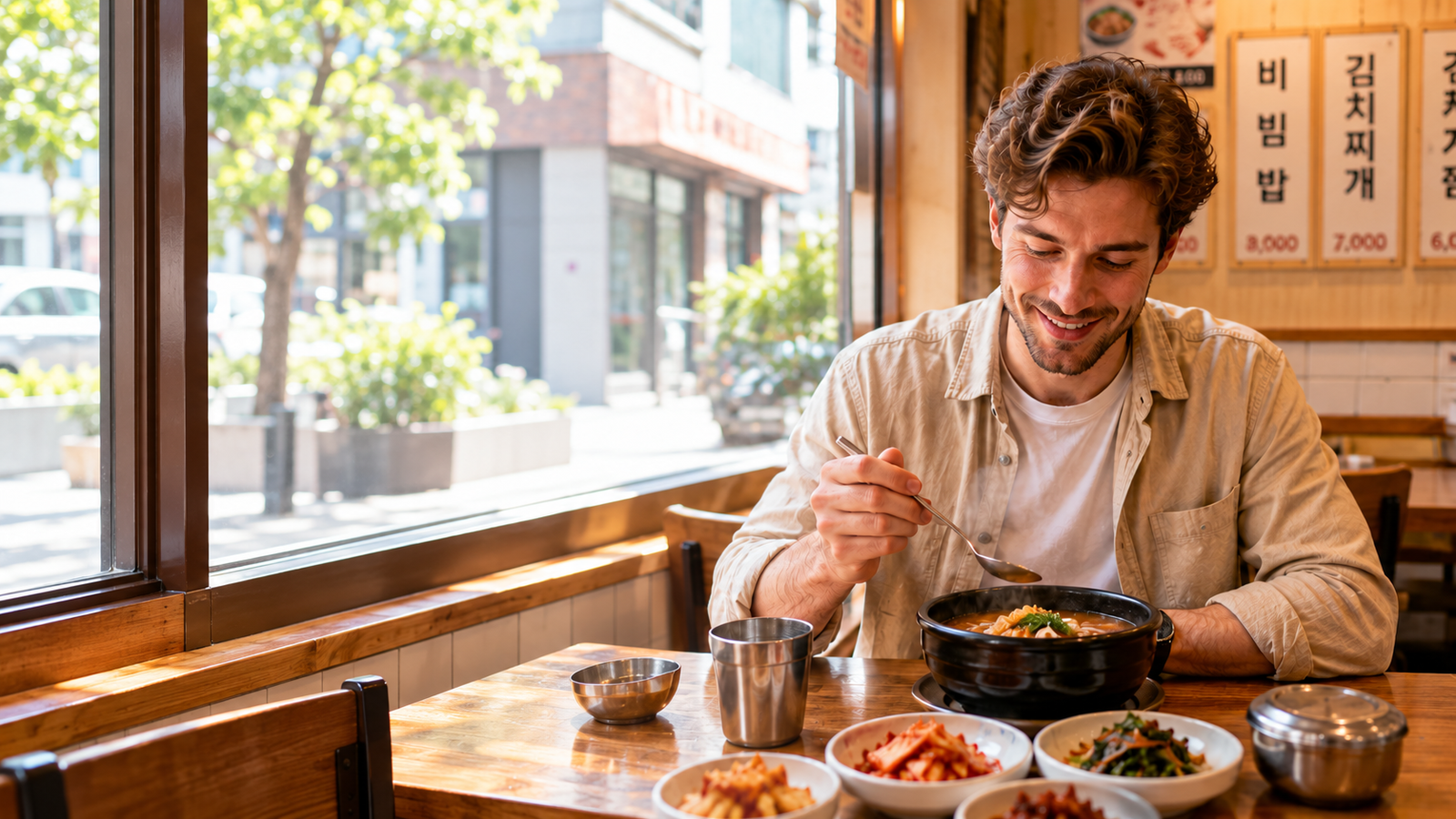
Solo dining in Korea is normal.
The awkward part is usually not being alone. It is choosing a restaurant or dish that was designed for one person.
A bowl of gukbap, noodles, bibimbap, kimbap, or a simple rice meal can be completely routine to eat alone. A barbecue restaurant, dakgalbi place, or restaurant built around a large shared pot can be different.
That is the useful distinction for travelers:
Korea is solo-dining friendly, but not every menu is solo-diner friendly.
Once you understand that, honbap — 혼밥, eating alone — becomes much easier to navigate.
Is Eating Alone in Korea Really Normal?
Yes.
People eat alone for ordinary reasons: a work schedule does not match anyone else’s, a student wants a quick meal, someone is on the way home, or they simply do not feel like organizing dinner with another person.
You will see solo diners in soup restaurants, noodle shops, kimbap places, food courts, fast-casual restaurants, and many newer restaurants with counters or small tables.
That does not mean every restaurant welcomes one person at every time.
The important difference is between social acceptance and restaurant setup.
Nobody may care that you are alone, while the restaurant may still serve its main dish only in two-person portions.
That is why a solo traveler can feel completely comfortable in one restaurant and unexpectedly awkward at the next one.
Where Is Solo Dining Easiest in Korea?
The easiest solo meals are usually dishes already portioned for one person.
Good examples include:
- gukbap and other soup-and-rice meals
- kalguksu or other noodles
- bibimbap
- kimbap and simple bunsik meals
- rice bowls
- many food-court meals
- restaurants with counter seating or one-person sets
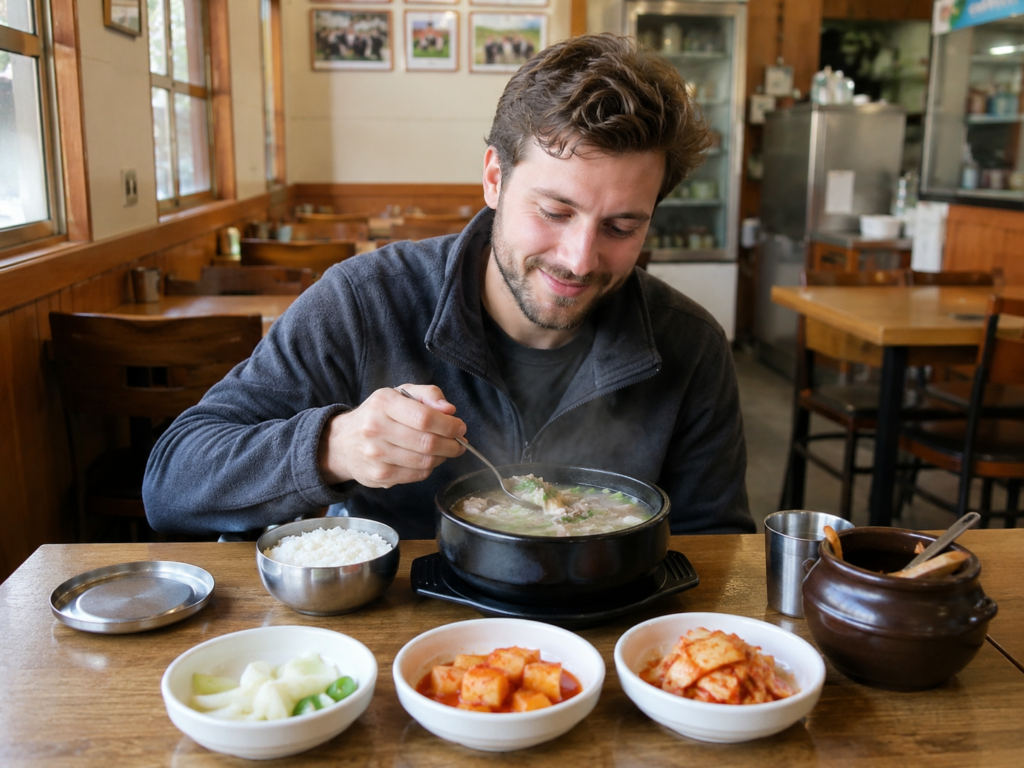
These places usually make the decision easy because the menu already answers the question: one dish, one person.
If I were tired, hungry, and did not want to negotiate with a menu, I would look for exactly this kind of restaurant.
A small local soup restaurant can actually be easier for a solo traveler than a famous restaurant that looks more “tourist friendly.”
The room may be plain, but the food format is simple.
Why Can One Person Enter but Still Be Asked to Order Two Servings?
Because one customer and one serving are not the same thing.
This is one of the most useful things to understand about eating alone in Korea.
A restaurant may be perfectly willing to seat one person but still require two portions of its main dish.
That can happen with meat, grilled dishes, shared pots, dakgalbi, or other foods that are prepared around a table setup rather than as one individual bowl.
So the question is not only:
“Can I eat here alone?”
It can also be:
“Can I order just one serving?”
Those are different questions.
If the menu is built around shared food, do not assume that seeing one empty chair means a one-person order is available.
Can You Eat Korean BBQ Alone?
Sometimes.
But I would never assume it.
Some Korean BBQ restaurants accept solo diners without any problem. Some have one-person sets. Some will seat you alone but require at least two servings of meat. Others may prefer not to take a one-person table during a busy dinner period.
That is usually an operational issue, not a judgment about eating alone.
A barbecue table uses a grill, ventilation, side dishes, staff attention, and a full table that might otherwise seat several customers.
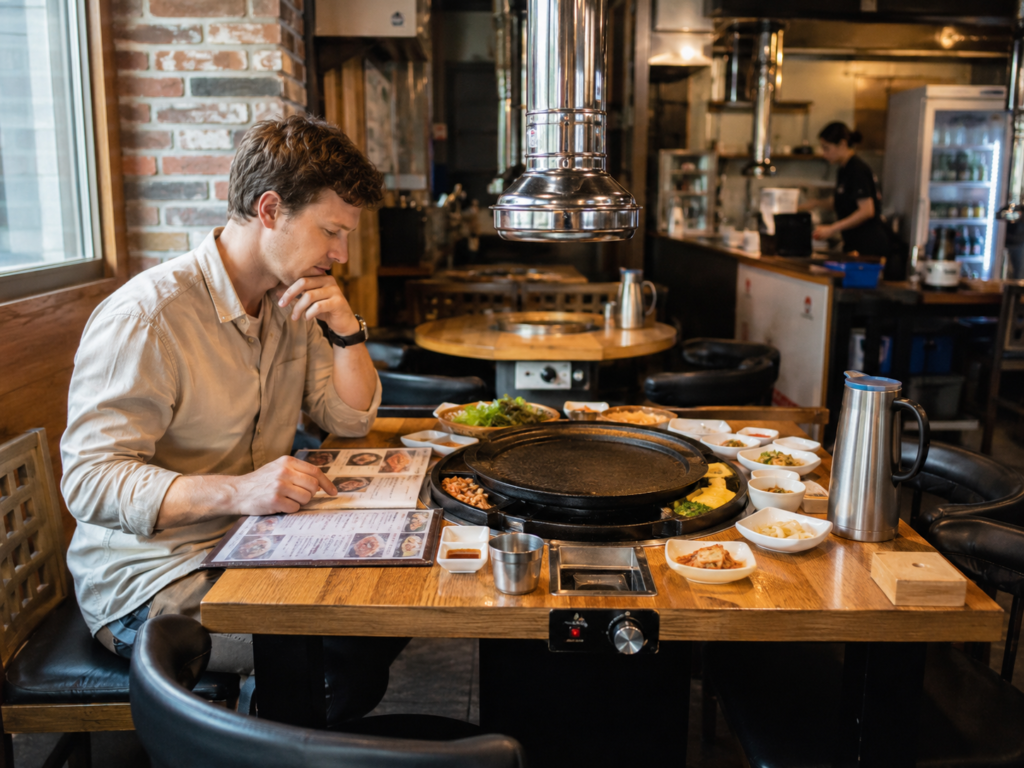
At a quiet time, one person may be easy to accommodate.
At 7 p.m. on a busy Friday, the same restaurant may make a different decision.
If Korean BBQ is an important part of your trip, check the restaurant before making it your only dinner plan.
Our separate Korean BBQ guide covers the restaurant setup in more detail.
Which Korean Foods Are Harder to Order Alone?
The most difficult dishes are usually the ones designed to be shared.
Examples can include:
- large jeongol hot pots
- budae jjigae served as a shared pot
- gamjatang
- dakgalbi cooked on a large table grill
- some barbecue menus
- set menus priced for two or more people
That does not mean you can never eat them alone.
It means you should check the portion rule before sitting down.
Some restaurants now offer smaller or one-person versions. Others still use the traditional shared format.
The dish name alone is not always enough to tell you which version you are looking at.
How Can You Tell If a Restaurant Is Solo-Friendly?
Before walking in, look for practical signals.
A restaurant is usually easier for one person if you see:
- counter seats
- small two-seat tables
- kiosks
- individual trays
- one-person sets
- menu items clearly priced as single portions
On Naver Map, searching 혼밥 together with the food or neighborhood can also surface places that recent diners describe as comfortable for eating alone.
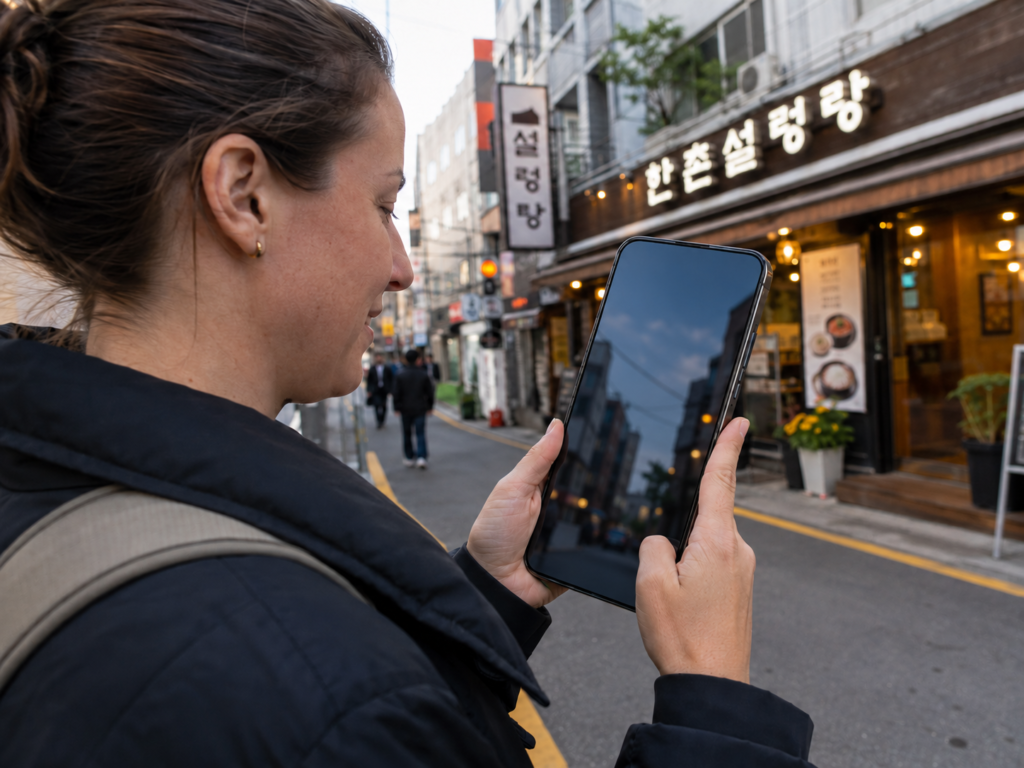
Recent reviews are useful because restaurant policies can change.
A place that accepted solo diners last year may have changed its menu or minimum order, and the opposite can happen too.
If you are going somewhere famous, save one or two nearby backups.
That turns a possible refusal into a two-minute change of plan instead of a ruined dinner.
What Korean Phrase Should You Use Before Sitting Down?
The most useful question is:
혼자인데 식사 가능할까요?
Honja-inde siksa ganeunghalkkayo?
“I’m alone — is it possible to eat here?”
If the restaurant says yes but the main dish looks like a shared menu, you can also ask:
1인분 주문 가능해요?
Il-inbun jumun ganeunghaeyo?
“Can I order one serving?”
These two questions solve different problems.
The first asks whether one person can dine there.
The second asks whether the food itself can be ordered as one portion.
You do not need much more Korean than that for this situation.
For tablets, kiosks, call bells, menu prices, and the actual ordering process, see our How to Order Food in Korea guide.
What If a Restaurant Says No?
Move on.
A refusal usually tells you more about the restaurant than about solo dining culture in Korea.
The menu may require two portions. The table may be built around a large grill. The restaurant may be full. Or the owner may simply know that one person will be difficult to serve efficiently at that moment.
You do not need to argue with the rule or take it personally.
This is also why I would not say, “Korea is easy for solo dining,” and leave it there.
That sentence is true in daily life but incomplete for travelers.
The more accurate version is:
Eating alone is normal. Choosing a one-person-friendly menu is the part that matters.
Once you start looking at the menu format instead of worrying about whether people will judge you, solo dining in Korea becomes much simpler.