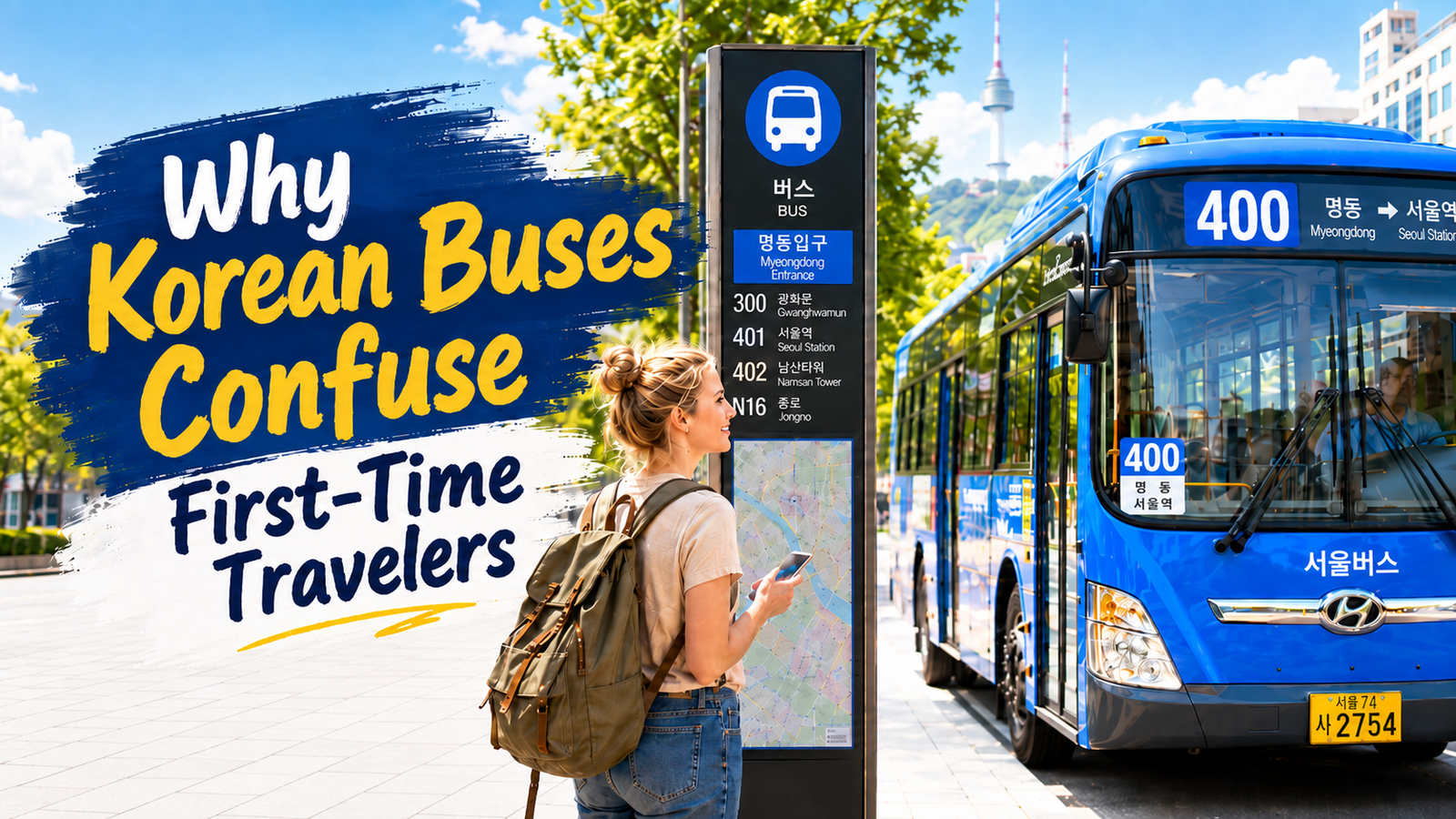
Learning how to ride a bus in Korea often begins with a small, unexpected moment.
The bus is three minutes away. Then one minute. Suddenly, three buses arrive at the same time.
You look up from your phone, but your bus has stopped farther down the road. People are already moving toward it. You hurry to the front door, tap your card, and barely have time to grab a handrail before the bus pulls away.
A few stops later, another question comes to mind: Were you supposed to tap your card again when getting off?
This is why Korean buses can feel harder to use than the subway, even when the route looks simple on a map. The difficult part is not one strange rule. It is the speed at which you have to notice small clues—the bus color, route number, bus stop number, blue bus lane, card reader, announcement, and bell.
Once you know what those clues mean, riding a bus in Korea becomes much less intimidating. This guide focuses on the part that happens after you have already chosen the bus route: finding the correct stop, boarding the right bus, paying correctly, and knowing when to get off. For broader decisions about subways, buses, taxis, and airport transfers, see Getting Around Korea: 6 Easy Subway, Bus, Taxi & Airport Tips.
Table of Contents
Before You Ride a Bus in Korea
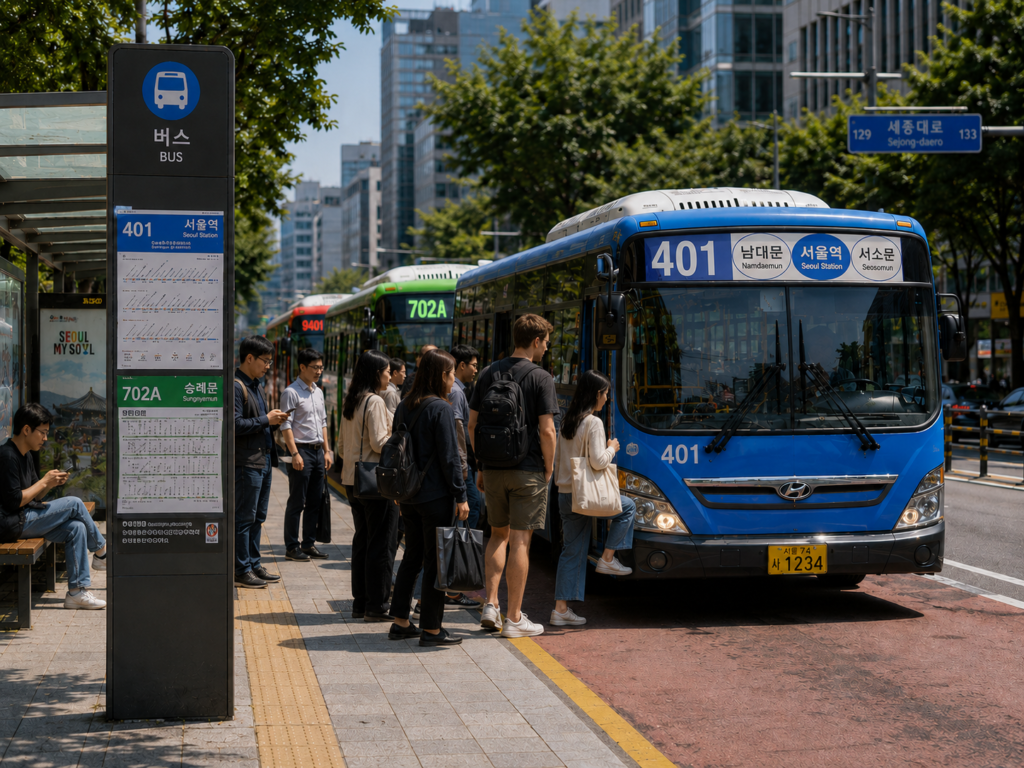
1. The Stop Name Is Not Enough—Check the Stop ID and Direction
You find the stop name in your map app, walk to the sign, and wait. The bus number is correct—but when it arrives, it heads in the opposite direction.
Stops on both sides of a road often have similar, or even identical, names. The safer clue is the small stop ID shown on the sign and in Naver Map or KakaoMap.
Before waiting, compare the ID in the app with the one at the actual stop. Then glance at the next two or three stops on the route. If they appear in the correct order, you are probably facing the right direction.
Save the stop ID, not just the stop name. It is the quickest way to avoid beginning your trip in the wrong direction.
For someone who uses Korean buses regularly, the stop name alone rarely feels like enough information. The direction and the next few stops are often checked almost automatically.
2. Bus Colors and Numbers Can Hint at Where the Bus Comes From
A red bus marked 9201 pulls into the stop. It is longer, looks more like a coach, and is probably not making a short trip around the neighborhood.
In Seoul, blue buses mainly connect major areas across the city, while green buses handle shorter local routes and connections to subway stations. Red buses usually travel farther, linking Seoul with surrounding parts of the metropolitan area.
Locals can sometimes make a rough guess about a red bus’s origin from its number. Similar number groups may serve the same general area, such as Bundang, Hanam, or Incheon.
You may also notice smaller neighborhood buses called maeul buses (마을버스). They often look like yellow minibuses, although their colors vary by area. These buses connect apartment complexes, residential streets, and hilly neighborhoods with nearby subway stations or larger bus routes. You can use T-money or another compatible transit card on them, just as you would on a regular city bus.
But do not treat the numbers as a secret code you need to memorize. Seoul, Gyeonggi Province, and Incheon do not share one perfectly unified numbering system. Bus colors are useful in Seoul and the surrounding metropolitan area, but color systems differ in other Korean cities. Treat the color as a clue, not a nationwide rule, and always confirm the actual route in your map app.
3. Why Is the Bus Stop in the Middle of the Road?
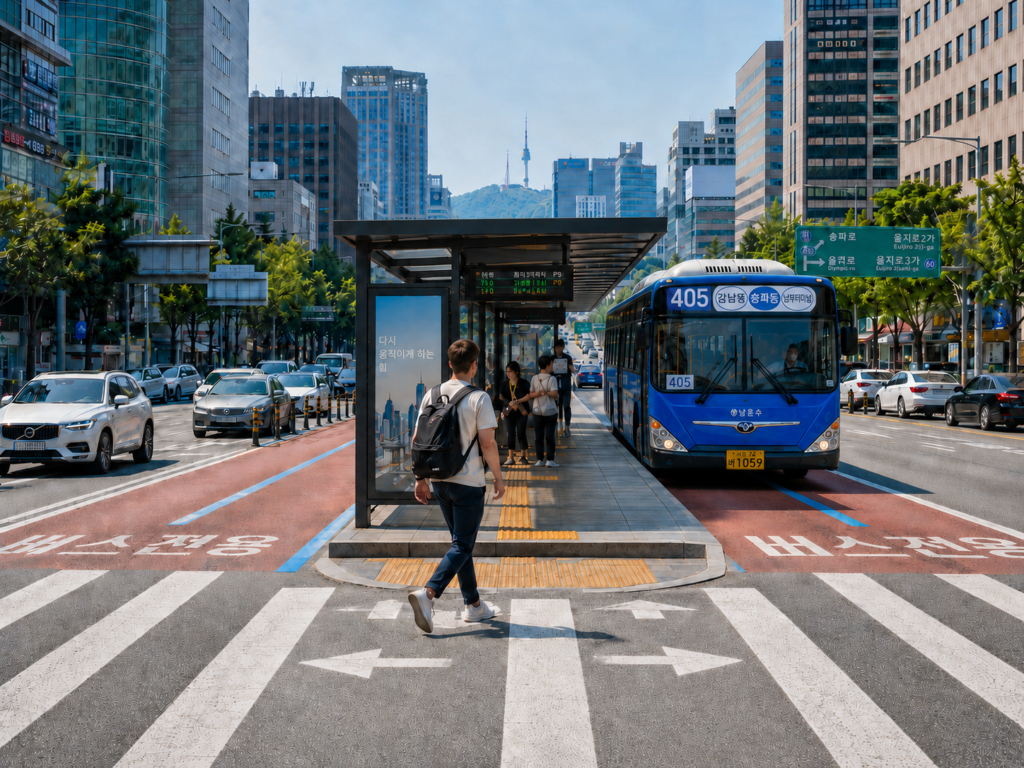
Your map says the bus stop is directly ahead. The only problem is that it appears to be sitting in the middle of an eight-lane road.
This is not a mapping error. Many major roads in Seoul have median bus lanes, with bus stops built in the center of the road. Passengers reach them through marked crosswalks while traffic continues moving on both sides.
Blue lines mark bus-only lanes, and many median bus lanes are also paved red to make them easier to recognize. The pavement may look faded or slightly pink in some places, but it is officially classified as red.
Many major Seoul roads use median bus lanes, while curbside and bus-lane operating rules can vary by road and posted hours. Follow the signs at the actual location.
Once you reach the median platform, check the direction again. Stops with the same or similar names may serve buses traveling in opposite directions, even when the platforms are only a few steps apart.
For an official overview of Seoul’s bus system and bus types, see the Seoul Metropolitan Government’s bus guide.
When the Bus Arrives, Everything Happens Fast
4. Board Through the Front Door—and Hold On First
When you ride a bus in Korea, have your transit card ready before the doors open.
The doors open, you tap your transit card, and before the card is back in your wallet, the bus is already moving.
Most Korean city buses use the front door for boarding and the rear door for getting off. One thing that feels normal to Korean commuters but can surprise visitors is how quickly the bus may move once boarding is finished. Locals tend to tap first and secure themselves before checking a phone or looking for the ideal seat.
If several buses arrive together, yours may stop farther ahead than expected. Keep the route number visible and approach only after the bus has stopped safely.
Traveling with a suitcase or shopping bags? Secure them first. Finding the perfect seat can wait.
Getting Off Is Where Most Travelers Hesitate
5. Tap Again When You Get Off—You Are Not Paying Twice
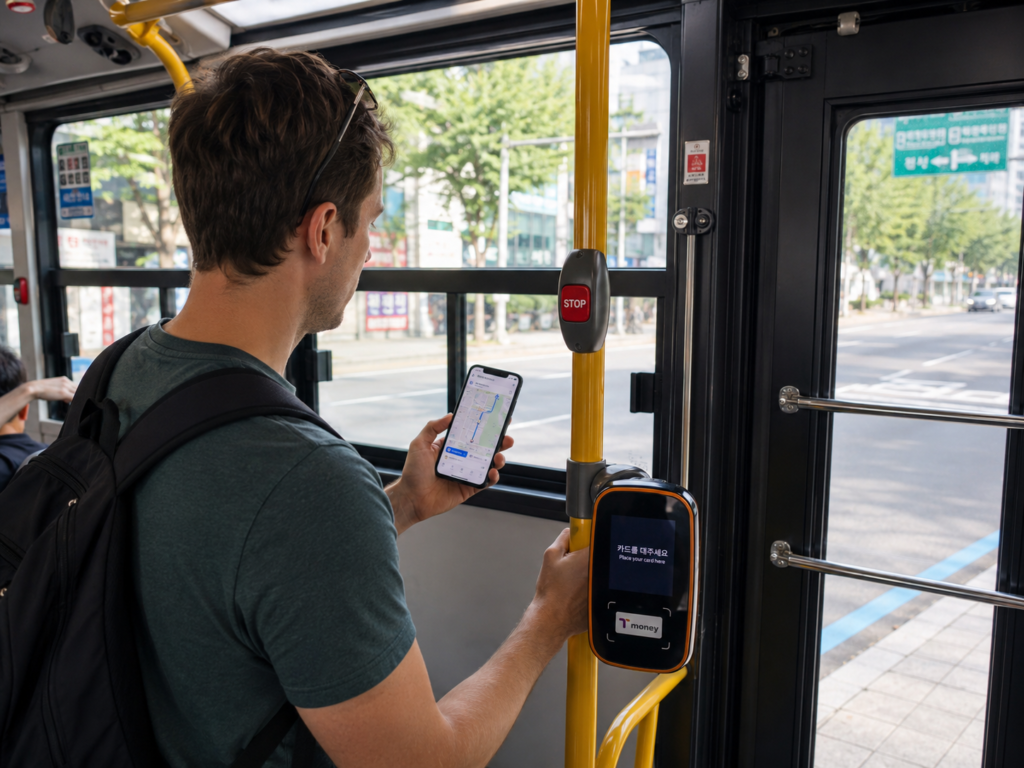
When passengers get off a Korean bus, they tap their transit cards again at the rear door. This does not mean they are paying twice.
The second tap tells the system where the ride ended. In the Seoul metropolitan integrated-fare system, it is also needed for transfer discounts.
If you forget to tap off, you may lose the transfer discount and pay an extra fare the next time you use the card.
In Seoul, you normally have 30 minutes to transfer after getting off. Between 9 p.m. and 7 a.m., the transfer window is 60 minutes. See the official Seoul bus guide for the metropolitan transfer rules.
The easiest rule is simple: tap when you get on, and tap again when you get off.
6. “This Stop” and “Next Stop” Are Easy to Mix Up
Your destination appears on the screen, so you stand up—only to realize that the bus has not reached it yet.
Many city buses, especially in Seoul, announce both the current stop and the next stop in Korean and English. Listen for these two Korean phrases:
- 이번 정류장은 (ee-buhn jung-nyoo-jahng-uhn) — “This stop is…”
- 다음 정류장은 (dah-um jung-nyoo-jahng-uhn) — “The next stop is…”
The announcements often come close together, and long or similar stop names can still be confusing. Keep the route open in Naver Map or KakaoMap and check how many stops remain. Korean passengers often start preparing before the bus reaches the stop. Waiting until you hear the full stop name, look up the route, collect your bags, and then decide can feel surprisingly rushed.
You do not need to understand the entire announcement. Once you recognize “다음 정류장은,” listen for your destination and prepare to get off.
7. Press the Stop Bell Before the Bus Reaches Your Stop
Your destination is next, but the driver does not automatically know that you want to get off.
Press one of the red STOP buttons before the bus reaches your destination. If another passenger has already pressed it, the button will light up, so you do not need to press it again.
Do not wait until the bus has completely reached the stop. Press the bell as soon as your destination becomes the next stop, then gather your belongings and move toward the rear door when it is safe.
If you miss your stop, stay calm. Get off at the next one and use your map app to find the safest way back.
Final Thoughts
Riding a bus in Korea becomes much easier once you know what to check before boarding and getting off.
What feels fast and automatic to someone who rides Korean buses every day can feel like several decisions happening at once on a first trip.
The stop ID helps you find the correct direction. The bus color and number give you clues about the route. Median bus lanes explain why some stops sit in the middle of the road, and tapping your transit card again when you get off keeps fares and transfers working properly.
You do not need to memorize the entire system. The trick is not to learn every bus rule—it is to reduce each ride to a few checks: the stop, the direction, the bus number, the card tap, and the bell.
Once these habits become familiar, riding a Korean bus feels much simpler.
Frequently Asked Questions
Can I Pay Cash on a Bus in Korea?
Do not rely on cash when using city buses in Korea. Cashless operation has expanded, and payment rules differ by city and route. A compatible transit card such as T-money or EZL is the simplest option for most travelers.
Incheon, for example, has operated its semi-public city bus network on a cashless basis since January 2025. See the official Incheon announcement.
Can I Tap My Foreign Credit Card Directly on a Korean Bus?
Do not rely on an overseas credit or debit card working directly on an ordinary Korean bus reader.
Seoul is developing and testing newer contactless and open-loop payment systems, but availability is not yet a nationwide standard. For a first-time traveler, a compatible Korean transit card such as T-money or EZL remains the safer default unless the specific bus or reader clearly supports another payment method.
Do not confuse Seoul’s Mobile Tmoney “Tagless” pilot with tapping any foreign contactless bank card. The Tagless pilot uses Mobile Tmoney on selected routes; see Tmoney’s official Tagless information.
Can Two People Use One T-Money Card?
On Seoul buses, one transit card can be used to pay for multiple passengers if you tell the driver the number of people before tapping. However, transfer rules become less convenient, especially when the group later changes to the subway. For travelers, one card per person is usually much simpler. See the official Seoul public transportation guide.
Can I Use T-Money on a Maeul Bus?
Yes. Maeul buses are part of Seoul’s public transportation network, and compatible transit cards such as T-money can be used just as they are on regular city buses. Tap when you board and again when you get off, especially if you plan to transfer.
Related Guides
You know how to ride the bus. Now make the rest of your journey through Korea easier.
Google Maps in Korea 2026: Naver Map, KakaoMap & What Changed
Google Maps does not work as well in Korea. Learn which map apps locals use so you can find bus stops, routes, and destinations more easily.
Getting Around Korea: 6 Easy Subway, Bus, Taxi & Airport Tips
A route may look simple on your phone but feel different once you start moving. Learn how Korea’s streets, transfers, and transportation system affect your journey.
How to Pay in Korea in 2026: Cards, Cash & Transit
Prepare the right combination of transit cards, foreign cards, and cash before your trip so you can pay and transfer without unnecessary problems.