Solo dining in Korea can feel surprisingly easy—or unexpectedly awkward. Order a bowl of bibimbap, noodles, or soup, and no one may look twice. Try the same thing at a barbecue restaurant or a place serving a large shared pot, and you may be told that the minimum order is for two people. Eating alone, or honbap (혼밥), is now a familiar part of everyday life in Korea. The challenge for travelers is usually not social awkwardness but whether a particular restaurant, dish, or table setup works for one person. The trick is not deciding whether you should eat alone, but knowing which restaurants and dishes are actually designed for one person.
Table of Contents
Eating Alone Isn’t the Problem—The Menu Is
1. Honbap Is an Everyday Habit, Not an Awkward Exception
In Korea, eating alone is no longer treated as unusual. Office workers often grab a quick lunch by themselves, students eat between classes, and many people stop for a simple dinner on the way home. Solo diners are a familiar sight in noodle shops, soup restaurants, convenience stores, food courts, and small neighborhood eateries. The Korean word honbap combines honja (혼자), meaning “alone,” with bap (밥), meaning “meal” or “rice.” The fact that it has its own everyday word shows how familiar solo dining has become.
2. One Diner Allowed Does Not Always Mean One Serving Available
A restaurant may welcome one customer but still require a minimum order of two servings. This is especially common at Korean barbecue restaurants and places serving dishes prepared on a shared grill or in one large pot. In some restaurants, you can sit alone as long as you order two portions; in others, solo customers may not be accepted at all. These rules often depend on the dish, table setup, and how busy the restaurant is. Before sitting down, check the menu for phrases such as “two servings minimum,” or simply ask whether one person can order.
The Easiest Meals for Solo Dining in Korea
3. Start With the One-Bowl Favorites Travelers Already Know
Meals prepared as a single bowl, plate, or individual tray are often among the easiest choices for solo diners. Bibimbap, naengmyeon, kalguksu, sundubu-jjigae, and many rice bowls are usually ordered one serving at a time, so the restaurant does not need to change its normal setup for one customer. These dishes are also useful for first-time visitors because the portion and price are easy to understand from the menu. Soup restaurants, noodle shops, and casual lunch spots are especially comfortable for eating alone, and you will often be surrounded by Korean solo diners doing exactly the same thing.
Areas around offices, universities, stations, and terminals often have more restaurants built around quick individual meals because solo customers are common there.
4. Go Beyond Bibimbap: Local Solo Meals Worth Discovering
Once you feel comfortable ordering alone, try dishes that many international visitors overlook. Ttukbaegi-bulgogi (뚝배기불고기) is sweet marinated beef served bubbling in a small stone pot, while galbitang (갈비탕) offers tender beef ribs in a clear, mild broth. Dwaeji-gukbap (돼지국밥), especially popular in Busan, combines pork and rice in a rich soup and is one of Korea’s most natural solo meals. Sujebi (수제비), made with hand-torn dough in a warm broth, is another comforting choice on a cold or rainy day. These dishes may be less famous abroad, but their individual portions and approachable flavors make them excellent introductions to everyday Korean food.
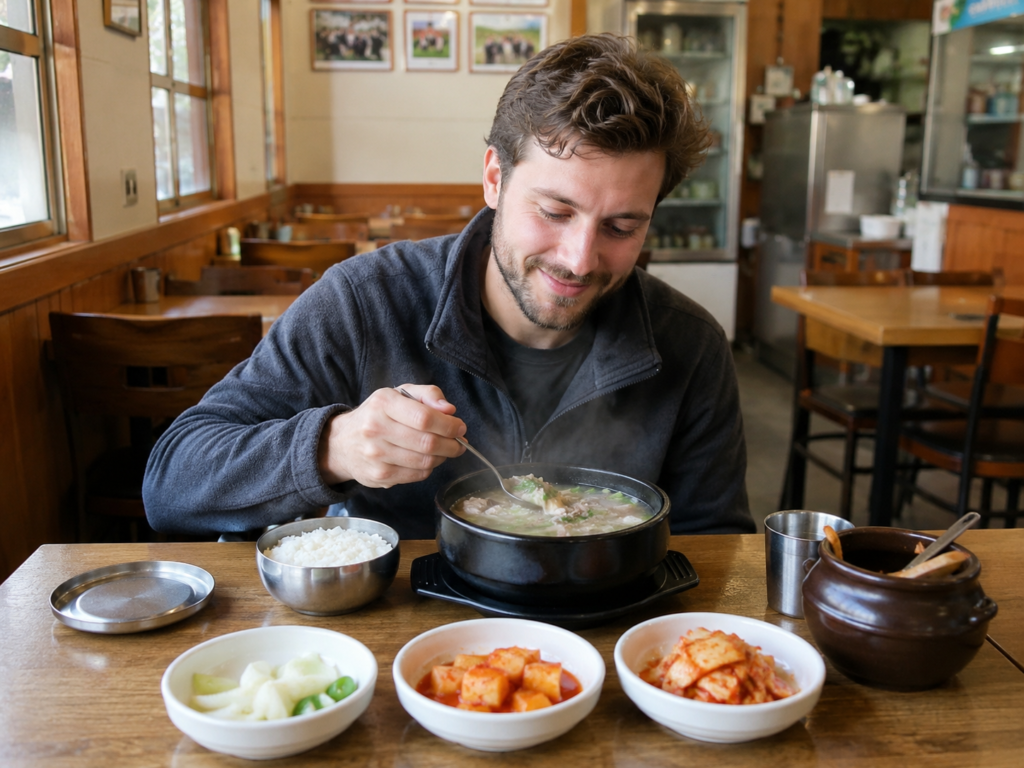
On Naver Map, search the neighborhood or station name together with the dish in Hangul—for example, “강남 돼지국밥” or “홍대 갈비탕.” This is usually more useful than searching only for “Korean food,” especially when you want a nearby restaurant serving a specific one-person meal.
5. Fast, Affordable, and Completely Normal to Eat Alone
For a quick meal, look for gimbap shops, bunsik restaurants, and casual rice-bowl counters. Gimbap (김밥), tteokbokki (떡볶이), ramyeon (라면), donkkaseu (돈가스), and deopbap (덮밥) are often inexpensive, served quickly, and easy to order for one. Many of these restaurants use compact tables, counter seats, or kiosks, so solo diners fit naturally into the space. They are also useful when you want a real meal without spending much time or money. In busy neighborhoods, you may see office workers, students, delivery drivers, and travelers all eating alone at the same time.
When One Seat Still Comes With a Two-Serving Rule
6. Korean BBQ Alone: Possible, but Never Assume
Yes, you can eat Korean BBQ or samgyupsal alone at some restaurants, but many still require at least two servings of meat. In practice, this may mean that one person can eat there as long as they order enough for two. Other restaurants may refuse solo customers, especially when every table has a large grill and the restaurant is busy. The rule can vary even between branches of the same chain, so do not rely only on online reviews.
Being allowed to enter does not guarantee that you can order one serving. Ask before sitting down, especially if the menu does not clearly show a minimum order.
7. Big Pots and Table Grills Were Built for Sharing
Some Korean dishes are difficult to serve for one because the cooking setup itself is designed for a group. Dakgalbi, gamjatang, budae-jjigae, and many hot pots are prepared in one large pan or pot placed in the middle of the table. Making a smaller version may not fit the restaurant’s ingredients, cookware, pricing, or table setup. If a restaurant says a dish requires two people, the reason is often operational rather than a negative attitude toward solo diners.
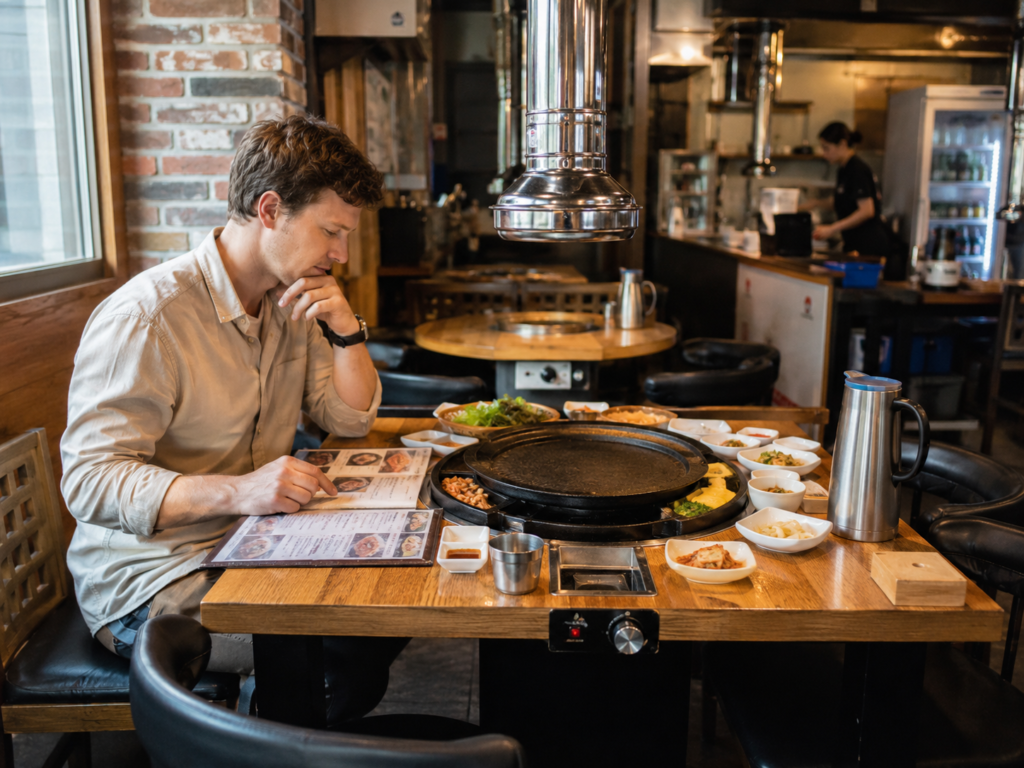
A “two-person minimum” often refers to the dish, not the number of people sitting at the table. Some restaurants may still serve one customer who agrees to order the full minimum amount.
8. Some Restaurants Say Yes—Until the Dinner Rush Begins
A restaurant that accepts solo diners during quiet hours may make a different decision once the dinner rush begins. One customer occupying a table designed for four can be difficult for a small or busy restaurant, especially at popular barbecue and shared-pot restaurants. However, many Korean restaurants close between lunch and dinner for a break time, so arriving in the middle of the afternoon is not always an option. Check the restaurant’s current hours on Naver Map before you go.
If you especially want a barbecue or shared-pot restaurant alone, visiting outside the busiest meal period may improve your chances. Check the restaurant’s current break time, last order time, and recent reviews before making a special trip.
How to Find a Solo-Friendly Restaurant Before You Walk In
9. Search the Korean Word “혼밥” on Naver Map
On Naver Map, combine the neighborhood or station name with honbap (혼밥), such as “강남 혼밥” or “홍대입구 혼밥.” This often brings up restaurants that Korean diners already consider comfortable for eating alone. Check recent reviews for phrases such as “혼자 먹기 좋아요” (good for eating alone), “1인 가능” (solo diners accepted), or “1인분 주문 가능” (one serving available). Photos can also reveal whether the restaurant has counter seats, small tables, kiosks, or individual trays.
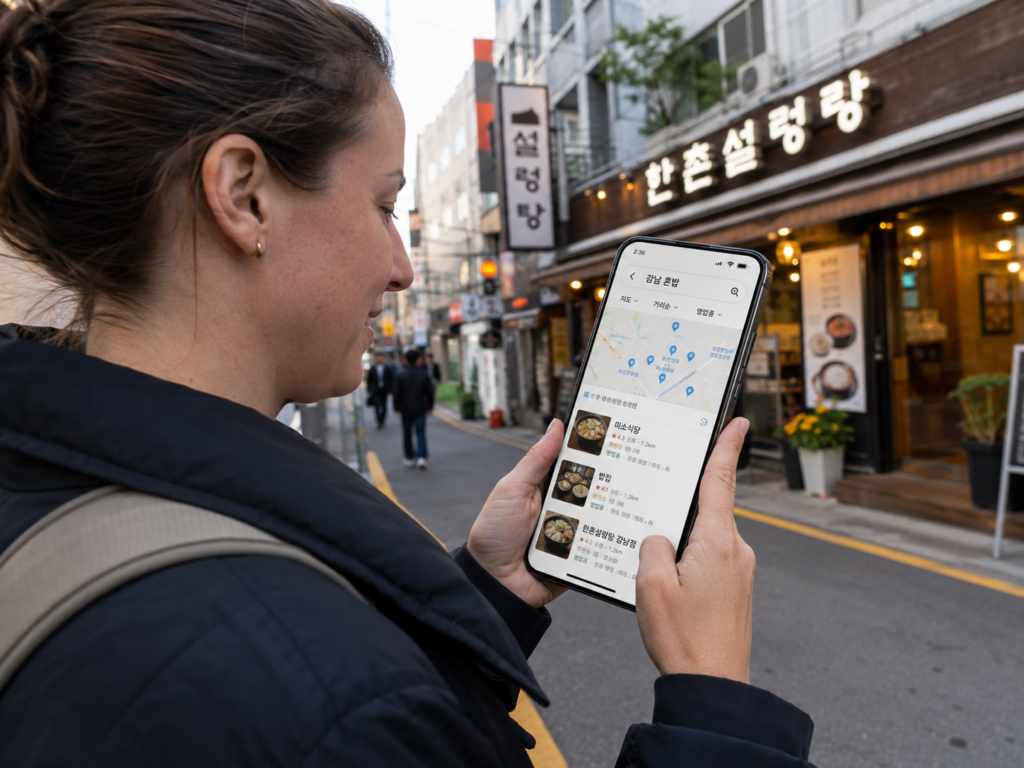
Recent Korean reviews can be more useful for checking current solo-dining policies than an older post, because management, seating layouts, and peak-hour rules can change. Even then, treat reviews as clues rather than a guarantee.
10. Look for Counter Seats, Kiosks, and One-Person Sets
The restaurant’s layout often tells you whether solo dining will feel easy. Counter seats, small two-person tables, ordering kiosks, and individual trays are all good signs. Menus that include phrases such as “1인 세트” (one-person set), “1인 메뉴” (solo menu), or “혼밥 세트” (solo dining set) are even clearer. These signals suggest that solo dining is likely to be easier, but they do not guarantee that every solo customer will be accepted at every time.
Check customer photos on Naver Map, not just the restaurant’s official images. Review photos often show the actual seating arrangement, portion size, and ordering system more clearly.
11. The One Korean Question That Prevents an Awkward Entrance
Before taking a seat, simply ask, “혼자인데 식사 가능할까요?” (Honja-inde siksa ganeunghalkkayo?), meaning “I’m alone—would it be possible to eat here?” This sounds polite and gives the staff a chance to explain any minimum-order or seating rules. At a barbecue restaurant, you can follow with “1인분 주문 가능해요?” (Il-inbun jumun ganeunghaeyo?), meaning “Can I order one serving?” A quick question at the entrance is much easier than discovering the rule after you have already sat down.
Save these phrases as a screenshot on your phone. Showing the Korean text is often easier than relying on pronunciation in a noisy restaurant.
If They Say No, It Usually Isn’t About You
12. Why a Restaurant May Turn Away One Customer
Being refused as a solo diner can feel personal, but a refusal does not necessarily mean the restaurant is unfriendly to foreigners or to people dining alone. Often, the issue is the menu, minimum order, table layout, limited staff, shared cooking, or current crowd level.
If the restaurant cannot accommodate one person, thank the staff and move on rather than trying to negotiate during a busy service.
13. Better Solo-Dining Backups Near You
If one restaurant cannot seat you, search nearby for a dish that is naturally sold in individual portions. Soup restaurants, noodle shops, gimbap shops, food courts, and department-store dining floors are often easier for solo diners than barbecue or shared-pot restaurants. On Naver Map, replace the restaurant name with the dish you want and add the neighborhood or station—for example, “명동 순두부찌개” or “강남역 칼국수.” This gives you several nearby alternatives instead of leaving you dependent on one restaurant.
When visiting a famous restaurant, a small local eatery, or somewhere during peak dining hours, saving two or three nearby backups can make changing plans much easier.
Final Thoughts: Korea Is Solo-Friendly—Once You Know What to Order
Eating alone in Korea is often easier than first-time visitors expect, but not every restaurant or menu is designed for one person. The main challenge is not social awkwardness but choosing a restaurant whose menu, seating, and minimum-order rules work for one person. One-bowl meals, soups, noodles, gimbap shops, and restaurants with counter seats are the safest choices. Barbecue, large hot pots, and table-grilled dishes may still require two servings or refuse solo diners during busy hours.
Learn a few Korean search terms, check recent Naver Map reviews, and confirm break times before you go. With the right dish and timing, solo dining can become one of the easiest ways to experience everyday Korean food.
Frequently Asked Questions
Can I Eat Korean BBQ Alone?
Yes, but the rules vary by restaurant. Some Korean barbecue restaurants accept solo diners if they order at least two servings of meat, while others offer dedicated one-person sets. A few may not accept solo customers at all, especially during busy evening hours. Check recent reviews, look for “1인 세트” on the menu, and ask “혼자인데 식사 가능할까요?” before sitting down.
Can I Order Two Servings for Myself?
Usually, yes. If the restaurant’s rule is a minimum order of two servings rather than a minimum of two people, one customer may order both portions. This is common at barbecue restaurants and places serving shared dishes. However, serving sizes can be larger than expected, and some restaurants may still prefer not to seat solo diners during peak hours. Confirm the rule before ordering by asking whether one person can order two servings.
Which Korean Foods Are Easiest to Eat Alone?
Meals served in one bowl, one plate, or an individual stone pot are usually the easiest. Bibimbap, gukbap, kalguksu, naengmyeon, sundubu-jjigae, galbitang, gimbap, and many rice bowls are commonly ordered one serving at a time. Noodle shops, soup restaurants, bunsik restaurants, food courts, and places with counter seats are also reliable choices for solo diners.
Is It Rude to Visit a Busy Restaurant Alone?
No, but timing matters. Eating alone is normal in Korea, and solo customers are not considered rude simply for entering a busy restaurant. However, a small restaurant with limited seating may be less able to accept one person at a large table during peak hours. If the restaurant is crowded, ask before sitting down and be prepared to choose another place if necessary.
How Do I Ask Whether Solo Dining Is Allowed?
Say, “혼자인데 식사 가능할까요?” (Honja-inde siksa ganeunghalkkayo?), which means, “I’m alone—would it be possible to eat here?” At a barbecue or shared-dish restaurant, you can also ask, “1인분 주문 가능해요?” (Il-inbun jumun ganeunghaeyo?), meaning, “Can I order one serving?” Showing the Korean sentence on your phone is perfectly acceptable if pronunciation feels difficult.
Related Guides
How to Order Food in Korea: 11 Practical Tips for Travelers
Learn how Korean restaurant menus, side dishes, ordering systems, and minimum-order rules work before your first meal.
Korean BBQ Restaurants: 13 Amazing Things Tourists Notice
Understand shared grills, meat portions, side dishes, and the restaurant customs that can make Korean barbecue confusing at first.
How to Pay in Korea in 2026: Cards, Cash & Transit
Find out where international cards work, when you may need cash, and how to pay smoothly at Korean restaurants and cafés.
Helpful Apps and Resources for Traveling in Korea
Learn how NAVER Map and other essential Korean travel apps can help you check restaurant hours, read local reviews, save backup options, and navigate more confidently.
Dining Together in Korea: Ordering, Sharing & Paying
Learn how shared dishes, portion sizes, cooking, and payment work when two or more people eat together.