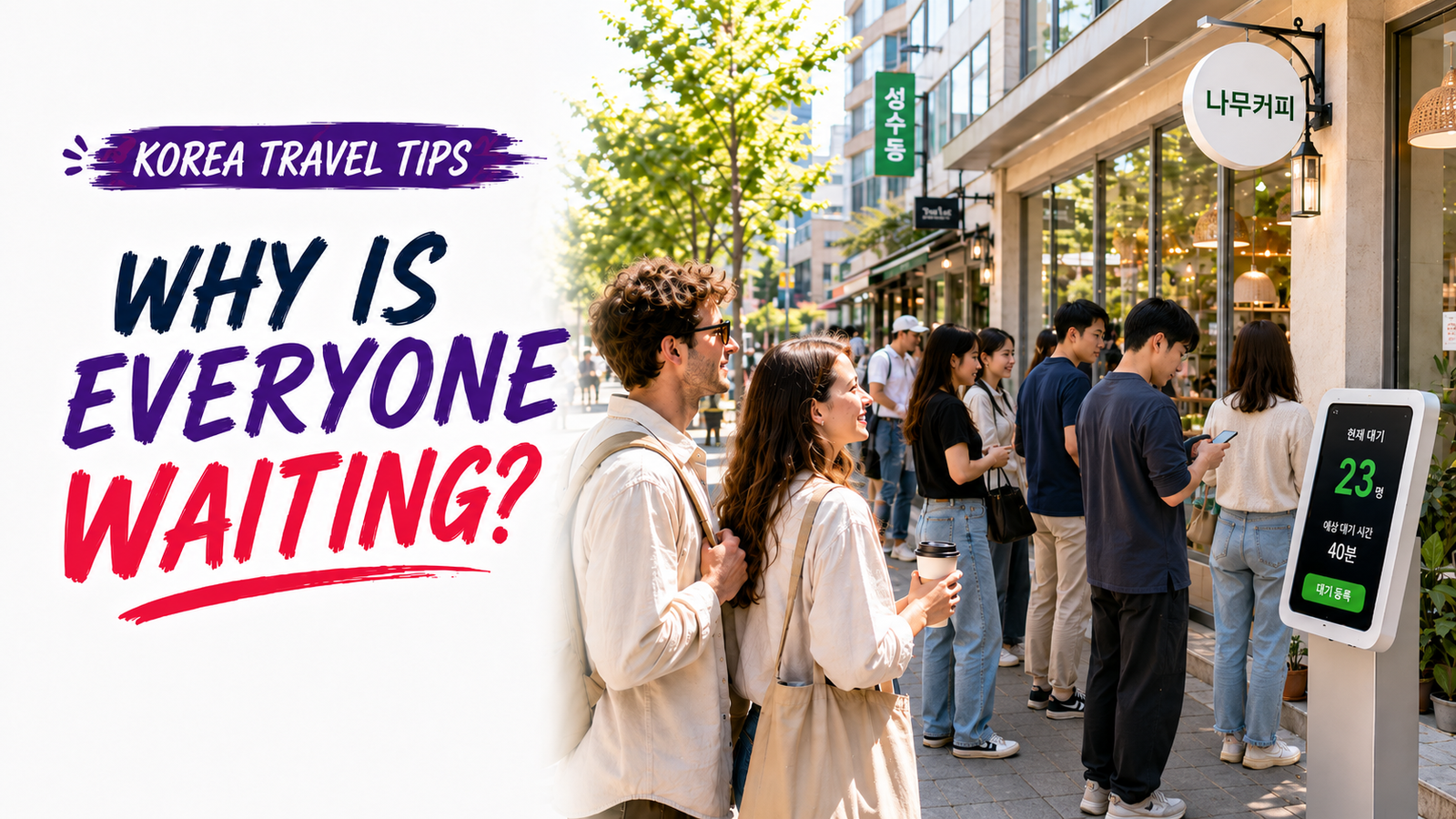
Korea is famous for speed.
Fast internet, fast delivery, fast subway transfers, fast cafés — fast everything.
So why are people still waiting outside restaurants, bakeries, pop-up stores, clinics, and cafés?
Korea’s reputation for speed can make long waits feel especially surprising. In busy neighborhoods, popular restaurants, pop-ups, clinics, and service counters, however, waiting is often managed through systems rather than one visible physical line.
In Korea, waiting does not always mean standing in one obvious line. It may mean taking a number ticket, watching a screen, registering on a tablet, using a reservation app, or holding a vibrating buzzer until your turn comes.
Waiting is often organized, but the system may not be obvious to a first-time visitor. Once you understand that, Korean waiting culture starts to make sense — and your trip becomes much easier.
Table of Contents
Why Fast Korea Still Has So Much Waiting
1. Why a Fast Country Still Has Long Lines
The first surprise is simple: a fast country can still have very long lines.
Walk through Seongsu, Yeonnam, Gangnam, or a busy department store food hall, and you may see people waiting outside a café, bakery, noodle shop, or pop-up store.
At first, it feels contradictory. Korea moves quickly, but everyone is standing still.
But popularity moves quickly too. A dessert goes viral, a restaurant appears on a food show, or a pop-up opens for one weekend — and suddenly, many people want the same experience at the same time.
That is why a line in Korea does not always mean the same thing.
Sometimes people are waiting because the food is genuinely worth it. Other times, they are waiting because the place is new, photogenic, popular online, or selling something only available for a short time.
A long line can lead to a great local experience, but popularity and quality are not always the same thing. Before joining, check what the place is actually known for and whether the experience is worth the time in your own itinerary.
2. The Line Is Often There Before You See It
For many travelers, a line means people standing in a row.
In Korea, the line is not always visible.
At restaurants, cafés, clinics, banks, and service counters, you may need to take a number ticket, add your name to a tablet, or check a waiting screen before you know where the actual wait begins.
Once people have joined the waiting list, they may sit nearby, step outside, or wait somewhere else until their turn is called. In Korea, not seeing a line does not always mean there is no line.
If you walk straight to the counter or wait in the wrong spot, you may accidentally miss your turn or confuse the order. When you arrive somewhere popular, check the entrance area first for a tablet, number ticket machine, paper waiting list, or screen before assuming you can walk right in.
For someone used to these systems in Korea, walking into a busy restaurant often starts with a quick glance near the entrance: Is there a tablet? A ticket machine? A waiting screen? For a visitor, that tiny check is easy to miss because the “line” may not look like a line at all.
Korean Waiting Culture and the Invisible Line You Might Miss
This is where Korean waiting culture can feel most confusing for first-time visitors.
3. Why Number Tickets Show Up So Often
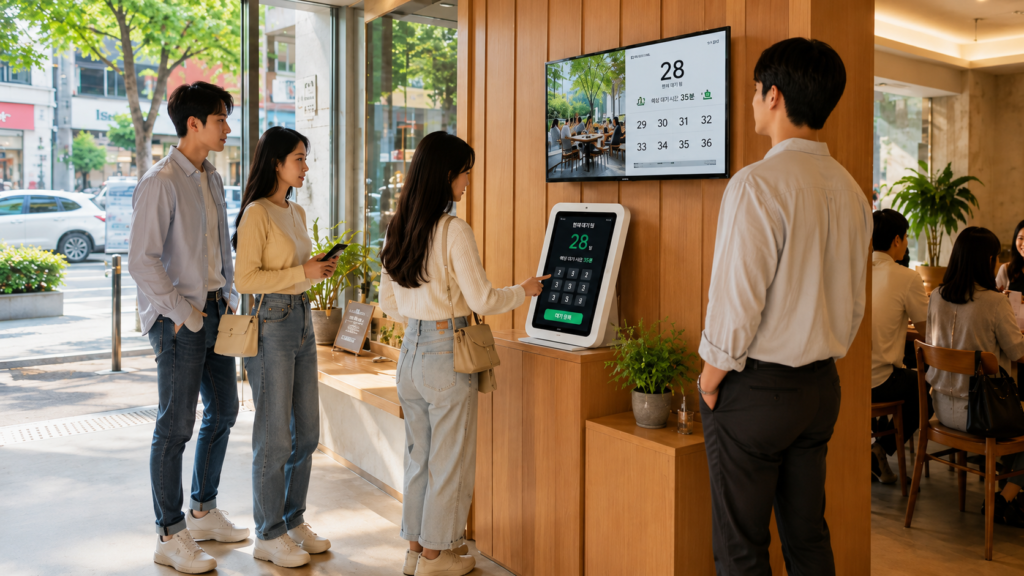
A number ticket itself is not unusual.
Many countries use them at banks, hospitals, government offices, and service counters.
What feels different in Korea is how often you may need one in everyday life.
In clinics, banks, mobile phone stores, pharmacies, food courts, and public offices, waiting may start by taking a numbered service ticket and watching a screen. Popular restaurants may instead use a table-specific waitlist.
The tools may look similar, but the purpose can differ. A bank or clinic may use a numbered service queue, while a restaurant may use a table-specific waitlist that also considers party size or reservation status.
Standing near the counter may feel like waiting, but your place may not be recorded until you use the relevant system. Before approaching the counter, quickly check the entrance area for a ticket machine, waiting screen, tablet, or small sign—and remember that the next step may differ between a service counter and a restaurant.
4. Why Is Everyone Standing Around Instead of Lining Up?
Sometimes in Korea, the strangest part is not the wait itself.
It is the way people wait.
Outside a popular restaurant or café, you may not see one clear line. People may be standing near the entrance, sitting on a bench, checking their phones, or walking around nearby.
To a first-time visitor, this can look confusing.
But often, everyone has already joined the waiting system. Their name may be on a tablet list, their phone number may be registered, or they may be waiting for a buzzer or phone notification.
Once a place has recorded the wait electronically, customers may be able to sit nearby or move around instead of remaining in one physical line.
It may look casual, but the order still matters.
If you only look for a visible line, you may miss the real waiting process: the order may be on a screen, in a tablet, or linked to a notification. If people are standing around but nobody is going inside, check near the door first or ask the staff, “Do I need to wait?”
5. What If the Waiting System Asks for a Phone Number?
This does not happen everywhere, but it can happen in Korea.
Some restaurants, cafés, or pop-up stores ask for a phone number when you join the waiting list. The system may use it to send a text message, app alert, or phone notification when your turn is close.
For Koreans, this usually feels normal because a phone number is often connected to reservations, waiting lists, deliveries, and customer service.
For travelers, it can be confusing. A data-only eSIM may give you internet access, but it may not give you a Korean phone number or SMS service. For the difference between data-only plans and plans that include a Korean number or calling features, see our Korea eSIM guide.
If an on-site tablet requires a Korean phone number, ask the staff what options are available. Some locations may be able to help manually, while others may use a system that does not support that workaround.
Korea Tourism Organization currently recommends CATCHTABLE Global as one option for international visitors. It allows users to sign up without a Korean phone number and, at participating restaurants, offers reservations and remote or on-site waitlisting. Not every restaurant uses it, and availability depends on the venue.
A phone number can sometimes be part of the waiting system, not just a way to make calls. If a tablet asks for one and you do not have it, show the staff this sentence: “한국 전화번호가 없어요. 대기 등록 도와주실 수 있나요?” It means, “I don’t have a Korean phone number. Can you help me join the waiting list?” Use it to ask whether another waiting method is available, rather than assuming manual registration will be possible.
6. Why Did Someone Who Arrived Later Go In First?
This can happen in many countries, but in Korea it may feel more confusing because the line is not always visible.
You may be waiting outside a restaurant, then suddenly see another group walk in before you.
It can feel like they skipped the line.
Often, there may be another explanation.
They may have registered earlier on an app, made a reservation, or matched the available table better. A table for two may open before a table for four.
In Korea, the real waiting order is often inside the system, not just in the people standing near the door.
Do not judge the order only by what you see outside. Earlier registration, reservations, seating availability, and party size can all affect which group is seated next. If you are unsure, check the screen or ask staff politely, “Can you check my waiting number?”
7. What If Your Number Comes Up and You Are Not There?
Korean waiting systems can move quickly.
You take a number, sit nearby, and check your phone for a moment. When you look up, your number may already be on the screen.
At restaurants, clinics, banks, and food courts, staff may call the next number if you do not respond.
What happens after a missed call depends on the venue. You may be asked to wait again, re-register, or speak with staff; in some places, staff may be able to call you again.
That is why it helps to keep checking the screen or notification while you wait.
Taking a number does not mean you can stop paying attention. Stay close enough to see the screen or hear your number, and if you miss your turn, speak with staff to find out what the venue requires next.
When Waiting Becomes Part of the Experience
8. Why Are People Waiting Before the Place Even Opens?
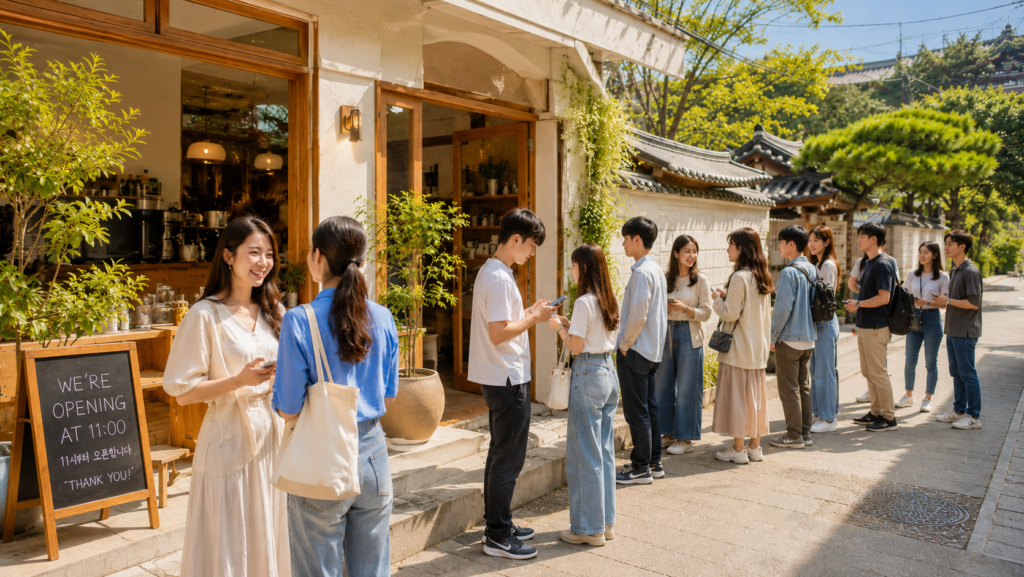
Waiting before a store opens is not only a Korean thing.
But in Korea, you may notice it in surprisingly everyday places — bakeries in Anguk (안국), cafés in Seongsu (성수), pop-up stores at The Hyundai Seoul (더현대 서울), or popular restaurants in Yeonnam (연남).
In Korea, this is often called an “open run” — or 오픈런.
People arrive early to buy a limited item, try a viral menu, or avoid a much longer wait later in the day.
For a particularly popular limited item or viral venue, arriving early can sometimes reduce the wait later in the day.
Open runs are not unique to Korea, but the term is also used here for cafés, bakeries, restaurants, pop-ups, and limited releases—not only luxury shops. For especially popular limited releases or viral venues, arriving at opening time may still mean finding a queue, so check recent reviews, opening hours, and reservation rules before you go.
9. Why Can One Viral Café Create a Line Overnight?
Waiting for a viral café is not unique to Korea.
In busy districts such as Seongsu and Yeonnam, online attention can build quickly.
If a café in Seongsu (성수) or Yeonnam (연남) becomes popular on TikTok or Instagram, a line may appear within days.
People are not always waiting only for coffee.
They may be waiting for a famous dessert, a limited menu, a beautiful interior, or the photo they want to take.
In Korea, this is often connected to 인증샷 — a photo that proves you were there.
Visitors may be drawn by different things: flavor, a limited menu, the interior, or a photo opportunity. Before waiting for a viral café, check recent reviews and photos. If most comments focus on the interior, decide whether that matches what you want from the stop.
10. How Can You Tell If a Place Is Worth the Wait?
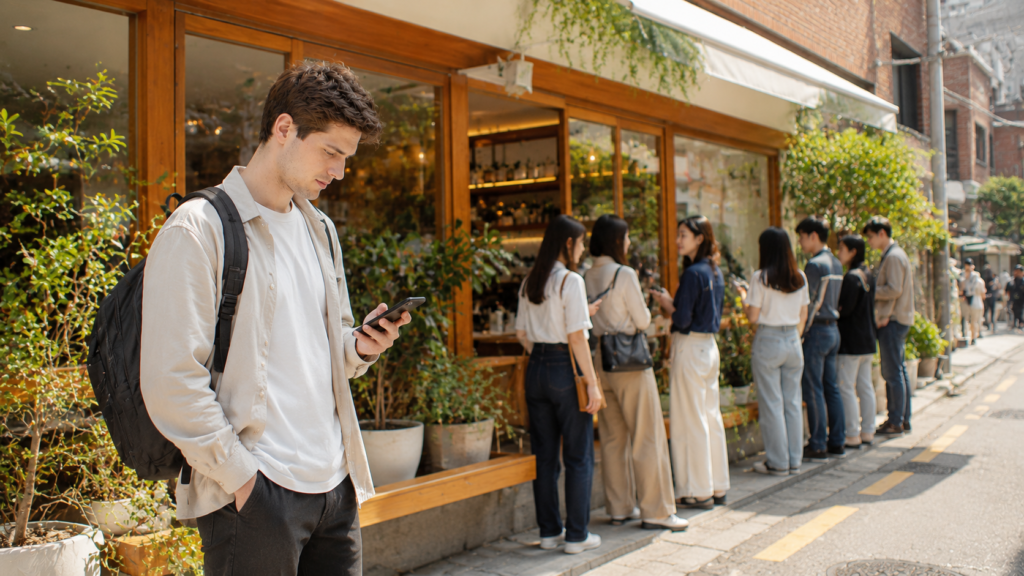
Before joining a long line in Korea, check what people are saying recently.
You do not need to understand every Korean review.
Just look for repeated clues.
If many recent reviews mention 웨이팅 — waiting — the place probably has a line. If you see 품절 — sold out — the popular item may sell out early. If you see 예약 — reservation — you may need to book ahead instead of walking in.
Photos can also help. A recent photo of a waiting tablet, number ticket machine, or line outside can tell you more than an old star rating.
The current waiting situation may be easier to understand from recent reviews and photos than from an older overall rating. Search the place name and check the newest posts first; even if the translation is imperfect, repeated words like 웨이팅, 품절, and 예약 can help you judge whether the wait is worth your travel time.
Final Thoughts
Waiting in Korea may look confusing at first, but there is usually a system behind it.
The useful habit is simple: check how the venue records its queue, pay attention to your turn, and ask staff when the process is unclear.
In Korea, the smartest traveler is not the person who waits the longest.
It is the person who knows when to wait — and when to move on.
Frequently Asked Questions
Do Koreans really wait this much?
Not everywhere. You will notice it most at popular restaurants, cafés, bakeries, clinics, pop-ups, and trendy areas like Seongsu (성수) or Yeonnam (연남).
Do I need a Korean phone number to join a waiting list?
Not always. Some waitlists require a Korean number, while others do not. Ask the venue about alternatives, and at participating restaurants, CATCHTABLE Global may allow international visitors to join a waitlist without a Korean phone number.
Is it worth waiting in long lines in Korea?
Sometimes. Before waiting, check recent reviews, photos, and words like 웨이팅, 예약, or 품절.
Related Guides
Want to understand Korea before you stand in the wrong line?
These guides will help you move, eat, and search like a local.
How to Order Food in Korea: 11 Practical Tips for Travelers
Learn what to expect when ordering at Korean restaurants, from menus to table habits.
→ Read the restaurant ordering guide
Google Maps in Korea 2026: Naver Map, KakaoMap & What Changed
Understand why local map apps matter when checking reviews, directions, and places in Korea.
→ Read the Korea map apps guide
Your Korea eSIM Has Data — So Why Can’t You Make a Call?
Understand the difference between data-only service and plans with a Korean phone number or calling features.
→ Read the Korea eSIM guide