

Looking for public restrooms in Korea when you urgently need a toilet? Start with a subway station, a large café or fast-food restaurant, or a public facility such as a museum or park.
But the closest building is not always the easiest place to use a restroom.
In Korea, a small café may share a toilet with other businesses in its building. A convenience store may not have a customer restroom. And a subway station restroom may be on the opposite side of the fare gates.
Those details matter when you don’t have time to wander around.
Here’s how I would decide where to go first—and what to do when the obvious choice doesn’t work.
Where Can You Find Public Restrooms in Korea Quickly?
The best place depends on what’s immediately around you.
If I’m walking through a busy shopping neighborhood and see a large café or fast-food restaurant, that’s often my first choice. These businesses are easy to recognize, and asking for the restroom usually feels straightforward.
If there’s a subway station nearby, that’s another useful option, particularly in Seoul.
At a museum, palace, park, or major tourist attraction, I would look for an on-site restroom before leaving the grounds.
My usual order is simple:
- Large café or fast-food restaurant nearby: Check there first.
- Subway station nearby: Follow the restroom signs, but check which side of the gates the toilet is on.
- Already inside a tourist attraction: Look for the facility’s own restroom.
- Nothing obvious nearby: Search
화장실on a Korean map or use Seoul’s public restroom map. - Only a convenience store nearby: Ask rather than assuming it has a customer toilet.
These are practical starting points, not guarantees. Opening hours, building access, and restroom policies vary.
Can You Use the Restroom in a Korean Café?
Often, yes—but finding it can be less obvious than you expect.
Imagine walking into a small café, asking for the toilet, and hearing:
“Go outside and turn right.”
That sounds strange if you’re expecting the restroom to be inside the shop.
In many Korean commercial buildings, several businesses occupy separate units but share facilities elsewhere in the building. The restroom might be down a corridor, near the stairs, or just outside the café’s entrance.
Sometimes there’s a keypad on the restroom door.
That doesn’t automatically mean the toilet is reserved for employees. The building may use a shared access code, which staff can provide when appropriate.
If you can’t find the restroom, ask before walking through an unfamiliar hallway.
A large café or fast-food restaurant can feel simpler when you’re in a hurry, but don’t assume every location offers unrestricted restroom access. Some facilities are intended for customers, and individual businesses set their own rules.
The useful thing to remember is that a restroom outside the café can still belong to the building the café uses.
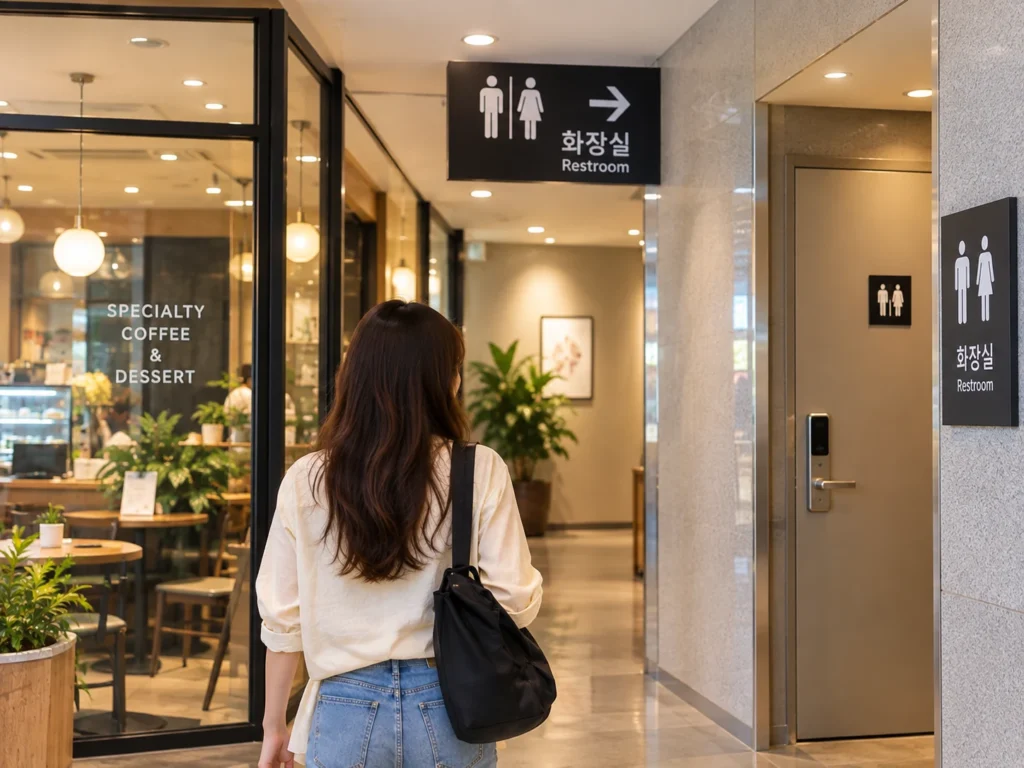
It’s one of those small details that becomes much easier once you understand how Korean commercial buildings work.
For other everyday situations that can surprise first-time visitors, see Travel Like a Local in Korea.
Do Convenience Stores Have Public Toilets in Korea?
Not every Korean convenience store has a restroom customers can use.
This is one of the most common assumptions I would avoid when looking for public restrooms in Korea.
Convenience stores are everywhere, so it seems logical that they would be reliable toilet stops. But a small store may have no accessible customer restroom, or its toilet may be located in a staff or shared-building area.
I don’t personally think of convenience stores as my first restroom option in Korea. Part of that is simply visibility: you often can’t tell from the street whether there’s a toilet available.
That doesn’t mean you should never ask.
If a convenience store is your only nearby option, a polite question is better than guessing.
You might be directed to a restroom, told that the building has a shared facility, or informed that there isn’t one available to customers.
If you can choose between a small convenience store and a large café across the street, I would generally try the café first.
The point isn’t that one type of business always has better facilities. It’s that availability is less predictable than the number of convenience stores might suggest.
Are Seoul Subway Restrooms Easy to Find?
Yes. Subway stations are among the most useful places to check when you need a toilet in Seoul.
Once inside, look for the familiar 🚻 symbol or signs marked 화장실.
You may see a directional arrow or a distance marker telling you how far away the restroom is. When you’re in a hurry, even a sign showing that the toilet is 40 meters away can be reassuring.
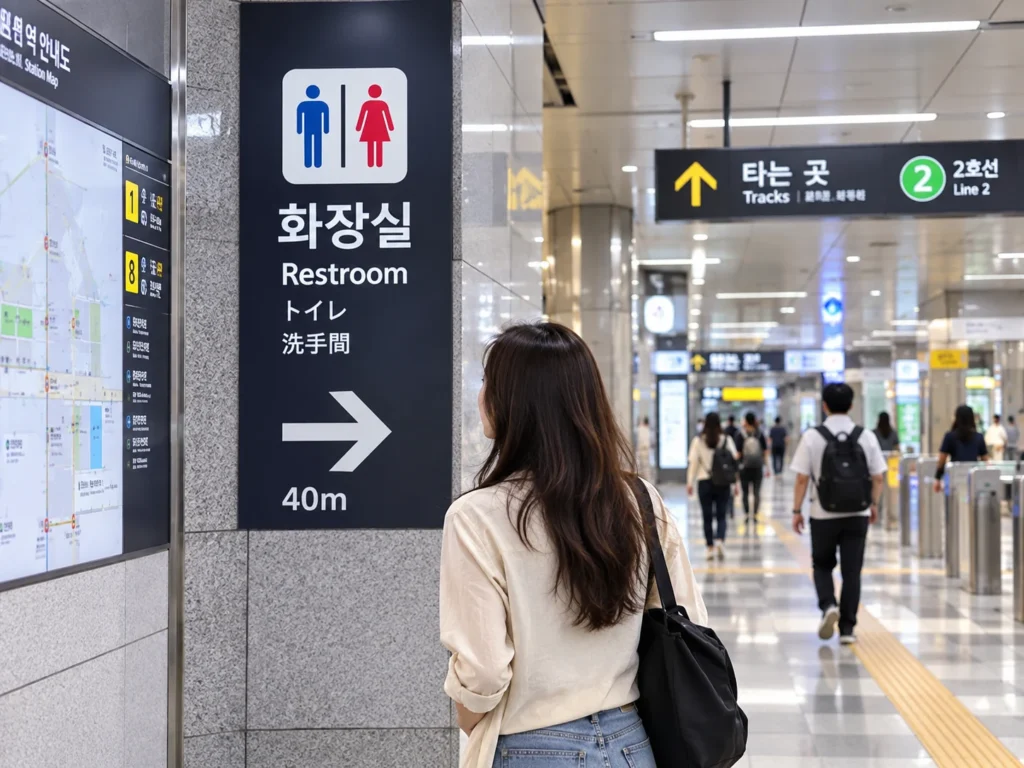
But there is one important detail.
A subway restroom may be inside or outside the fare gates.
If you’re entering a station from the street, a restroom beyond the gates may not be accessible without entering the paid area.
If you’re already riding the subway, the opposite situation can happen: the nearest restroom may be outside the gates, meaning you need to exit to reach it.
Before tapping your transit card, look at the restroom signs or ask station staff where the toilet is located.
For more practical advice about station etiquette and getting around, see Korean Subway Culture.
Can You Leave a Seoul Subway Station and Re-enter Within 15 Minutes?
On eligible Seoul subway sections, re-entering the same station within 15 minutes after tapping out can be treated as a transfer rather than a new base-fare journey.
This can be especially useful when you need to leave the paid area to use a restroom.
However, the policy has conditions:
- You must re-enter the same station within the allowed time.
- It applies to designated subway lines and sections.
- Re-entry is handled under the transfer system, so it isn’t an unlimited free-exit privilege.
- You should not assume the rule applies to every railway operator or station in Korea.
Seoul’s official guidance specifically identifies urgent restroom use as one reason this policy is helpful.
Before relying on it, check the current applicable lines and conditions on the Seoul Metropolitan Government’s subway guidance.
The practical lesson is simple: check where the toilet is before exiting, and don’t assume you can always pass through the gates again without an additional fare.
How Do You Find Public Toilets in Seoul on a Map?
When there isn’t an obvious café, station, or public building nearby, your phone becomes the next best option.
The Korean word to search is:
화장실
It means restroom or toilet.
If you’re already using Naver Map or another Korean map service, try searching for that word and checking the results around your current location.
You can also use Seoul’s official public-restroom map:
Find public restrooms on Smart Seoul Map
This is especially useful when you’re walking through an unfamiliar neighborhood or a large outdoor area.
However, a map marker isn’t a guarantee that a restroom is accessible at every hour. A toilet inside a public building may close when the building closes, and some locations may have access restrictions.
Check the location and any available details before walking a long distance.
I wouldn’t install a separate app just to find a toilet. Use the map you already have first, then check the city map if you need another option.
Can You Find Restrooms at Korean Parks and Tourist Attractions?
Often, yes—and this is where visitors sometimes make an unnecessary detour.
Imagine you’re visiting a palace, museum, or large park. You need a restroom, but you don’t immediately see a sign.
Your first instinct might be to leave and find a café.
Before doing that, look around the attraction itself.
Large public and tourist facilities often have toilets for visitors. They may be near an entrance, visitor center, information desk, or another part of the grounds rather than beside the main attraction.
Look for 🚻 or 화장실 on the site’s signs and maps.
If you don’t see either, ask an employee or visit the information desk.
This is particularly important at large outdoor attractions. Walking out through the main entrance could take longer than finding a restroom inside.
At a traditional tourist site, the restroom may also be in a separate modern facility rather than inside the historic building you’re visiting.
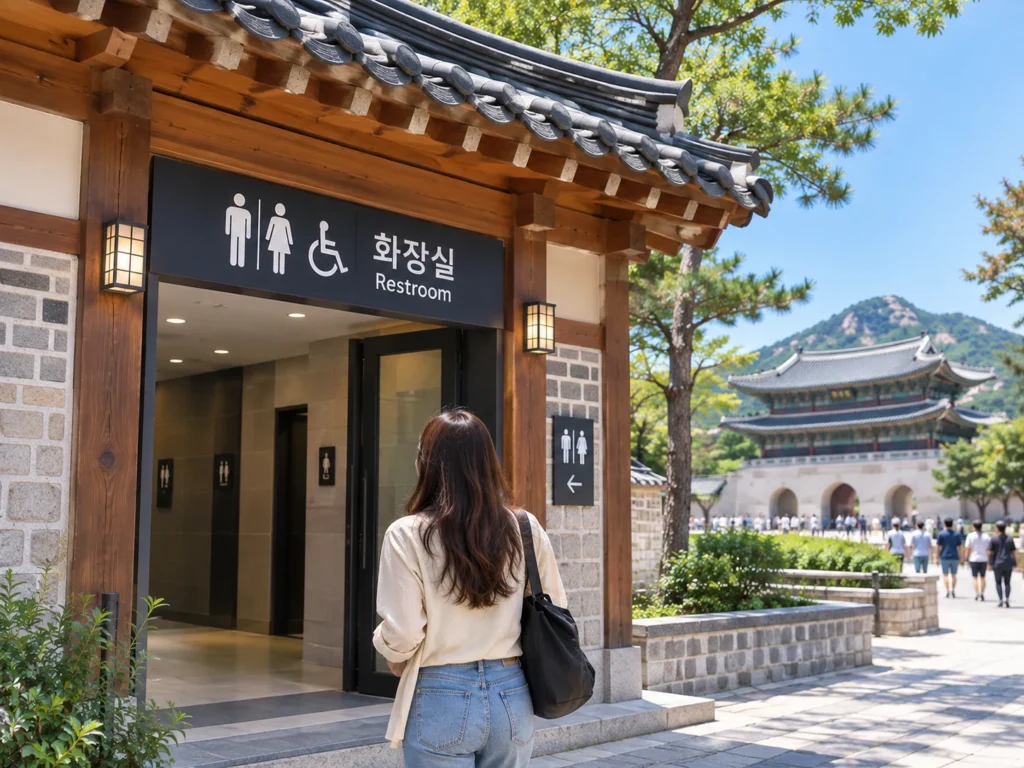
The same advice applies to public parks: check the park map and nearby facilities before heading back toward the street.
Not every attraction has toilets in every area, and some facilities may close earlier than the grounds themselves. It’s worth checking before you move to the next stop.
How Do You Ask for a Restroom in Korean?
You don’t need a long Korean sentence.
The most useful phrase is:
화장실 어디예요?
Hwajangsil eodiyeyo?
“Where is the restroom?”
The important word is 화장실 (hwajangsil).
Even if you forget the full sentence, saying “화장실?” with a questioning tone will often communicate what you’re looking for.
You can also show the word on your phone.
If someone points down a hallway or toward a stairwell, remember that the toilet might be a shared building facility rather than a room inside the business you’re standing in.
And if there’s a keypad on the door, don’t guess the code or try to force it open. Ask the staff whether the restroom is available and how to access it.
One more useful distinction: 화장실 is the ordinary word to use when looking for a toilet. You don’t need to learn a different term for cafés, subway stations, or tourist attractions.
What Should You Do If You Need a Toilet Right Now?
When time matters, don’t search for the theoretically perfect restroom. Choose the nearest realistic option.
- On a shopping street? Try a large café or fast-food restaurant, especially if you can easily ask the staff.
- Near a subway station? Follow the 🚻 signs and check whether the restroom is inside or outside the fare gates.
- Inside a palace, museum, or park? Check for an on-site restroom before leaving.
- In an unfamiliar neighborhood? Search 화장실 on your map or check Seoul’s public-restroom map.
- Standing outside a small café? Ask whether its restroom is inside the shop or shared with the building.
- Only a convenience store in sight? Ask. Don’t assume the answer will automatically be yes—or no.
Finding public restrooms in Korea gets easier once you understand these patterns.
The trick is not simply knowing that toilets exist. It’s recognizing which nearby place is most likely to be accessible when you need one.