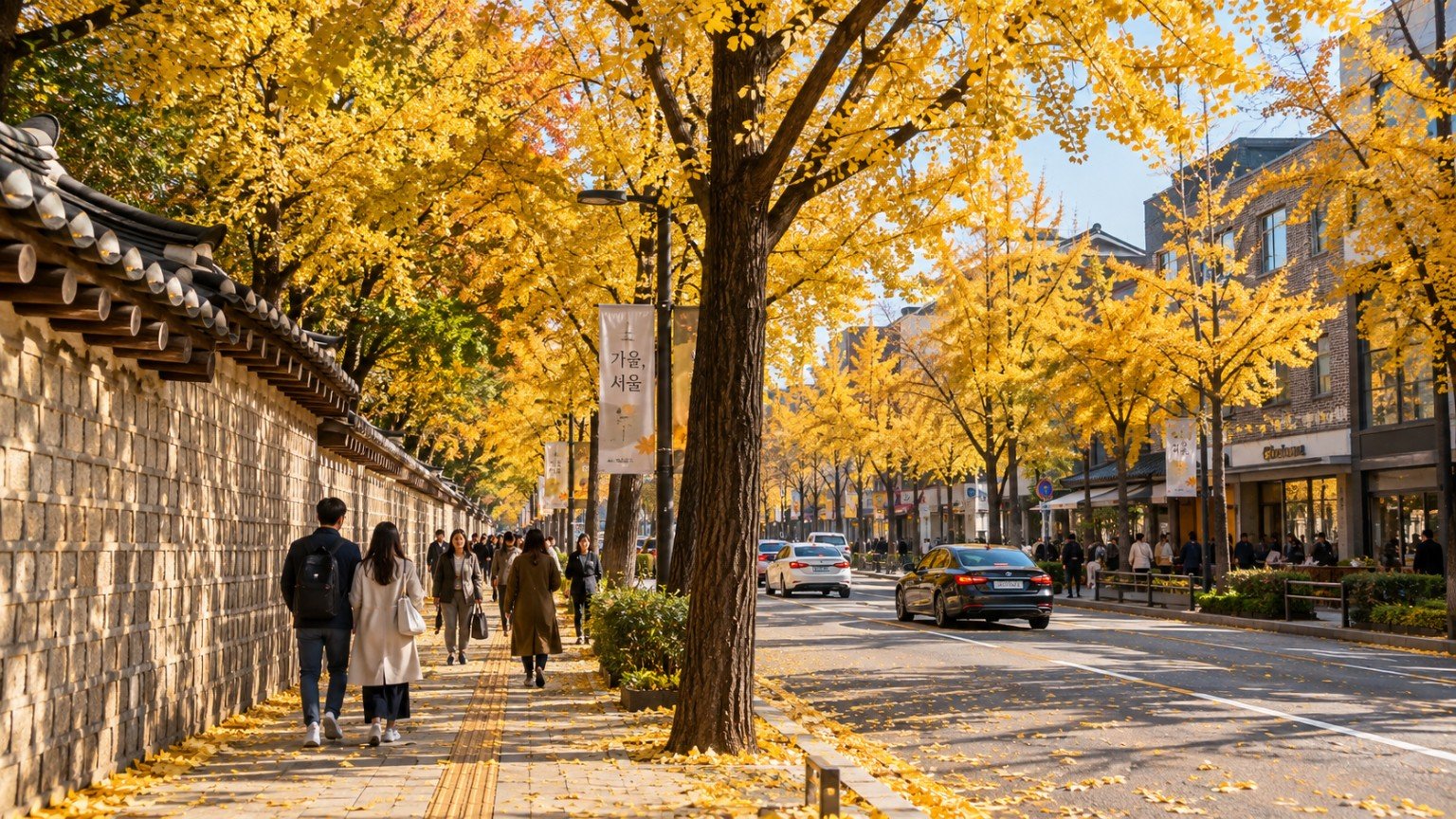
Autumn in Seoul can be ridiculously beautiful.
The sticky summer humidity finally disappears, the air turns crisp, and entire streets begin changing from green to yellow. The ginkgo trees in Seoul are especially dramatic. When a whole row turns at once, even an ordinary Seoul street can suddenly look like a movie scene.
Then you smell something.
Not flowers. Not food.
Something much closer to… poop.
Welcome to ginkgo season in Korea.
I’ve stepped on fallen ginkgo seeds plenty of times myself. They are not limited to famous parks or scenic spots. You find them on residential streets, around schools, near apartment neighborhoods, and sometimes practically outside your front door.
For Koreans, the smell is unpleasant, but strangely familiar.
When I notice it, I usually don’t think:
What is that terrible smell?
It is more like:
Ah, the ginkgo seeds are falling. Autumn is here.
And then I start watching where I put my feet.
Why Are There So Many Ginkgo Trees in Seoul?
There is a practical reason.
Ginkgo biloba has been the official tree of Seoul since 1971. The Seoul Metropolitan Government says it was chosen not only for its beauty and long life, but also because it is highly resistant to urban pollution, disease, and insects. Seoul Metropolitan Government
That toughness matters in Seoul.
A tree growing beside a busy road has to survive exhaust, compacted soil, hot and humid summers, freezing winters, roadwork, and constant human activity.
Ginkgo trees are remarkably good at it.
So when a visitor looks at the smelly things scattered across the pavement and wonders, Why would anyone plant so many of these?, there is actually a sensible answer.
And once a ginkgo tree grows large, there is another reason people put up with it.
It is beautiful.
When the leaves turn completely yellow, an ordinary road can become a golden tunnel.
That is basically the Korean ginkgo experience in one sentence:
Beautiful above. Smelly below.
What Actually Causes That Famous Ginkgo Smell?
First, the yellow leaves are innocent.
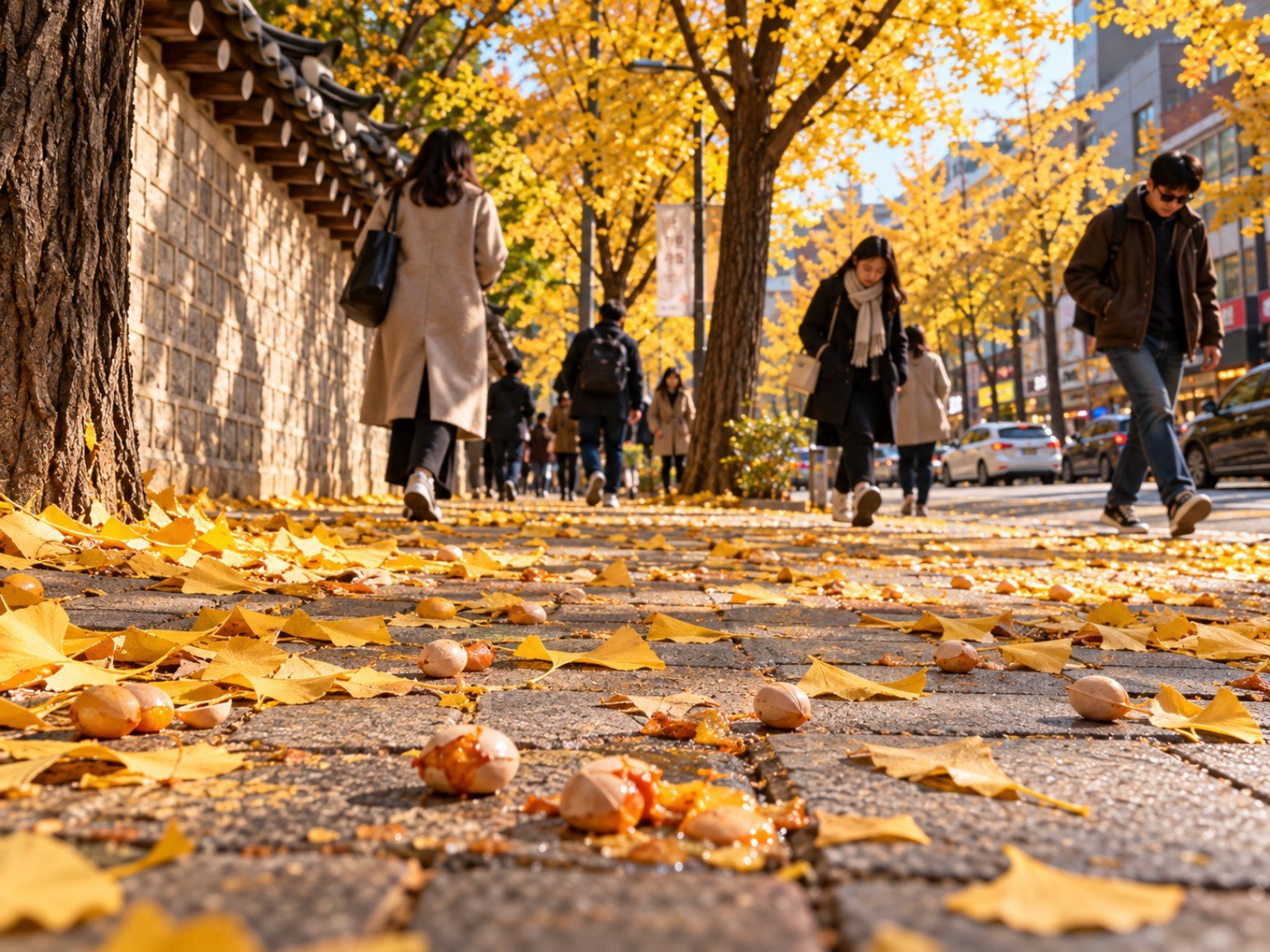
The smell comes from the soft outer layer surrounding the seeds produced by female ginkgo trees—the round yellow or orange things people commonly call “ginkgo fruit.”
Ginkgo trees have separate male and female trees. Only the female trees produce these seeds.
Once the soft outer layer falls, starts breaking down, or gets crushed by shoes and car tires, the smell becomes much stronger.
One of the compounds associated with that distinctive odor is butyric acid, also associated with smells such as rancid butter. Royal Botanic Gardens, Kew
And something so small can smell surprisingly powerful.
One second:
Seoul in autumn is gorgeous.
The next:
Wait. What did I just step on?
How Do Koreans Walk Around Fallen Ginkgo Seeds?
This is one of those small Korean habits nobody formally teaches you.
You just learn.
When ginkgo seeds have been falling for a while, you can usually see where other people have already stepped on them. There are flattened marks and smashed bits on the pavement.
So you naturally start avoiding them.
Sometimes it feels like playing chess with the sidewalk.
Left foot here.
Right foot there.
Avoid that one.
Step between those two.
Most Koreans don’t stop in surprise every time they smell ginkgo. We already know what it is.
You smell it and think:
“It’s that time of year again.”
It is not that we like the smell.
It is simply one of those little signs that tells you autumn has arrived.
What Happens If You Step on One?
Nothing dramatic happens to you.
Your shoe is another story.
Sometimes you don’t even realize you stepped on one.
You walk into a café or another indoor space, sit down, and suddenly notice that familiar smell somewhere nearby.
You look around.
Where is it coming from?
Then you realize:
It is coming from the bottom of your own shoe.
Once that soft outer layer gets crushed into the sole, the smell can follow you around surprisingly well.
That is why the best strategy is extremely simple:
Don’t step on one.
If you see small yellow-orange balls scattered beneath a ginkgo tree, pay a little more attention to the pavement.
And if you smell ginkgo before you see any?
Look down.
Why Doesn’t Seoul Just Remove All the Female Ginkgo Trees?
Because mature street trees are valuable.
Large ginkgo trees create shade, help shape the streetscape, and can survive urban conditions that are difficult for many other species.
Instead of simply removing every female tree, Seoul actively manages the seeds.
In Seoul’s published street-tree figures, there were 102,794 ginkgo street trees, including 25,127 female trees, or about 24%. The city uses collection teams, nets, high-access equipment, and vibration harvesting machines to remove seeds before they fall, with busy pedestrian areas given priority. Seoul Metropolitan Government Media Hub
So if you see workers shaking or collecting ginkgo seeds in autumn, they are not doing anything unusual.
They are dealing with one of Seoul’s recurring seasonal jobs.
And, indirectly, protecting your shoes.
Did Koreans Really Used to Pick Ginkgo Seeds Up From the Street?
Yes.
When I was younger, it was much more common to see people gathering fallen ginkgo seeds.
These days, I hardly see anyone doing it.
Life has changed. Fewer people want to collect smelly seeds, clean off the outer layer, dry or peel them, and prepare them when properly processed ginkgo is easy enough to buy.
But Koreans still eat the seed inside.
Once peeled and properly cooked, ginkgo seeds have a pleasantly chewy texture and taste completely different from what you would expect after smelling the ones on the street.
That contrast is actually quite funny.
On the sidewalk:
Please don’t step on that.
On a plate:
This is pretty good.
In Korea, you may hear the common advice not to eat more than about seven ginkgo seeds at a time. The exact safe amount can vary, so the simplest rule is to enjoy just a few.
That cautious approach makes sense. Ginkgo seeds contain natural toxins, and cooking reduces but does not completely eliminate them. Food-safety guidance recommends limiting consumption to only a few cooked seeds rather than eating a large quantity. Centre for Food Safety
So if you get the chance to try properly prepared ginkgo in Korea, try a few.
Just don’t take that as an invitation to collect the ones lying on the sidewalk.
Where Can You See Beautiful Ginkgo Trees in Seoul?
Here is the irony.
The tree responsible for one of Seoul’s least glamorous autumn smells also creates some of its most beautiful fall scenery.
Sinsa-dong Garosu-gil
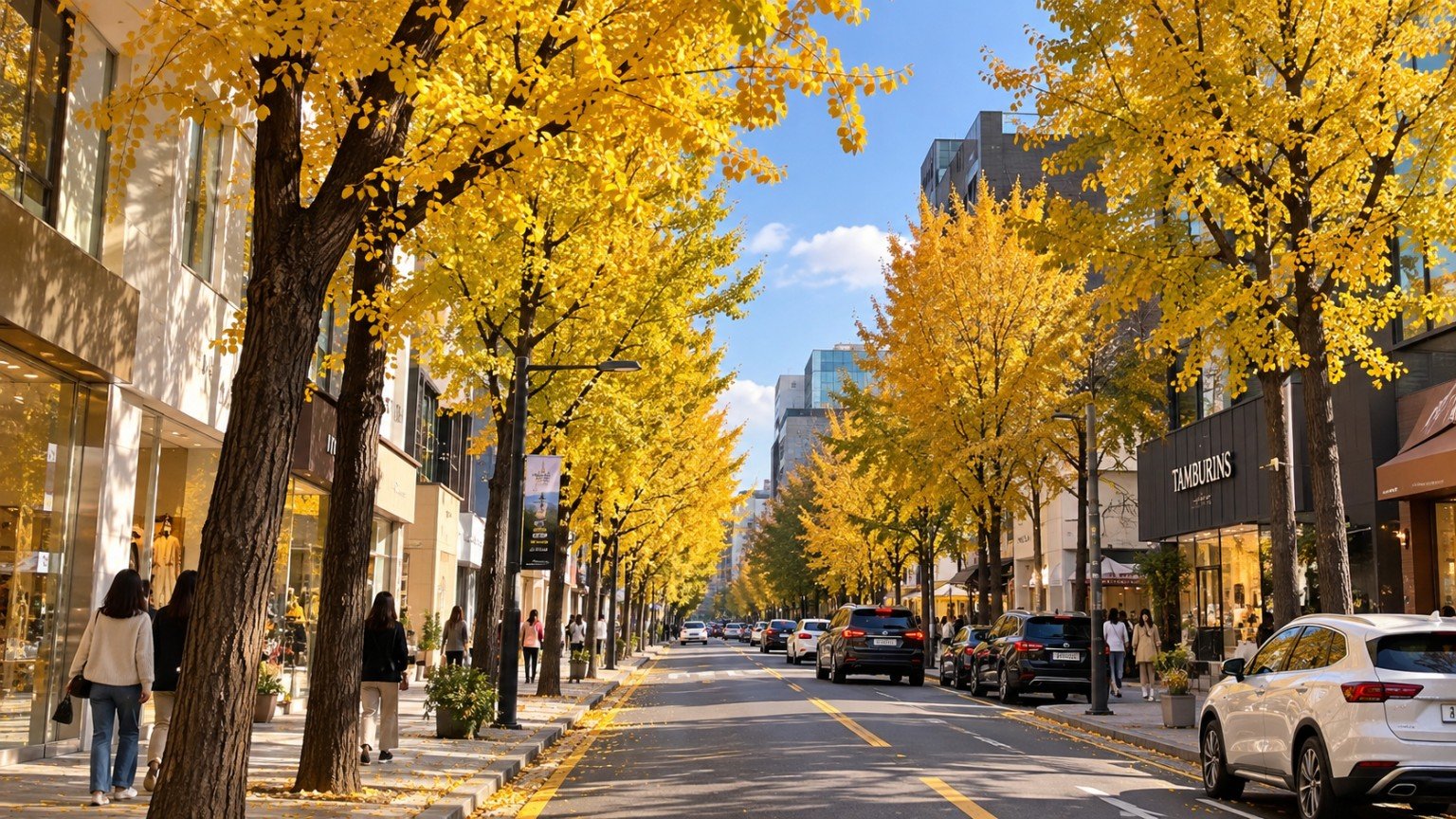
Garosu-gil (가로수길) literally means a tree-lined street, and the famous street in Sinsa-dong is lined with ginkgo trees.
Seoul’s own description specifically identifies the ginkgo trees running along the street from the Sinsa Station area toward Apgujeong. Seoul Metropolitan Government
People may know Garosu-gil better for cafés, shops, fashion, and city life.
But when the ginkgo trees turn yellow, the trees become part of the attraction too.
There is something very Seoul about brilliant yellow leaves hanging over shops, cars, cafés, and people going about an ordinary day.
Jeongdong-gil and the Deoksugung Stone Wall
For a very different atmosphere, walk around Jeongdong-gil near Deoksugung Palace.
Here, yellow ginkgo trees sit beside stone walls and historic buildings instead of modern storefronts.
The Seoul Metropolitan Government specifically recommends Jeongdong-gil’s ginkgo tree trail for autumn walks. Seoul Metropolitan Government
Garosu-gil feels urban and contemporary.
Jeongdong-gil feels quieter, older, and unmistakably autumnal.
Gyeongbokgung Palace
Gyeongbokgung is another place where I love seeing ginkgo trees in autumn.
The palace already has strong visual contrast from its wooden architecture and colorful dancheong. Add a huge ginkgo tree turning completely yellow, and the result can be spectacular.
VISITKOREA also includes Gyeongbokgung among Seoul’s notable autumn foliage destinations for 2026. VISITKOREA
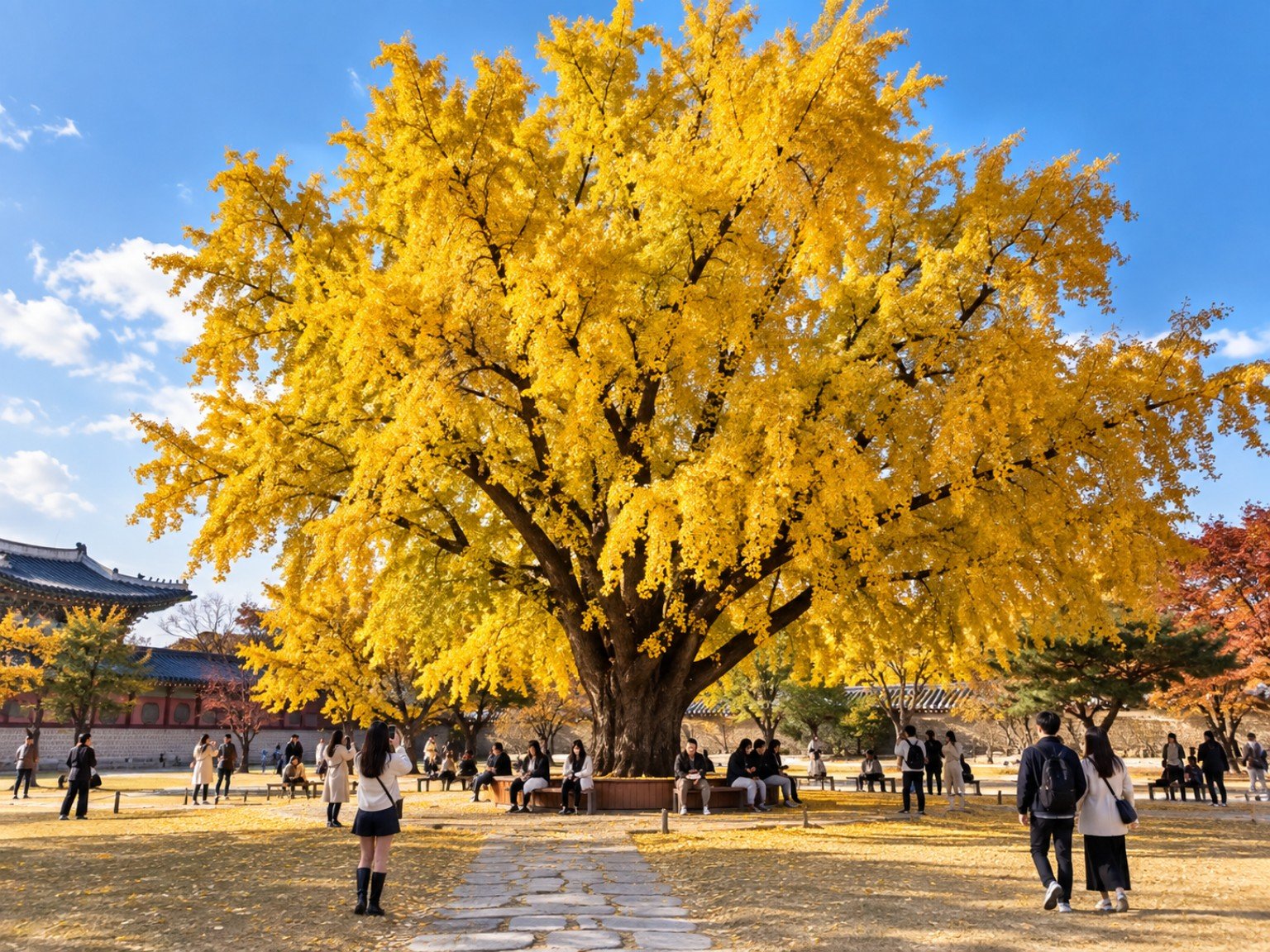
You do not really need to plan an entire “ginkgo tour.”
That is part of what makes these trees interesting.
In Seoul, you often encounter them simply by living your day.
When Do Ginkgo Trees Turn Yellow in Seoul?
For Seoul, late October through early November is the period I would watch most closely.
In the official 2026 fall foliage forecast, Bukhansan in Seoul is expected to begin changing around October 23 and peak around November 4, although actual timing can change with temperature, rain, and wind. Ginkgo timing is not identical to mountain foliage, so treat those dates as a seasonal guide rather than an appointment. VISITKOREA
If golden ginkgo streets are important to your trip, look at recent local photos just before you go.
The peak yellow stage does not last forever.
A windy day can turn a golden canopy into a yellow carpet almost overnight.
By around this stage, many of the ginkgo seeds have already fallen too.
That is one of the funny contradictions of Seoul’s ginkgo season:
The messiest, smelliest part and the most beautiful part can happen almost at the same time.
Should Travelers Worry About the Ginkgo Smell?
Not at all.
My advice is to treat it as one of Korea’s unofficial signs that autumn has arrived.
Cherry blossoms announce spring.
Humid evenings and cicadas announce summer.
And sometime in autumn, that unmistakable ginkgo smell appears.
For someone visiting Seoul for the first time, it may be surprising.
For many Koreans, it is simply:
“Ah, autumn.”
So don’t let the smell spoil the season.
Look up at the yellow trees.
Take the photos.
Walk through the golden streets.
And when you see Koreans suddenly moving their feet rather carefully between little yellow things on the pavement, follow their example.
They know what they are doing.
The smell is part of the season. Stepping on one doesn’t have to be.
FAQ
Do all ginkgo trees in Korea smell?
No. The unpleasant smell comes from the fleshy outer layer around seeds produced by female ginkgo trees. Male trees do not produce those seeds.
Why do fallen ginkgo seeds smell so bad?
The outer layer contains odor-producing compounds, including butyric acid. The smell becomes particularly noticeable when the seeds fall, soften, decompose, or are crushed.
When can I see yellow ginkgo trees in Seoul?
Late October through early November is usually the key period to watch, but temperatures, rain, and wind can shift the timing each year.
Can you eat ginkgo seeds in Korea?
Yes. Properly prepared and cooked ginkgo seeds are eaten in Korea and have a chewy texture. However, they contain natural toxins and should be eaten only in small amounts.
In Korea, you may hear the common advice not to eat more than about seven at a time; the simplest rule is to enjoy just a few.
Where can I see ginkgo trees in Seoul?
You will encounter them throughout the city, but Sinsa-dong Garosu-gil and Jeongdong-gil are particularly known for ginkgo-lined streets. Gyeongbokgung is also a beautiful place to experience Seoul’s autumn colors.
Related Guides
Autumn Foliage Near Seoul: 5 Local Day Trips for Fall 2026
Want to see more than Seoul’s street trees? This guide compares five different fall trips near Seoul, from mountain scenery and fortress walls to lakes and valleys.
→ Read the Autumn Foliage Near Seoul guide
Hiking in Korea: Essential Guide for First-Time Visitors
Autumn is one of Korea’s most popular hiking seasons. Learn what first-time visitors should know about Korean trails, hiking culture, crowds, weather, and what to bring.