
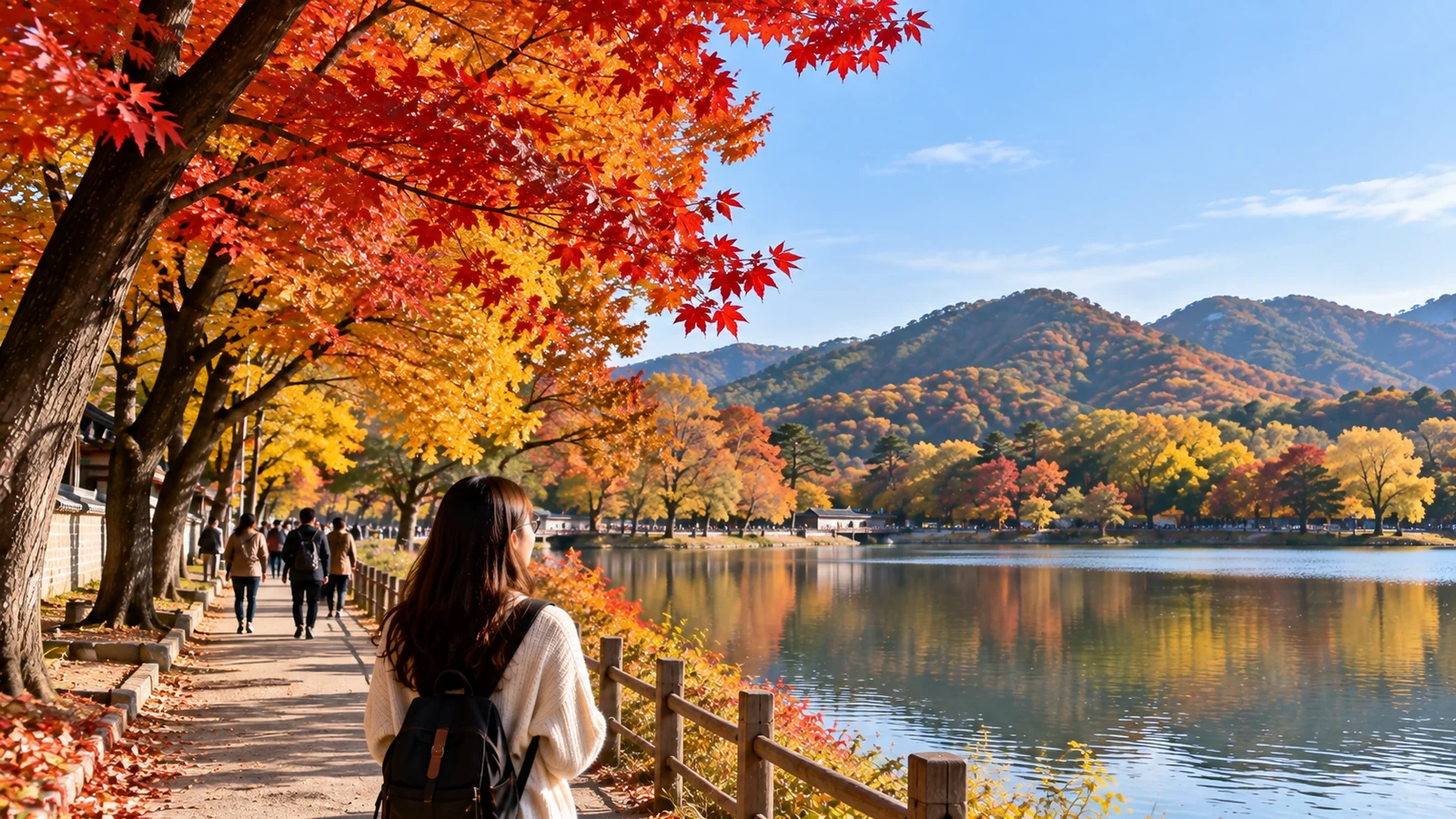
If you are looking for autumn foliage near Seoul in 2026, you do not need to build your entire trip around Nami Island or fight for one famous reservation.
Some of the best fall days are much simpler: a fortress wall in the mountains, a valley behind a Seoul neighborhood, a lakeside park reached by subway, silver grass above a reservoir, or morning mist where two rivers meet.
The more useful question is not:
“Which place has the most famous autumn leaves?”
It is:
“How much travel effort do I want to spend for the kind of fall scenery I actually want?”
That is how I would choose between these five.
When Will Autumn Foliage Peak Near Seoul in 2026?
For Seoul-area planning, the most useful current benchmark is Bukhansan.
VISITKOREA’s 2026 fall foliage forecast expects first foliage at Bukhansan around October 23 and peak foliage around November 4.
The Korea Forest Service’s September 22 prediction points in the same general direction: autumn color is expected to spread south from northern Gangwon in early October, with many areas reaching peak conditions in late October. Its national tree-type averages place maple and oak peak color around October 31 and ginkgo around October 30.
Those dates are forecasts, not appointments.
Namhansanseong, Suseongdong Valley, Seoul Grand Park, Myeongseongsan, and Dumulmeori do not all peak on the same day. Elevation, tree species, rain, wind, and temperature can move the best color forward or backward.
For the five places in this guide, I would watch late October through early November most closely, then check current photos and local conditions a few days before going.
That is more reliable than choosing one “peak foliage date” weeks in advance.
Official sources:
Which Autumn Day Trip Fits You Best?
| If you want… | Start with… | Trip effort |
|---|---|---|
| Fortress walls + mountain foliage | Namhansanseong | Half to full day |
| A short hidden-nature stop inside Seoul | Suseongdong Valley | 2–4 hours |
| Easy subway access + lake + forest | Seoul Grand Park | Half day |
| Lake + waterfalls + silver grass + hiking | Sanjeong Lake & Myeongseongsan | Full day |
| River mist + reeds + slow photography | Dumulmeori | Half to full day |
The easiest place is not automatically the one you will remember most.
But the farthest place is not automatically “better” either.
That is why travel effort matters.
Map: Where Are These Five Places?
1. Namhansanseong — For Fortress Walls and Mountain Color
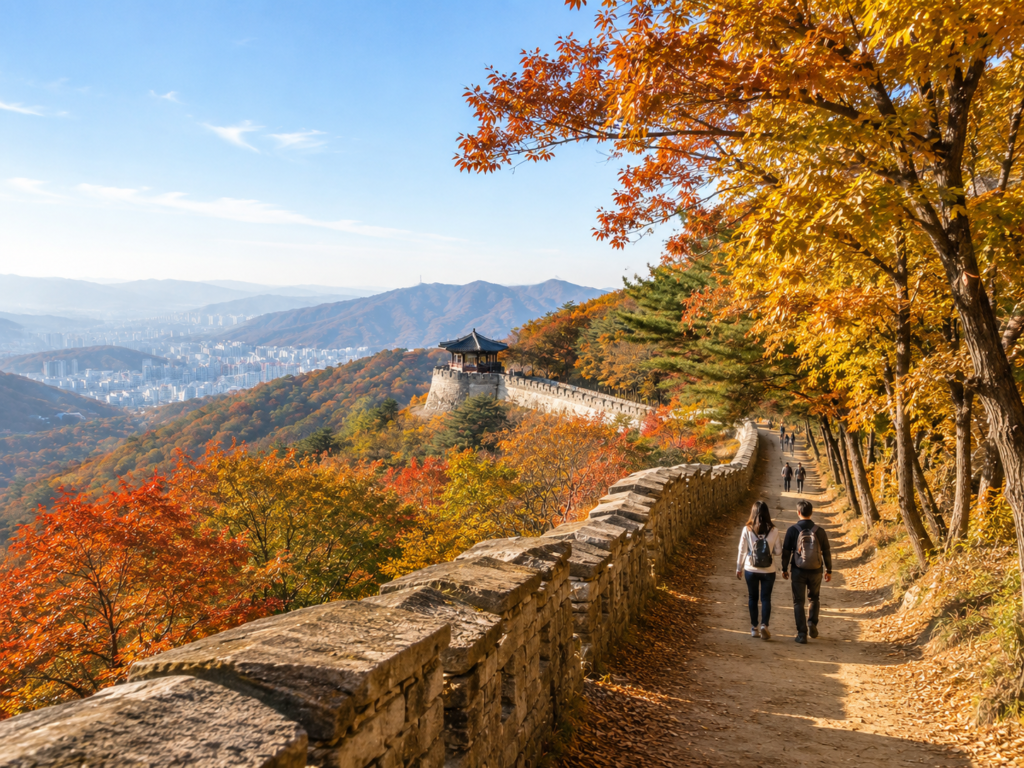
If you want one fall view that immediately looks Korean, Namhansanseong is the strongest all-around choice on this list.
The leaves are not the only scenery.
The fortress wall bends across the mountain, old gates appear between trees, and the walk combines history with autumn rather than treating foliage as a standalone attraction.
Namhansanseong is a UNESCO World Heritage landscape with five official trail routes. The full fortress wall runs for 12.4 kilometers, but you do not need to walk anything close to that distance.
You can keep the day easy around the fortress village and Temporary Palace, or continue farther along the wall if you want a proper mountain walk.
The Temporary Palace currently operates 10:00–18:00 from April through October and 10:00–17:00 from November through March. It is closed on Mondays except public holidays. The fortress landscape itself is much broader than the palace opening hours.
From Seoul, many visitors use Subway Line 8 to Sanseong Station and continue by local bus.
The important choice is not whether Namhansanseong is “easy” or “hard.”
It is how much of the wall you decide to walk.
If you want autumn plus Korean history in the same frame, start here.
Official information:
Namhansanseong World Heritage Center
2. Suseongdong Valley — For a Short Fall Escape Without Leaving Seoul
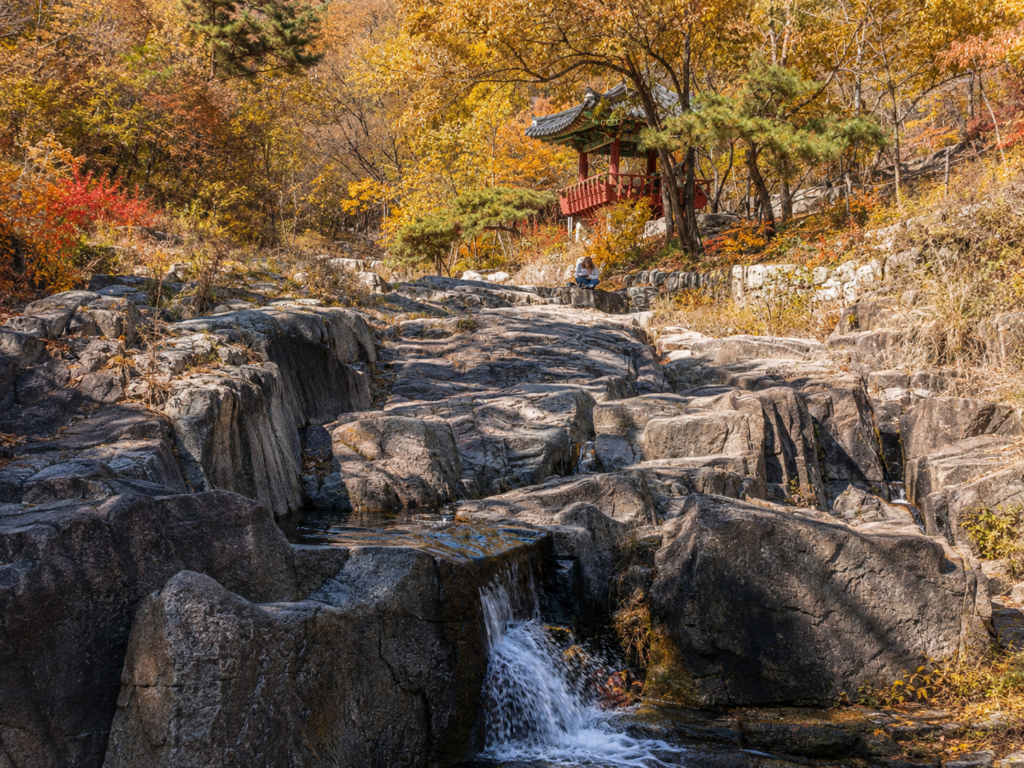
Suseongdong Valley is the choice I would make when there is not enough time for a real day trip.
You can spend the morning around Gyeongbokgung or Seochon, then keep moving toward the foot of Inwangsan.
The city gradually gives way to rocks, trees, water, and mountain scenery.
That contrast is the point.
This is not remote countryside. You are still in central Seoul.
Visit Seoul’s current listing describes Suseongdong as a historic valley connected with the Joseon painter Jeong Seon. Apartment buildings once occupied part of the landscape; they were later removed and the valley was restored.
The valley is currently listed as open 24 hours, year-round, with free admission.
The official access route is Line 3 to Gyeongbokgung Station Exit 3, then Jongno 09 village bus toward the Park No-soo Art Museum stop, followed by a short walk.
Or, if the weather is good, walk up through Seochon.
That is the version I prefer because the transition from neighborhood streets to valley scenery becomes part of the experience.
Official information:
Visit Seoul — Suseongdong Valley
3. Seoul Grand Park — For the Easiest Low-Stress Nature Day
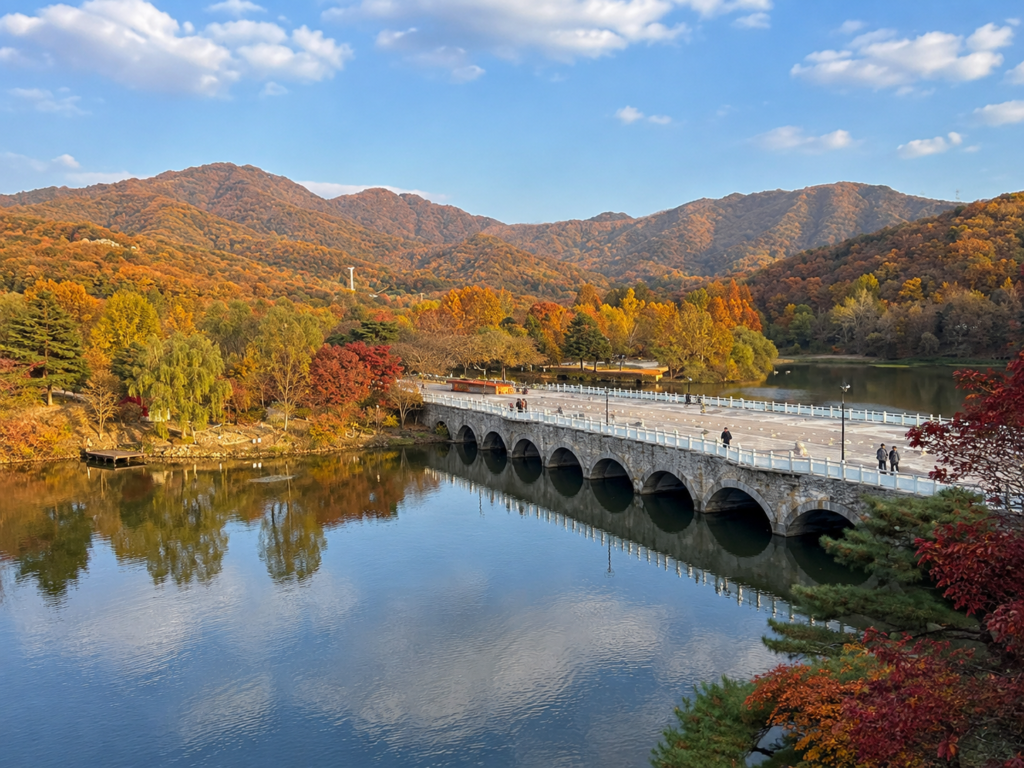
Seoul Grand Park is useful when you want fall scenery without turning transportation into the main event.
Take Line 4 to Seoul Grand Park Station and you are already close to a large landscape of lake, wooded hills, zoo and garden areas, and walking routes.
International visitors often think of the zoo first.
In autumn, I would think about the wider park.
The combination of water, forest, and gentle walking makes this one of the easiest choices for travelers who want nature but do not want a serious hike.
The official Seoul Grand Park site currently lists September–October zoo and garden hours as 09:00–18:00 and recommends public transportation on weekends and public holidays because road traffic and parking can become difficult.
Do not assume every free trail has exactly the same access rules as the zoo or botanical facilities. Check the specific route or facility you plan to use before going.
This is the place I would choose for a mixed group where some people want a proper walk and others do not.
Official information:
Seoul Grand Park
4. Sanjeong Lake & Myeongseongsan — For a Full Autumn Day
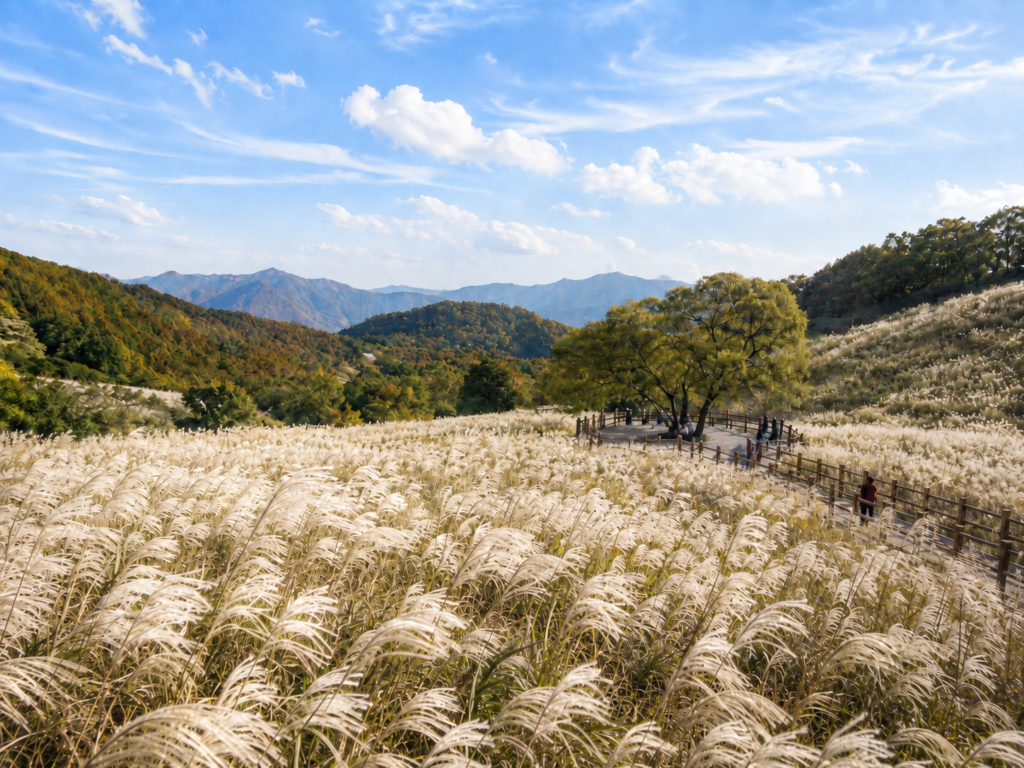
This is the farthest option on the list.
It also gives you the biggest range of autumn scenery.
Sanjeong Lake has an approximately 3-kilometer walking trail around the water, with Myeongseongsan rising behind it.
You can stop there and still have a worthwhile day.
Or you can continue toward Myeongseongsan’s silver-grass fields.
The popular mountain route passes Biseon Falls and Deungnyong Falls before reaching the silver grass.
That gives you three very different versions of the same outing:
Easy: walk around Sanjeong Lake.
More active: continue toward the waterfalls and silver-grass fields.
Hiking day: go farther into Myeongseongsan.
This flexibility is why the longer trip can be worth it.
But there is one practical detail that matters: VISITKOREA notes that access to the Myeongseongsan area can be restricted when military shooting training is taking place nearby.
Check current access before traveling all the way to Pocheon.
The lake itself is currently listed as open 24 hours and year-round.
Official information:
5. Dumulmeori — For Mist, Reeds, and a Slower Kind of Autumn
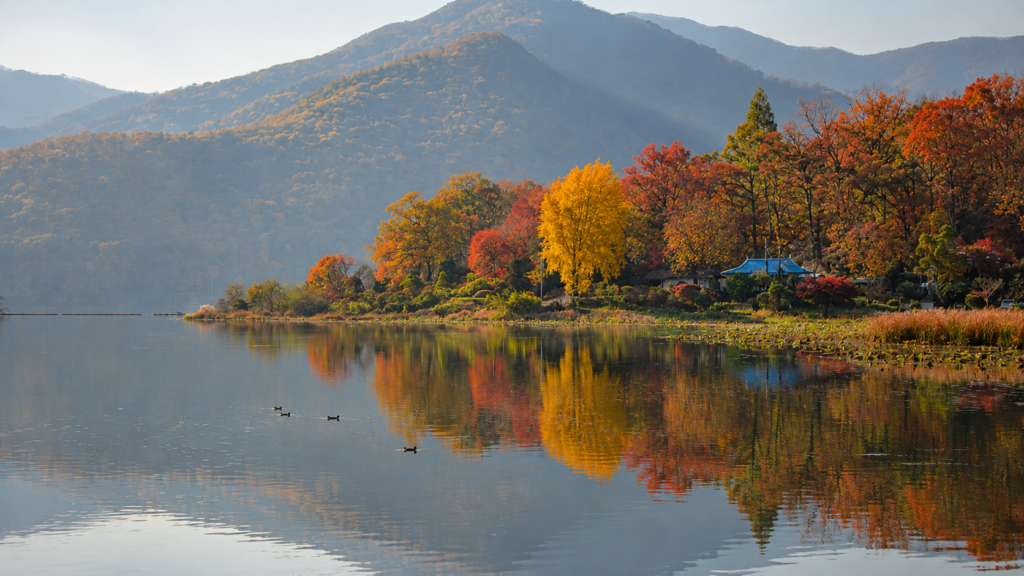
Dumulmeori is not the place I would choose if your only goal is the densest wall of red maple leaves.
Its strength is atmosphere.
This is where the Bukhangang and Namhangang rivers meet and continue as the Hangang.
Yangpyeong’s tourism office highlights the same things Korean photographers come for: early-morning mist, sunrise, old zelkova trees, reeds, broad water, and a landscape that changes with the seasons.
In autumn, the experience can be more silver, brown, gold, and misty than bright red.
That is exactly why it feels different from the mountain destinations on this list.
Dumulmeori is currently listed as open 24 hours, year-round, with free admission.
You do not have to arrive before sunrise.
But if photography is one of the reasons you travel, dawn gives you the best chance of seeing the version of Dumulmeori that made it famous with Korean photographers.
At a normal hour, it is still an easy riverside walk.
You can also combine the area with Semiwon or other Yangpyeong stops instead of treating one photograph as the entire trip.
Official information:
Yangpyeong Tourism — Dumulmeori
What About Hwadam Forest?
Hwadam Forest is missing from the five on purpose.
I have been there, and autumn can be spectacular.
The problem is not the scenery.
It is getting the right peak-season reservation.
When I booked, I kept checking cancelled tickets at different times because the date and time I really wanted were not initially available. Eventually I managed to change the reservation.
That experience is exactly why I would not tell an international traveler, “Just go to Hwadam Forest,” as if it were as simple as choosing a subway stop.
If you secure a suitable reservation, great.
If you do not, there is no reason to treat your Seoul autumn trip as a failure.
The five places above give you options with very different levels of effort, atmosphere, and transportation planning.
Which One Would I Choose With Limited Time?
With two or three hours, choose Suseongdong Valley.
With half a day and easy subway access, choose Seoul Grand Park.
For history plus mountain foliage, choose Namhansanseong.
For a full autumn day, choose Sanjeong Lake and Myeongseongsan.
For photography and atmosphere, choose Dumulmeori.
That is not a ranking.
It is a way to avoid spending three hours in transit for scenery that does not match what you actually wanted.
What Should You Check the Day Before You Go?
Check three things:
1. Current foliage photos or reports
A forecast published weeks earlier cannot tell you exactly what the trees look like tomorrow.
2. Weather and wind
Heavy rain or strong wind can change foliage conditions quickly.
3. Your final transit home
This matters most for Pocheon and other destinations outside the Seoul subway core.
For independent day trips, a Korean map app is especially useful for local buses and Korean place names. If Google Maps feels incomplete during your trip, our Korea map-app guide explains what locals use instead.
If you are choosing a hotel specifically to make day trips easier, our Where to Stay in Seoul guide explains why the station and final walking route often matter more than the neighborhood’s reputation.
And if Namhansanseong or Myeongseongsan is turning into a real hiking day rather than a sightseeing walk, see our Hiking in Korea guide before choosing shoes and trail difficulty.
The main thing I would not do is chase one “perfect foliage date.”
Choose the kind of autumn day you want first.
Then use the current 2026 forecast to decide when to go.