
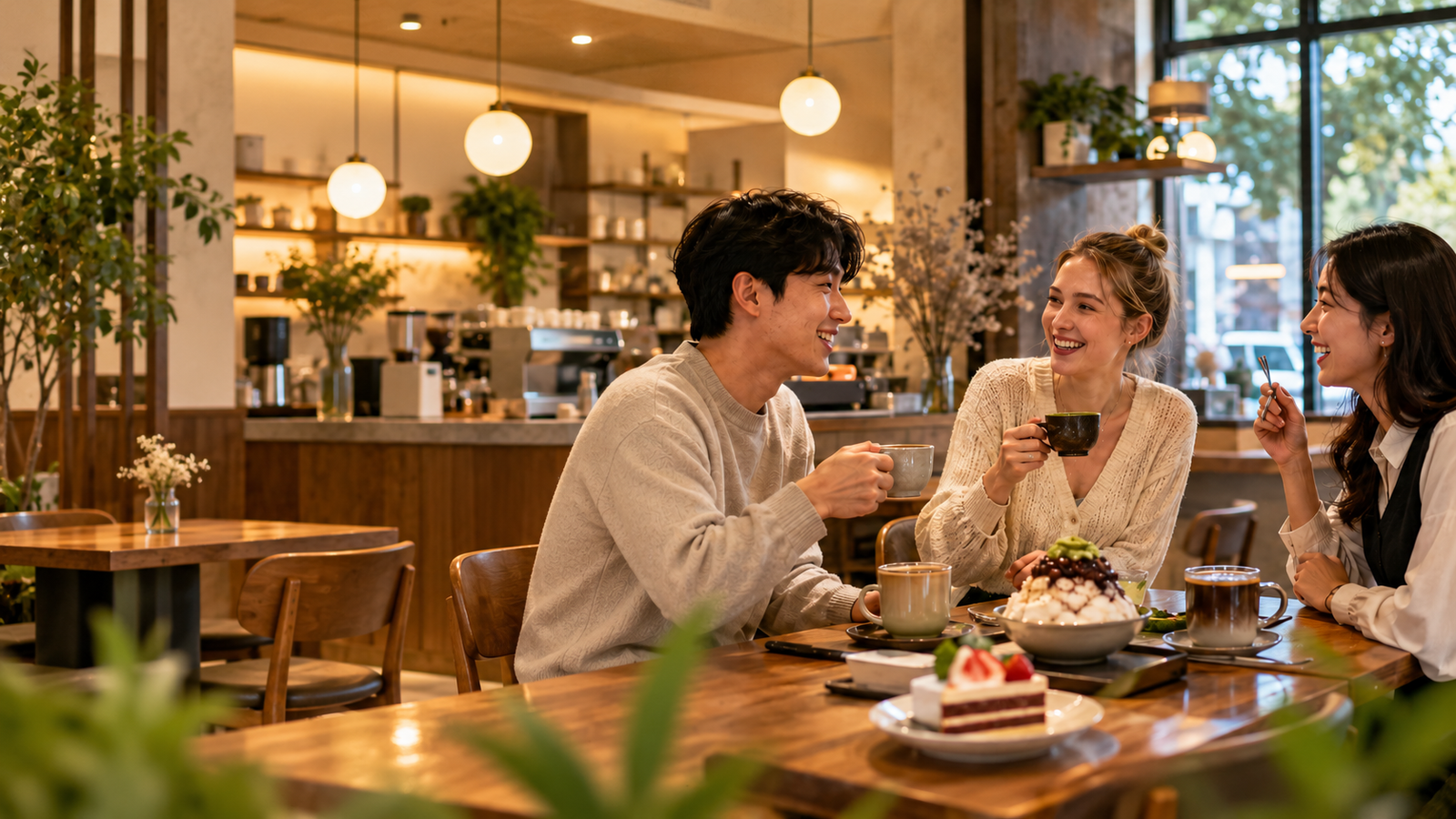
The question of why Koreans move to a cafe after eating has a simple answer.
Usually, it is not because everyone suddenly needs coffee.
The meal may be finished, but the time together is not.
That is the part that can surprise first-time visitors. In Korea, a social meal often has a clear change of space: the group eats at the restaurant, pays, leaves, and then decides whether to keep talking somewhere else.
A cafe is an easy second stop because nobody needs to order another full meal, people can sit comfortably, and the mood becomes less about eating and more about conversation.
That does not mean every Korean meal ends with coffee, and it is not a uniquely Korean idea to spend more time together after dinner.
What feels especially familiar in Korea is the change of place.
The restaurant closes one part of the gathering. The cafe begins another.
Why Leave the Restaurant If the Conversation Is Not Over?
Because the restaurant and the cafe often serve different purposes.
In a barbecue restaurant, noodle shop, stew restaurant, or busy neighborhood diner, the table is organized around food.
People are grilling, sharing side dishes, ordering more, clearing space, and paying attention to the meal.
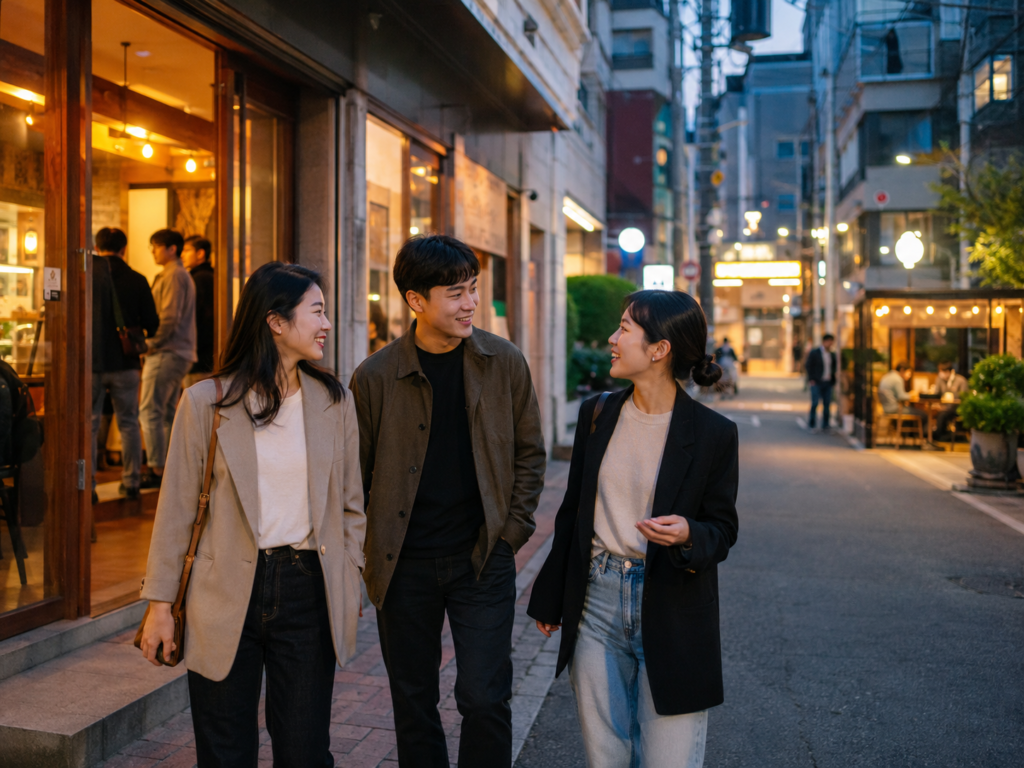
Once the food is finished, staying for another hour with nothing on the table can feel less natural than simply moving somewhere designed for sitting and talking.
That does not mean Korean restaurants always rush customers out.
Some places are perfectly comfortable for lingering.
But in many casual restaurants, the meal itself is the center of the visit. A cafe gives the group a new space where there is no need to keep eating.
The short walk between the two places also creates a useful break.
Someone can say goodbye after dinner. The rest can continue.
The group may become smaller, the seating changes, and the conversation often changes with it.
Is the Cafe a Korean “Second Round”?
Sometimes that is a useful way to understand it.
Koreans commonly use 1차 (ilcha) and 2차 (icha) to describe the first and second stops of a social outing.
The expressions are strongly associated with nights out, especially when people move from dinner to drinks or another venue.
But the same basic rhythm can appear without alcohol.
Dinner is the first stop.
A cafe may become the next one.
Most people are not formally announcing, “Now we begin the second round.”
Someone simply says:
카페 갈래?
Kape gallae?
“Want to go to a cafe?”
That question can sound like it is about coffee.
Socially, it may mean:
Do we want to keep spending time together?
That is the more useful translation.
Why Does Moving Somewhere Else Change the Mood?
A restaurant has a built-in rhythm.
The food arrives. People eat. Shared dishes disappear. Someone asks for the bill.
A cafe is looser.
The group can slow down and keep talking, but that does not mean staying for hours on one drink. That can put a real strain on a small cafe.
I’ve noticed some cafes posting a time limit of about two hours. Some people also order another drink or something to eat when they stay longer. It depends on the cafe, so check its seating and ordering rules.
That is why the second stop can feel different even when exactly the same people are sitting together.
On a date, the cafe may be the quieter part of the evening.
With friends, it may be where the conversation becomes longer because nobody is busy grilling meat or reaching across the table.
With family, it may simply be a comfortable place to sit before everyone goes home.
Official Korean tourism material also describes cafes as places where people spend time with loved ones and enjoy conversation, not simply places to buy coffee.
That matches the everyday logic well.
The drink gives you a reason to sit down.
The real activity may be talking.
Who Pays for the Coffee?
There is no fixed rule.
One familiar pattern is:
“You bought the meal, so I’ll get the coffee.”
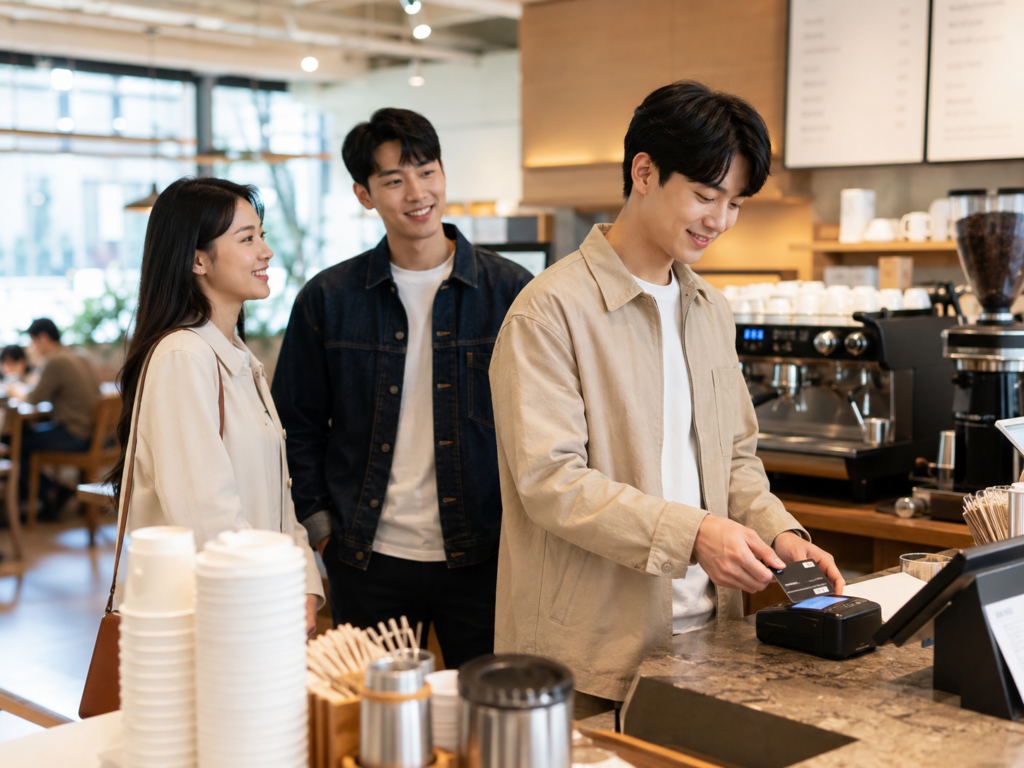
It is an easy way to return the gesture without calculating whether every person spent exactly the same amount.
Dinner may have cost much more than the drinks.
The point is not mathematical equality.
It is simply a way of saying, “You treated us earlier, so let me take this one.”
But do not turn that into a rule about age, gender, friendship, or seniority.
Friends may pay separately.
Someone may insist on treating the whole group.
A younger person may offer after an older person paid for dinner.
Or everyone may simply split things in whatever way is normal for that group.
If you are meeting Korean friends and are unsure, you do not need to solve the etiquette in advance.
Offering to buy the coffee is polite.
If someone says no, let the moment be simple.
For the broader question of how group meals and bill-splitting work, see our Dining Together in Korea guide.
Why Order Dessert When Everyone Just Ate?
Because the dessert is not always functioning as “another meal.”
A group may order one slice of cake, one pastry, or one bowl of bingsu to share while they talk.
The table needs something on it, but nobody necessarily needs to be hungry.
Koreans also joke that “the dessert stomach is separate.”
You will hear versions of that joke because it captures something familiar: people can be completely full from dinner and still become interested when cake or shaved ice appears.
That is not uniquely Korean.
What matters here is the social function.
A dessert gives the group something small to share while the second part of the gathering continues.
When Is the After-Meal Cafe Most Common?
You are most likely to notice it after a meal that was already social.
Dates are an obvious example.
Dinner can feel structured. A cafe makes it easier to sit face-to-face and continue talking.
Friends who have not seen each other for a while may also move because the meal ended before the conversation did.
Family gatherings can follow the same pattern, especially when people want somewhere with comfortable seats, desserts, or enough space for children or older relatives.
Office workers often do a much shorter version after lunch.
That may be a takeaway coffee or 20 minutes at a nearby cafe before returning to work.

The important point is that these are not all the same ritual.
The common thread is simply this:
The group wants a small amount of extra time after the meal.
How Do Koreans Choose the Cafe After a Meal?
Usually, convenience matters more than finding the “best cafe in Seoul.”
If four people have just finished dinner, the priorities may be:
- somewhere nearby
- enough seats for the group
- open late enough
- not too noisy
- dessert if people want it
- no difficult stairs if someone needs easier access
- parking if the group arrived by car
That is why the cafe chosen after dinner may be a chain even when the neighborhood has a famous independent coffee shop.
The goal is not always to add another destination to the itinerary.
Sometimes the nearest place with six empty chairs is exactly the right cafe.
This is an important difference between visiting a cafe as an attraction and using a cafe as social space.
Korean cafe culture includes both.
Do You Have to Join If Someone Suggests Coffee?
No.
A cafe invitation is normally an invitation to continue the gathering, not an obligation.
If you have another plan, are tired, or simply need to leave, you can say so politely.
You do not need to worry that declining automatically means you disliked the meal or the people.
What is useful for travelers is understanding the timing.
If a Korean friend invites you to dinner at 7 p.m., do not automatically assume the entire evening ends the moment the bill is paid.
If the meeting is social, there may be another stop.
So if you have a train, tour, reservation, or early morning, mention it naturally.
That avoids the awkward situation where everyone starts walking toward a cafe and you suddenly discover you needed to leave 20 minutes ago.
How Long Does the Cafe Part Usually Last?
There is no standard length.
A lunch coffee with coworkers might be 15 or 20 minutes.
A date or long-awaited friend meetup might continue for another hour or more.
Sometimes people order, talk briefly, and leave.
Sometimes the cafe becomes longer than the meal.
The same is true for cost.
Coffee, tea, cake, or bingsu can turn “dinner” into a noticeably longer and more expensive social outing than the restaurant bill alone suggests.
That is worth remembering if you are traveling on a tight schedule or budget.
So What Does “Shall We Go to a Cafe?” Really Mean?
Sometimes it means exactly what it says.
Someone wants coffee.
But after a social meal in Korea, it often carries one more message:
I am not ready for the time together to end yet.
That is why the cafe is easier to understand when you stop thinking of it as a beverage stop.
It is a continuation space.
The restaurant was for the meal.
The cafe is where the group decides whether the gathering has another chapter.
And if you want to understand the wider role of cafés in everyday Korean life — from studying and laptops to design cafés, takeout chains, and seat etiquette — our Korean Cafe Culture guide covers that separately.