
Korean cafe culture is about much more than coffee—and that becomes clear the moment you walk into a cafe.
You might see a laptop and a bag sitting alone on a table. In another cafe, people may be studying quietly with their screens open. A few doors away, customers may be taking photos of the interior before touching their drinks. Then, on the same street, you may find a tiny low-cost cafe with almost no seats, built for people to grab a large iced coffee and leave.
To Koreans, these different scenes are all part of everyday cafe culture. One cafe sells a comfortable place to stay. Another sells quiet time for work or study. Some sell beautiful spaces and desserts, while others focus on low prices, large drinks, and fast pickup.
But not every cafe works in the same way. A large chain may be comfortable for laptop users, while a small independent cafe may limit seating time. A stylish cafe may be designed for photos and conversation, while a takeout shop may not be a place to sit at all.
In Korea, choosing a cafe is not only about what you want to drink. It is also about what you want to do there.
Table of Contents
Korean Cafe Culture Begins With Unspoken Rules
1. Why Do People Leave Laptops and Bags on the Table?
There is a joke about this: Koreans see an unattended laptop and think, “That looks like a good seat.” Foreign visitors see the same laptop and think, “Someone actually left that there?”
Walk into a busy cafe in Korea, and you may spot a table with no one sitting there. But a laptop, bag, jacket, or book is already on it. In most cases, that means the seat is taken.
People often choose a table first and then go to the counter to order. Someone visiting alone may also leave a bag or laptop behind during a short trip to the restroom. Most Koreans understand that these items are marking someone’s temporary space, so moving them or sitting there would feel rude.
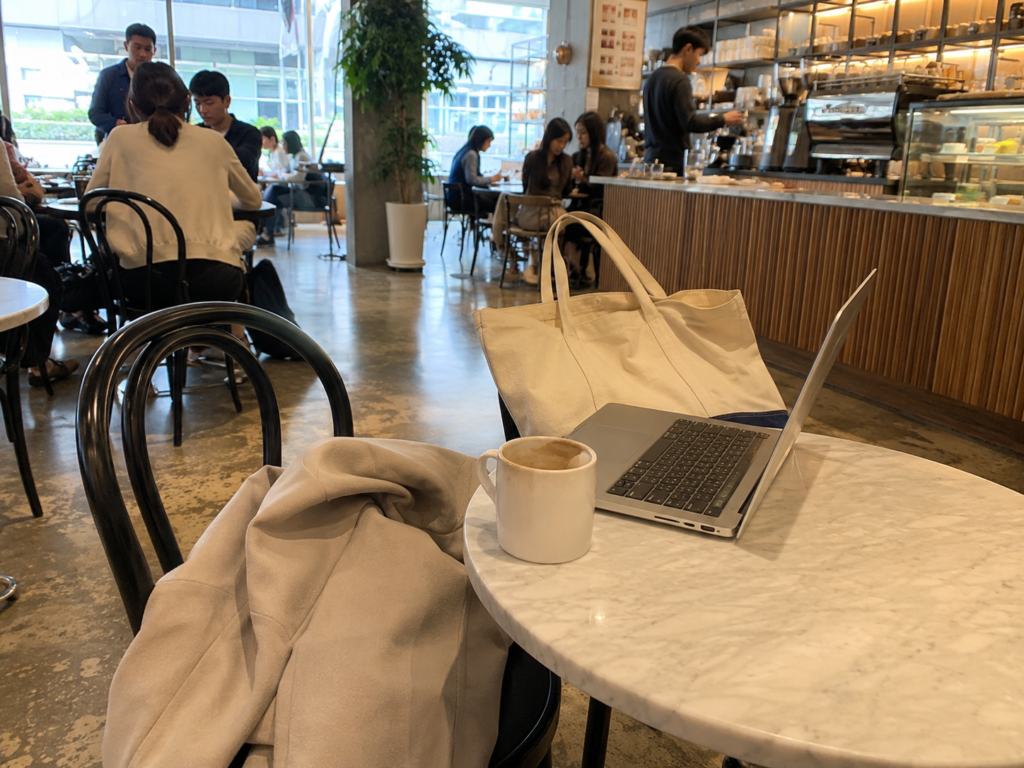
Leaving an ordinary bag or laptop at a cafe table for a short time is a familiar sight in Korea. Social norms around not touching another person’s belongings, along with the widespread presence of CCTV, may help people feel more comfortable doing it. But theft is still possible, and the habit should never be treated as a guarantee of safety.
The rule also works in reverse. A table may look empty, but a single bag, coat, book, or charging cable usually means someone is coming back.
For a visitor, the practical rule is simple: if a table has someone’s bag, coat, book, charging cable, or laptop on it, assume the seat is taken and do not move the belongings. Even if you see locals leaving items behind, keep your passport, wallet, phone, and other important valuables with you.
2. Can You Open a Laptop in Any Korean Cafe?
Open a laptop in a large Starbucks or another spacious chain cafe in Korea, and you will probably blend in. Students watch online classes, office workers answer emails, and freelancers work at tables. Koreans call these customers cagongjok (카공족)—people who study or work in cafes.
But not every cafe welcomes long laptop sessions.
Large chains often have more seats, Wi-Fi, and power outlets, so staying longer may feel more natural, depending on the branch. Small independent cafes may have only a few tables, which makes each seat important. Some require one drink per person, limit visits to two hours, or restrict laptops during busy periods.
You can often read the room. Large tables, outlets, and several open laptops usually mean the cafe is work-friendly. Small tables, limited seating, and a waiting line suggest a shorter visit.
For several hours of quiet concentration, consider a study cafe (스터디카페). It is closer to a self-service study room, where you usually pay for time rather than simply ordering a drink.
Cafe rules change with the size and purpose of the space, and you can often read the room. Check posted rules; in a small or crowded cafe, ordering something extra or leaving when you have finished may fit the space better than settling in for hours.
Korean Cafes Compete With Experiences, Not Just Coffee
3. Why Are There So Many Cafes on the Same Street?
Walk down a busy street in Korea, and you may pass several cafes within a few minutes. Sometimes they are almost next door to one another.
They may all sell coffee, but they are not always selling the same experience.
One cafe may be quiet and spacious for studying or working. Another may focus on desserts, dates, or photos. A bakery cafe sells bread as much as coffee, while a roastery attracts people who care about beans and brewing.
Cafes also fit naturally into the Korean day. A meal often continues with a second stop at a cafe, where friends, couples, or coworkers can talk longer without staying at the restaurant. Coffee is also part of the commute, the lunch break, and the time between classes or appointments.
At the other end are low-cost takeout cafes. These shops may have few seats or none at all. They compete with large drinks, low prices, and fast pickup, especially near offices, schools, subway stations, and shopping streets.
That is why several cafes can exist close together. One customer wants a place to stay. Another wants dessert and photos. Someone else only wants an inexpensive iced coffee on the way to work.
A place marked “cafe” may be designed for a long visit, a short break, or takeout only. Recent photos and reviews on Naver Map or Kakao Map usually reveal the seating, atmosphere, and type of visit the cafe is designed for.
4. Why Does the Interior Sometimes Matter More Than the Coffee?
In some Korean cafes, customers begin taking photos before they even taste their drinks.
A cafe may be built inside a hanok, an old factory, a warehouse, or a large garden. In places such as Seongsu-dong Cafe Street, old industrial buildings and workshops now stand beside trendy cafes and cultural spaces. Other cafes create one striking wall, staircase, window, rooftop, or view that becomes the main reason people visit.
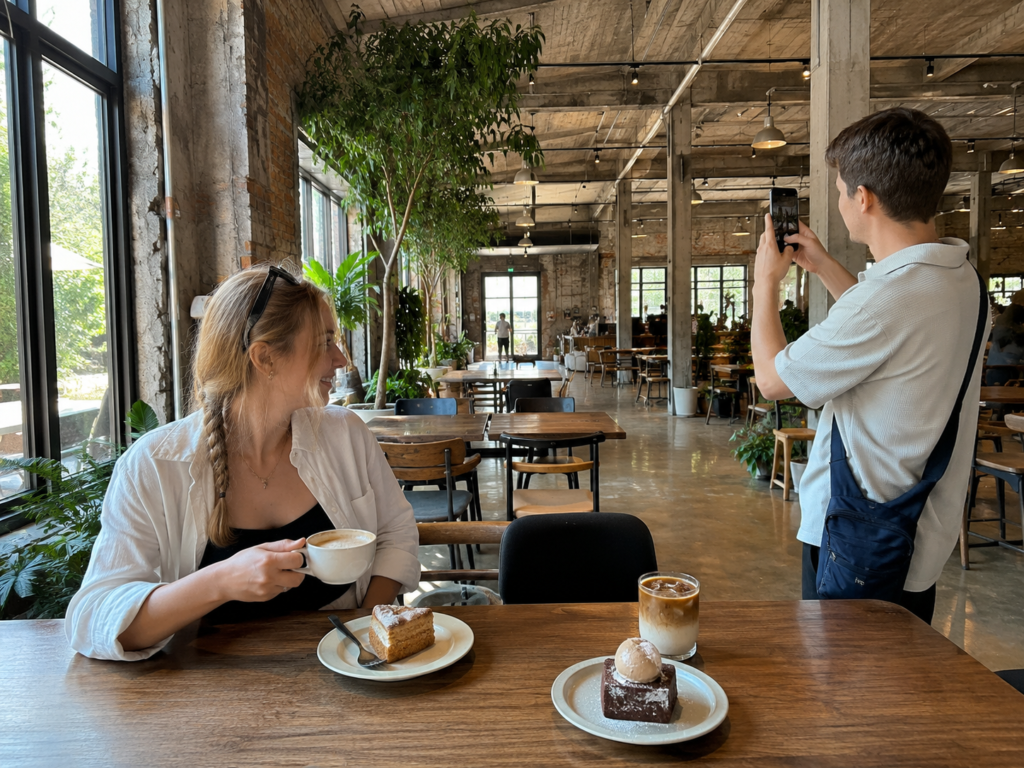
In these places, the interior is not just decoration. It is part of what the cafe sells.
For many customers, visiting a cafe can be a small outing rather than a simple coffee break. They may travel to a new neighborhood, meet a friend, order a carefully presented dessert, and spend time enjoying the space. The drink is only one part of the experience.
A memorable interior also attracts photos, social media posts, and word-of-mouth. This can turn an ordinary cafe into a destination people include in a weekend trip.
That does not mean the coffee is always bad. It simply means the atmosphere, design, and location may matter as much as the drink.
A popular photo cafe may be crowded, expensive, or less comfortable than it appears online, and some have rules about tripods, commercial photography, or restricted areas. Check recent visitor photos, not only the cafe’s official images. Avoid photographing other customers, and do not block doors, stairs, or walkways while taking pictures.
Self-Service Goes One Step Further in Korea
5. How Can a Cafe Run With No Staff?
You may enter a Korean cafe, look around, and realize there is no staff member anywhere.
At an unmanned cafe, customers usually order from a machine, collect their own drinks, and clean up after themselves. CCTV, remote monitoring, automatic coffee machines, and clear instructions allow the shop to operate without staff on site.
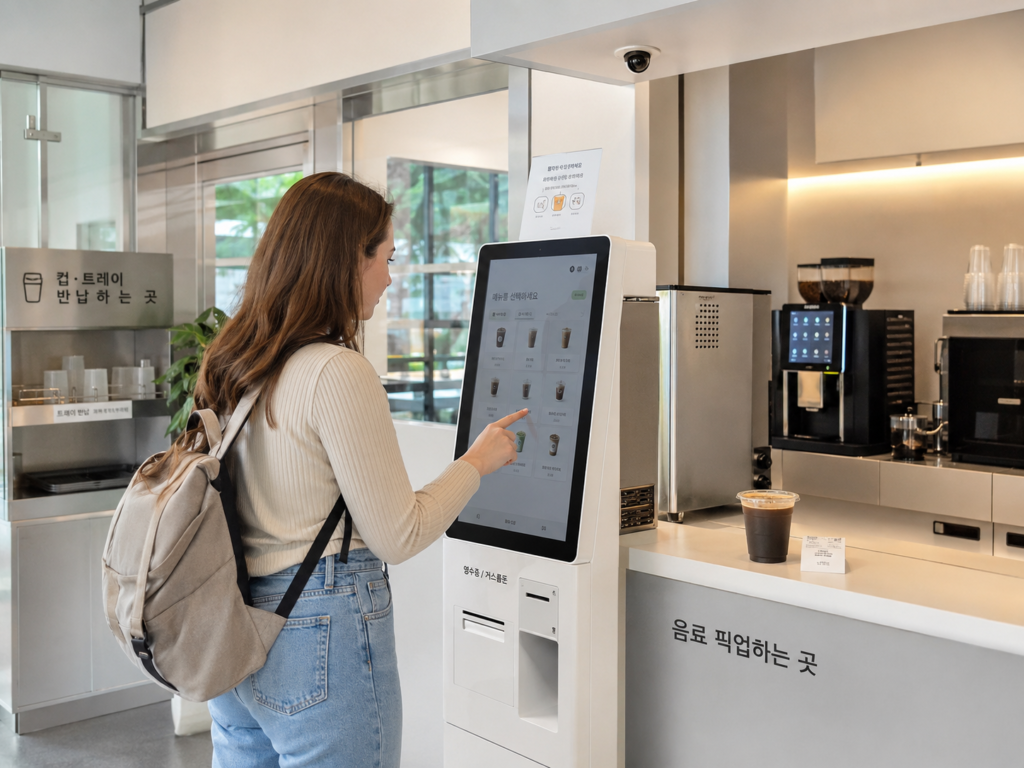
This system feels less unusual in Korea because customers are already familiar with kiosks, self-checkout, and unmanned convenience stores, ice cream shops, and photo booths. Small businesses can also use automation to operate with fewer staff or remain open later.
Still, an unmanned cafe is different from a regular cafe. There may be no one nearby to fix a payment error, answer a question, or help when a machine stops working. Some are open late or 24 hours, but others have limited opening times.
Unmanned cafes can be cheap, quiet, and convenient, but help may be limited when something goes wrong. Before ordering, check the contact number and refund instructions, then look for signs showing where to return cups and trays and how to sort the trash.
Choose a Cafe by the Experience You Want
6. Which Korean Cafe Should You Visit?
There is no single “most Korean” cafe. The best choice depends on what you want to experience.
For everyday local life, try a neighborhood cafe where people meet friends and spend time together. To see cagongjok, visit a large chain with wide tables and power outlets. If you need several quiet hours, a study cafe is more suitable. Cafes can also be practical cooling stops during hot summer afternoons; Is Korea Too Hot in Summer? An Honest Local Guide covers the humidity, midday heat, and sightseeing timing in detail.
For many Koreans, a cafe is also where the social part of a meal continues. Friends, couples, and coworkers may leave a restaurant after eating, then spend another hour talking over coffee or dessert. The cafe becomes the second half of the meal—not because anyone is still hungry, but because the conversation is not finished. Learn more about why Koreans move to a cafe after eating.
For design, desserts, and photos, choose a stylish cafe, a hanok cafe, or a converted factory or warehouse. If you only want a large, inexpensive drink, look for a low-cost takeout chain near a subway station or office area.
An unmanned cafe offers another side of modern Korea: self-service, automation, and little direct contact with staff.
Korean cafes are not all used in the same way. Decide what you want to do before searching, then check recent photos and reviews to see whether the cafe matches your plan. Choosing the right type makes the experience more enjoyable and helps you avoid using the space in the wrong way.
Final Thoughts
In Korea, a cafe is rarely just a place to buy coffee.
It may be a study space, a meeting point, a photo destination, a quick takeout stop, or a fully unmanned shop. The important thing is to understand what kind of space you have entered.
Look at the tables, the people, and the signs. A little observation will tell you whether to stay, work, take photos, or simply grab your drink and leave.
Once you understand that, Korean cafe culture becomes much easier—and much more interesting—to enjoy.
Frequently Asked Questions
Do Korean cafes require one drink per person?
Many independent cafes do, especially when seating is limited. Large chains may be more flexible, but you should always check the signs or menu. If you plan to stay for a long time, ordering another drink or dessert is considerate.
Can I leave my laptop or bag on the table?
You may see Koreans do this for a short time, but it is still safer to keep your passport, wallet, phone, and other valuables with you. Never move another customer’s belongings to take a seat.
Can I work in a Korean cafe for several hours?
It depends on the cafe. Large chains and spacious cafes are usually more suitable for long laptop sessions. Small or busy cafes may limit laptop use or seating time. A study cafe is better when you need quiet, focused work.
Are unmanned cafes easy for foreign visitors to use?
Many are simple, but the instructions may be mostly in Korean, and help is limited if the machine or payment process fails. Check the contact number and refund information before ordering.
Related Guides
Google Maps in Korea 2026: Naver Map, KakaoMap & What Changed
Use Naver Map and Kakao Map to check recent cafe photos, seating, opening hours, and reviews before you visit.
How to Pay in Korea in 2026: Cards, Cash & Transit
Learn how card payments and self-service kiosks work in Korean cafes and other everyday businesses.
Travel Like a Local in Korea: 20 Everyday Korean Habits
Discover the small habits and unspoken rules that make everyday places in Korea easier to understand.