
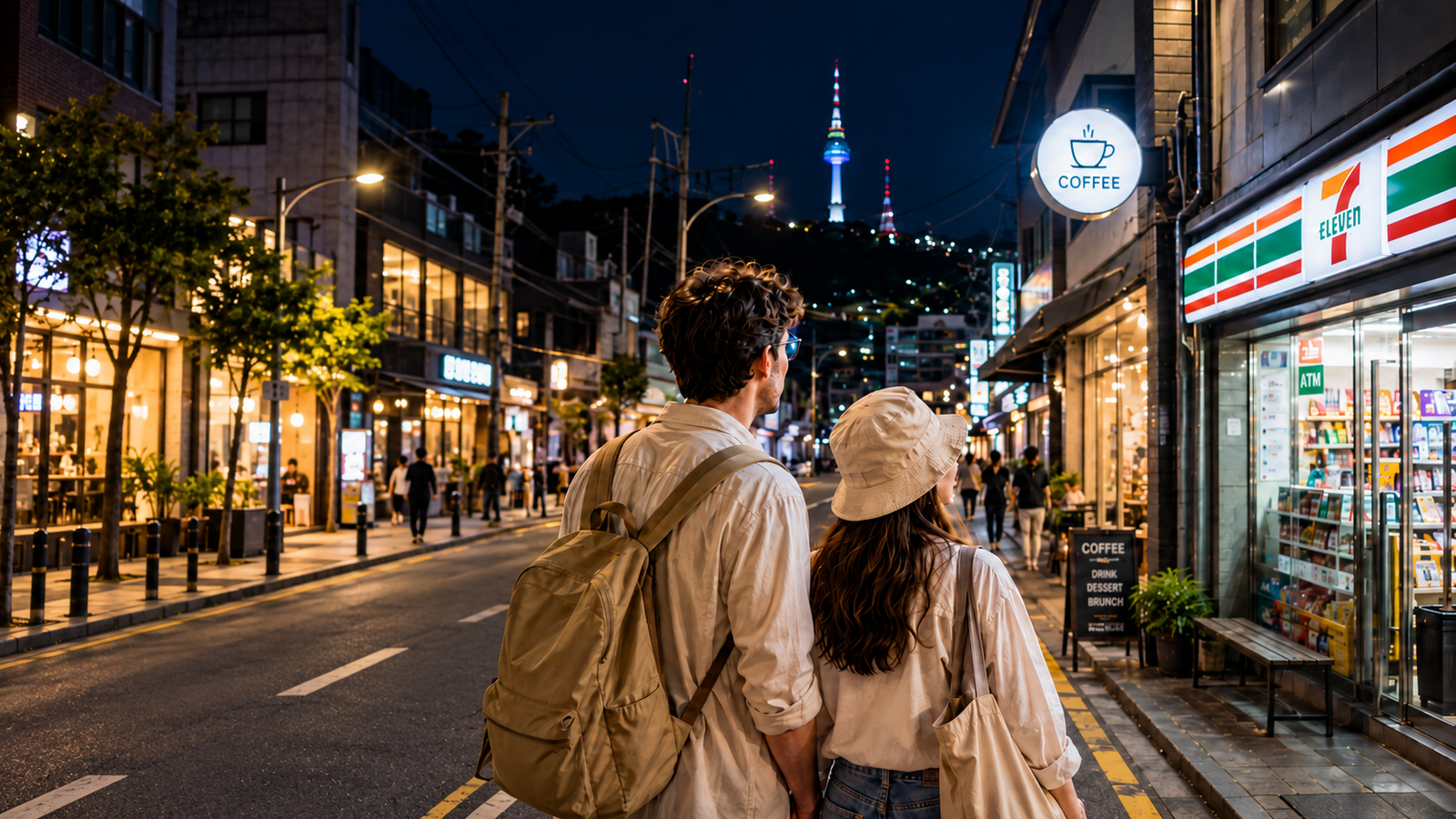
Walking back to your hotel after dinner can feel quite different from leaving a bar at 2 a.m. In Korea, the route home matters as much as the time.
For many travelers, Korea feels surprisingly comfortable after dark—especially in busy parts of Seoul and other large cities. Streets stay active, convenience stores and restaurants are still open, taxis keep moving, and walking alone does not automatically make you stand out.
But I would not describe Korea as a place where you can stop thinking about safety.
Korea often feels comfortable at night, but the street, the route, the crowd, and how you plan to get home still matter.
That is also close to the way many locals think about it. The question is usually not, “Is the whole country safe after midnight?” It is more practical: Is this road bright? Are other people around? Is this a nightlife area? Is there an easy way to leave? Do I know how I am getting home?
Official travel guidance is broadly reassuring but not absolute. The U.S. Department of State currently lists South Korea at Level 1, “Exercise normal precautions,” and says violent crime and crimes against property are rare for most visitors. The UK government likewise says crime against foreigners is rare, while specifically warning that theft and assaults, including sexual assault, can occur around bars and nightlife areas.
That difference—generally comfortable, not risk-free—is the most accurate way to approach Korea at night.
Why Can Korea Feel Comfortable After Dark?
One reason is simple: in many Korean cities, nighttime does not mean the streets suddenly become empty.
At 10 or 11 p.m., you may still see office workers going home, students leaving study rooms, couples walking after dinner, people buying snacks, delivery riders moving between buildings, and residents walking their dogs.
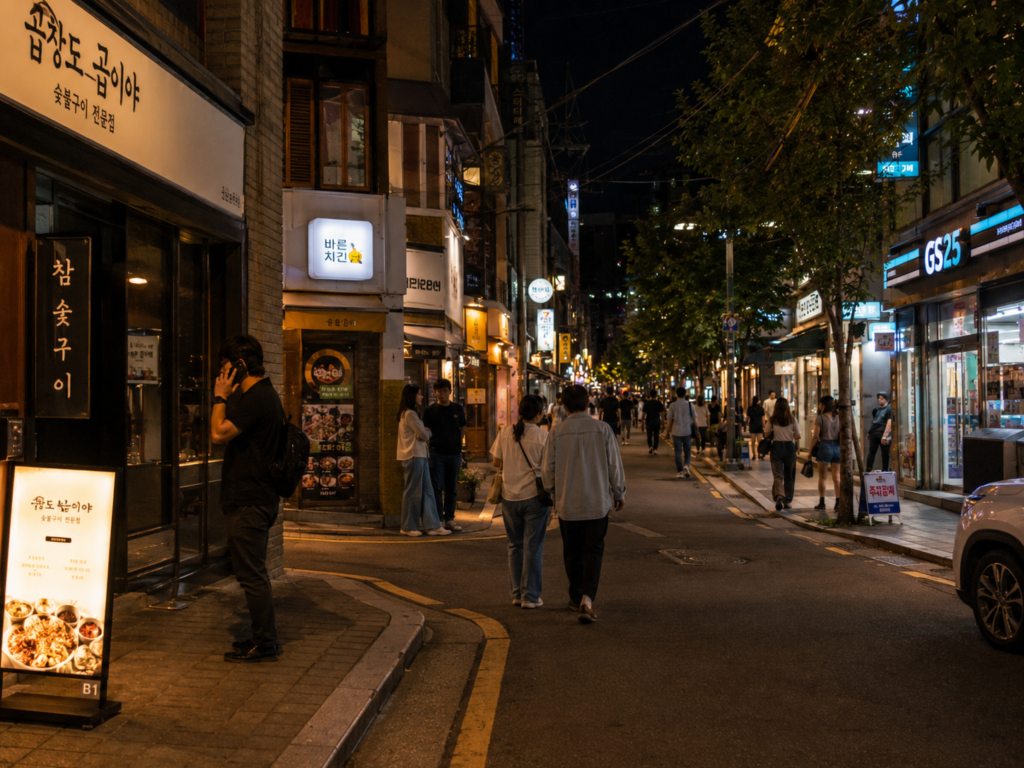
In a busy neighborhood, this ordinary activity changes the feeling of the street.
You are not necessarily walking through a city that has “shut down” for the night. Apartment entrances are lit, restaurants may still be serving, taxis are passing, and other people are moving in the same direction.
That can make a first-time visitor feel more relaxed than expected.
The important part is not to turn that feeling into a rule.
A bright street in Hongdae at midnight, a quiet residential alley at 2 a.m., and a riverside path after nearby businesses have closed are three very different situations.
Korea does not have one single “nighttime atmosphere.”
The Route Matters More Than the Hour
If I am walking somewhere unfamiliar late at night, I care more about the route than whether the clock says 10 p.m., midnight, or later.
A navigation app may offer the shortest route through a small alley, a park, a stairway behind buildings, or a quiet riverside path.
During the day, that may be perfectly convenient.
Late at night, I would often rather spend a few extra minutes on the larger road.
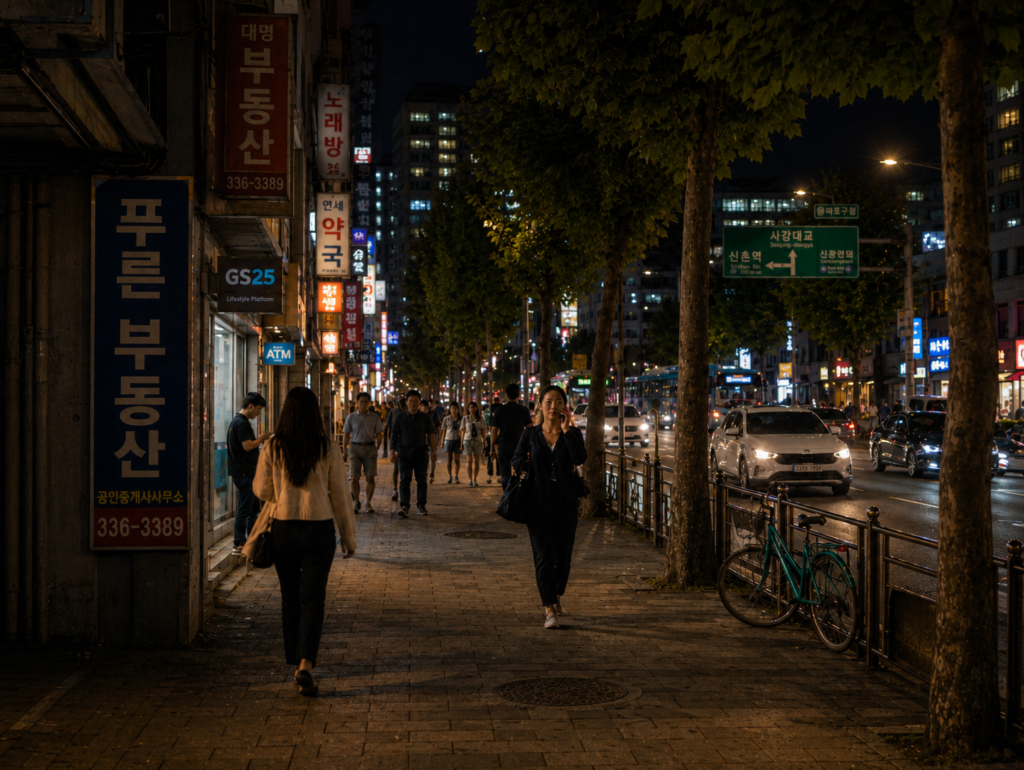
That is not because every alley is dangerous. It is because a main road usually gives you more options: more light, more passing traffic, more open businesses, and an easier place to call a taxi or change direction if you become uncomfortable.
This is one of the simplest local habits a traveler can copy.
Do not keep following the map just because the blue line says it is three minutes faster.
If the route suddenly feels too empty or too dark, go back toward the main road.
A Busy Nightlife Street Is Not Automatically Safer
Crowds can make a street feel reassuring.
But nightlife changes the calculation.
In places such as Hongdae, Itaewon, and parts of Gangnam, the street may be bright and full of people well after midnight. That does not remove risks associated with heavy drinking, crowded bars, lost belongings, unwanted attention, or arguments.
The UK government’s South Korea travel advice specifically notes that assaults, including sexual assault, have occurred around bars and nightlife areas and advises extra care when traveling alone at night.
So I would not tell a solo traveler—especially a woman traveling alone—that “Korea is so safe you do not need to worry.”
A better rule is:
- keep your phone and wallet where you can feel them in crowded venues
- know who you came with and how you are leaving
- do not accept a ride from an unofficial vehicle
- if someone is making you uncomfortable, move toward staff, security, a hotel lobby, restaurant, or another staffed public place
- leave before the situation becomes something you need to “wait and see” about
A lively street can be easier to navigate than an empty one, but a crowd is not the same thing as protection.
An Open Convenience Store Can Be a Useful Reset Point
One very Korean-looking nighttime scene is the bright convenience store on an otherwise quiet street.
I would not call a convenience store a “safe zone,” and not every branch is open 24 hours.
But an open convenience store can be useful when you need a moment to reset.
You can step inside, check your map under good lighting, confirm your accommodation address, or buy a charging cable if one is available. Ask staff before waiting inside for a taxi.
The same is true of an open hotel lobby, restaurant, police facility, or other staffed public place.
The important idea is not “convenience stores keep Korea safe.”
It is that when something feels wrong, you do not have to keep walking just because you already started down that street.
Move somewhere public and staffed. Recheck the route. Call someone. Change the plan.
Visible Safety Systems Help, but They Are Not a Guarantee
Visitors often notice CCTV cameras, emergency buttons, intercoms, and other safety equipment in Korean public spaces.
In Seoul, the city’s Ansimi public-safety system can connect users with district CCTV control centers and support emergency response when help is requested.
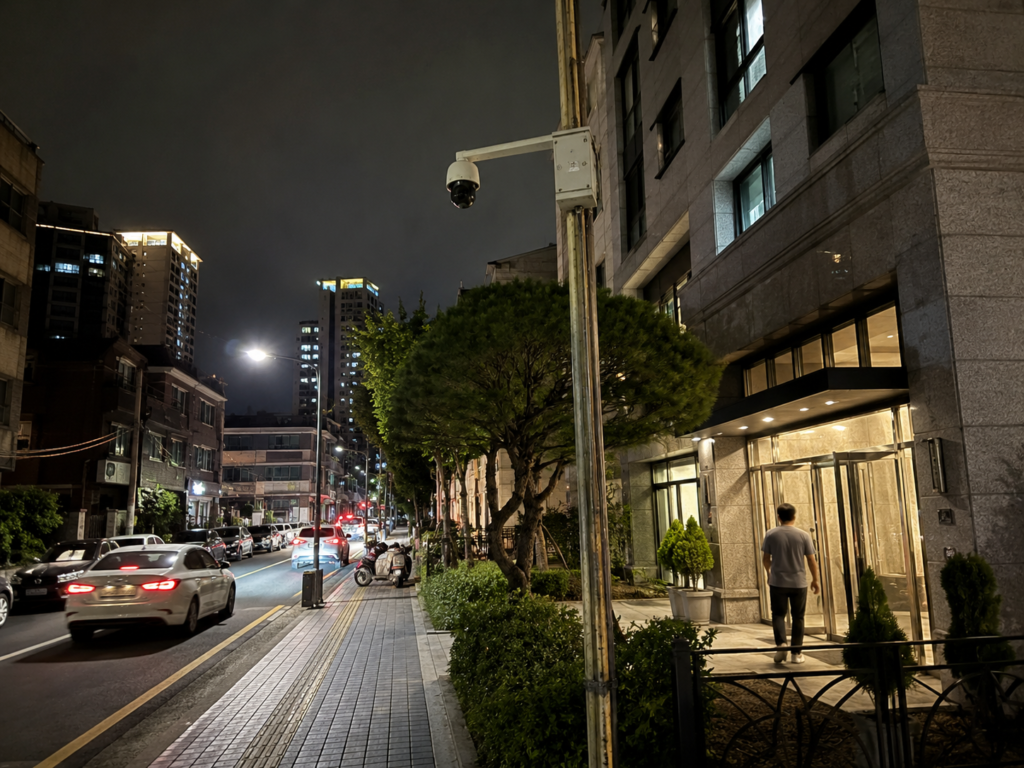
These systems are useful infrastructure.
But they should not be interpreted as proof that nothing bad can happen.
A camera records a place. An emergency button gives you another way to ask for help. Neither one replaces ordinary judgment.
This distinction matters because “Korea has lots of CCTV” is sometimes turned into an exaggerated explanation for why the country feels safe.
I would not rely on that.
If a place feels wrong, the better response is still to leave, find a busier route, enter a staffed location, or call for help.
Getting Home Is Part of Night Safety
A night out feels very different when you already know how you are getting back.
Korean public transportation runs late in many cities, but it does not run all night on every route.
Do not assume the subway will still be available simply because restaurants and bars are open.
Before going somewhere late, I would check:
- the last useful subway or bus for my direction
- whether I would need to transfer
- whether a taxi can realistically pick me up near the venue
- the Korean name and address of my accommodation
If regular transit has ended, use a legitimate taxi or taxi-hailing service.
Our Taking a Taxi in Korea guide explains why the pickup point matters and how to avoid standing somewhere a driver cannot easily reach.
For a traveler, having a clear way home is often more useful than memorizing a long list of “dangerous” and “safe” neighborhoods.
Is It Safe to Walk Alone at Night in Seoul?
On a busy, well-lit street, walking alone is common and usually does not attract much attention.
That is one reason Seoul can feel comfortable to solo travelers.
But I would still separate “walking alone is normal” from “every place is equally safe.”
If I were alone late at night, I would be more cautious around:
- very quiet shortcuts
- parks or riverside paths after foot traffic drops
- nightlife streets where the crowd has become heavily intoxicated
- unfamiliar areas where most businesses have already closed
- any person or situation that makes me feel I need to keep checking behind me
You do not need to justify changing your route.
If a street feels wrong, take the longer road.
That is not being overly nervous. It is simply giving yourself more options.
What Should You Do If You Feel Unsafe in Korea?
The first step is usually to move toward people and staff rather than continuing deeper into an unfamiliar route.
Go to a main road, an open business, a hotel lobby, a subway station with staff, or another obvious public place.
If you need police assistance, Korea’s police emergency number is 112.
For fire, rescue, or a medical emergency, call 119.
These numbers are also listed in the UK government’s emergency contacts for South Korea.
Save your accommodation name and address in Korean before you go out. Keep enough battery to use your map or call a taxi. If you are going to drink, decide how you will return before you are tired or intoxicated.
Those small preparations matter more than trying to decide whether an entire country is “safe” or “unsafe.”
So, Is Korea Safe at Night?
For most visitors, Korea can feel very comfortable after dark, and current official travel guidance treats South Korea as a destination where normal precautions are appropriate.
But the useful local mindset is not “nothing will happen here.”
It is:
Choose the brighter route. Notice when the crowd changes. Know how you are getting home. And if something feels wrong, change the plan early.
That lets you enjoy one of the nicest parts of Korean city life—the fact that the evening often continues long after dinner—without confusing a comfortable atmosphere with a guarantee.