
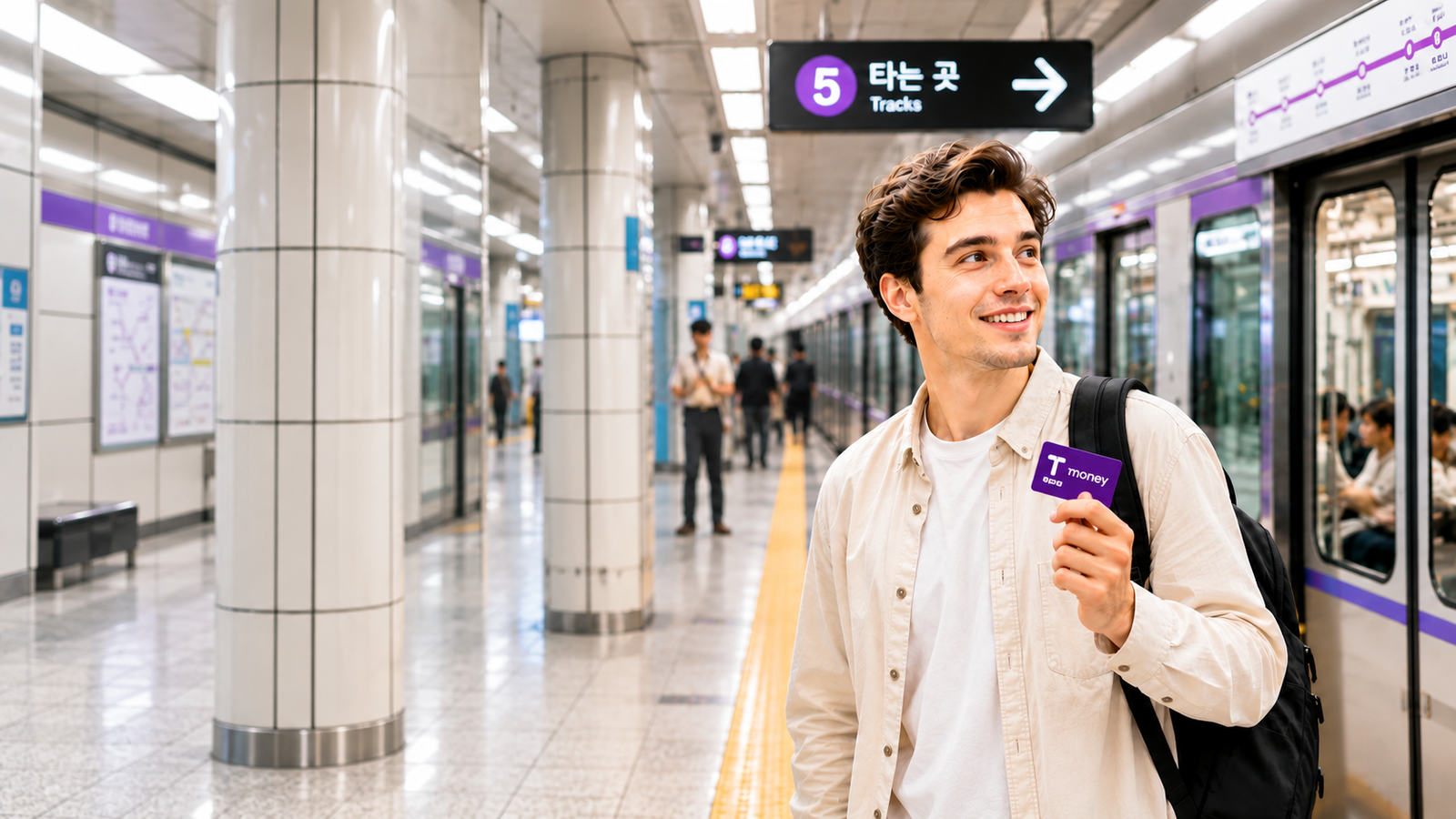
The Seoul subway is easy to use once you understand the map.
The harder part is often knowing what to do with yourself once you are inside a crowded train.
Should you move away from the door?
Is it okay to sit in that empty seat?
Do you need to apologize every time someone bumps into you?
And why does everyone suddenly seem to move before the train has even reached the next station?
Korean subway culture is not really a list of strict rules.
Most of it comes down to something much simpler:
Try not to make a crowded space harder for the people around you.
As someone who lives in Korea, that is what I notice far more than whether someone has memorized every piece of subway etiquette.
The Main Rule Is Not to Become an Obstacle
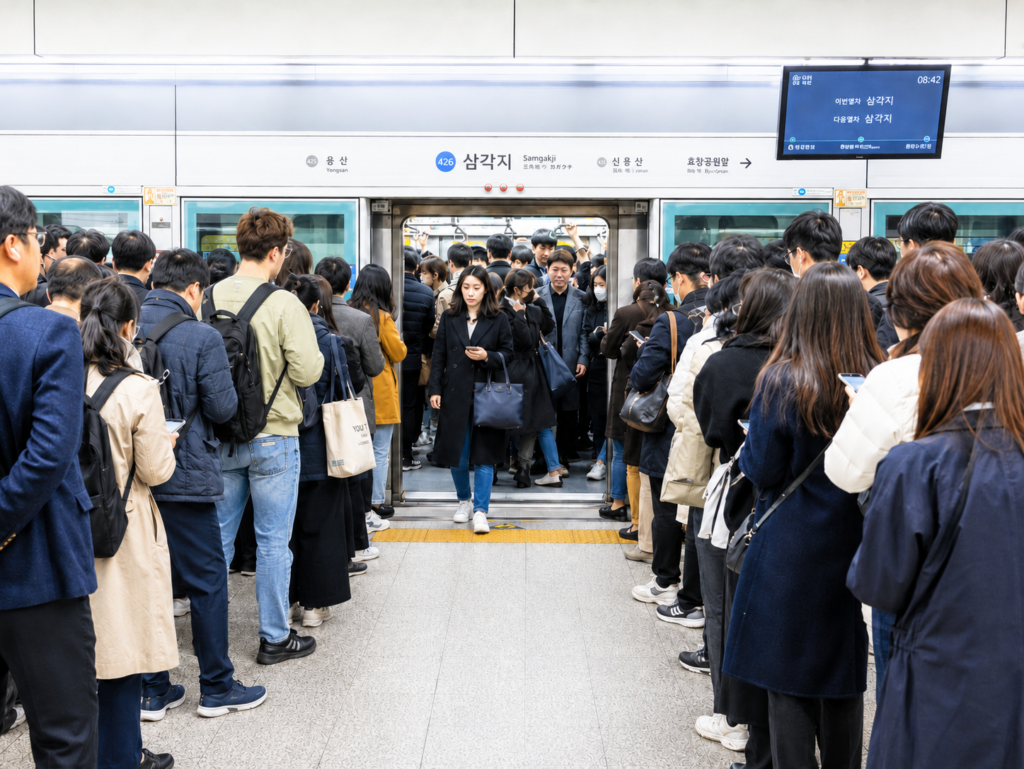
When a subway car is busy, people are constantly calculating space.
Where can I stand?
Can that person get out?
Is there enough room for someone to pass?
Can I move without blocking the doorway?
Nobody is consciously asking all of those questions every second, of course. After using the subway for years, it becomes almost automatic.
That is why Korean subway etiquette can sometimes look very efficient without anyone saying much.
When the doors open, passengers getting off usually take priority.
People waiting on the platform generally stand to the sides and leave the center open.
Once the exiting passengers have passed, everyone begins boarding.
During rush hour, this may look much less neat than the diagrams painted on the platform.
But the basic idea remains the same:
Do not stand where everyone else needs to move.
Sometimes I Actually Step Off the Train to Let Other People Out
This is one of those small things that is difficult to explain until you have been on a crowded Korean subway.
Imagine you are standing right next to the door, but it is not your stop.
The doors open.
Several people behind you need to get off.
What do you do?
If I think they can get past me, I usually stay near the side of the doorway and make myself as narrow as possible.
But if I realize that people cannot reasonably get out unless I move, I step onto the platform.
Then I move slightly to the side, let them exit, and get back on the train. If you do this, watch the gap and reboard only while the doors are fully open. If they start closing, wait for the next train rather than trying to squeeze in. Seoul’s subway safety guidance gives the same warning about closing doors.
You will see other passengers do this too.
It does not mean they accidentally got off at the wrong station.
They are simply clearing the doorway.
For a first-time visitor, this is worth knowing because otherwise you may try very hard to stay inside the train when temporarily stepping out would actually make everything easier.
Backpacks Become Much More Noticeable When the Train Is Full
A backpack that feels completely harmless on an empty train can become surprisingly annoying on a packed one.
You cannot always feel what your backpack is doing behind you.
It may be pressing against someone, hitting them when you turn, or taking up the small amount of space another passenger was trying to use.
You will sometimes see people move their backpacks to the front when the subway becomes crowded.
Not everyone does it.
It is not some perfectly followed Korean rule.
But people do it often enough that it is worth noticing.
Personally, I am very aware of backpacks worn on the back in extremely crowded trains because the person carrying one may not realize how much space it is taking.
If your train is packed, hold your backpack close in front of you or low by your side without blocking the aisle or putting it where someone could trip over it.
A Quiet Subway Does Not Mean You Cannot Talk
Korean subway cars often feel quieter than visitors expect.
People still talk.
Friends chat.
Couples talk to each other.
Someone may answer a short phone call.
The difference is usually volume.
Watching a video or listening to music through your phone speaker is much more noticeable in a quiet carriage than a normal conversation between two people.
This is not just an imaginary cultural rule. Seoul Metro has actively campaigned for passengers to use earphones because noise from phones has generated passenger complaints.
Official source: Seoul Metro’s campaign for earphone use
You do not need to sit in complete silence.
Just remember that your phone audio does not need to become everyone else’s audio.
The Pink Pregnancy Seat Feels Different From a Normal Empty Seat
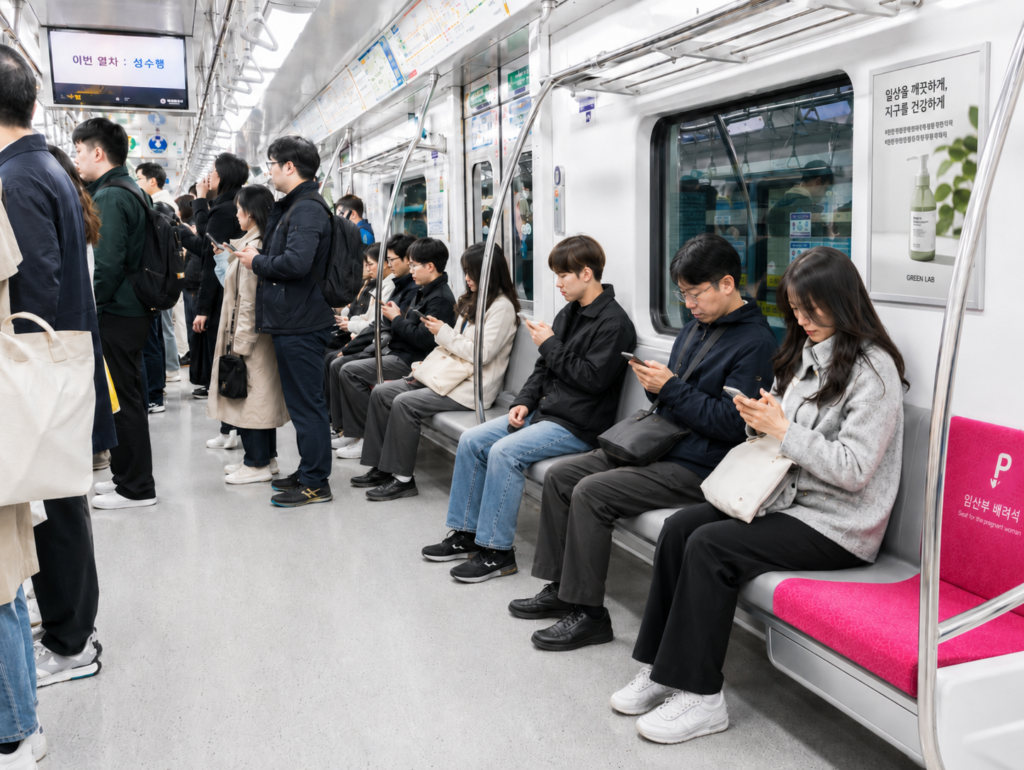
Special seating can be confusing if you are visiting Korea for the first time.
There are general priority seats intended for passengers who may need a seat more urgently.
There are also easily recognizable pink seats designated for pregnant passengers. Seoul introduced the distinctive pink design specifically to make pregnancy seating more visible.
Official source: Seoul’s introduction of the pink seat design. Seoul’s pregnancy-seat guidance also encourages passengers to leave these seats empty for pregnant riders. Early pregnancy may not be visible, so do not rely on appearance to decide whether someone needs the seat.
What people actually do around these seats varies.
Some passengers will sit in certain priority areas when they are empty.
Others avoid them.
I personally try not to sit in either if I can help it.
It is not because I believe nobody else is ever allowed to sit there.
For me, it is simpler.
If I sat there, I would probably spend the entire ride wondering whether someone who needed the seat more was about to get on.
So I would rather stand.
My choice to avoid both types of seat is a personal habit. The pink-seat campaign is a separate request to keep those seats available for pregnant passengers.
But it also explains something visitors sometimes notice: a train may be crowded while certain specially marked seats remain empty.
On a Packed Train, Not Every Small Bump Gets an Apology
This can feel strange depending on where you come from.
When a subway is extremely crowded, people inevitably touch.
Shoulders bump.
Bags brush against coats.
Someone moves slightly because the person behind them moved.
In that situation, people do not necessarily say “sorry” every single time two bodies touch.
Small accidental contact can be part of moving through a packed space.
That does not mean pushing people is acceptable.
And if you step hard on someone’s foot, knock into someone badly, or clearly cause a problem, apologizing is normal.
But tiny unavoidable contact during rush hour is often just absorbed into the flow.
It is less personal than it may feel at first.
People Often Start Moving Before Their Stop
If the train is fairly empty, you can wait until the doors open and leave without much thought.
A crowded train is different.
People often begin preparing before their station arrives.
They may put away their phone, move their bag, stand up, or gradually work their way closer to the door.
This is not necessarily impatience.
They are trying to avoid discovering at the last second that six people are standing between them and the exit.
You do not need to camp directly in front of the door several stations early.
But if your stop is next and the train is crowded, it helps to start paying attention to your route out. Keep hold of a rail while the train is moving, and do not push through other passengers.
A quiet 잠시만요 — jamsimanyo, roughly “excuse me” or “just a moment,” can also help when you genuinely need to pass.
Not Every Local Thinks the Fastest Subway Is the Best Choice
This is one part of Korean transportation culture that route-planning apps cannot really show you.
The fastest route is not always the route I want.
Personally, I dislike extremely crowded subway rides.
If I can take a bus that takes longer but gives me a reasonable chance of sitting down, I sometimes choose the bus instead.
Especially in the morning.
I do not want to use all of my energy before the day has even started just to save a few minutes.
Other people make completely different choices.
Someone with a long commute may care much more about speed.
Someone else may deliberately leave earlier to avoid peak congestion.
The point is that locals do not always optimize transportation around the smallest number of minutes.
Comfort, crowding, transfers, weather, and how tired you already are can matter just as much.
That is a useful way to think about transportation in Korea in general.
You Do Not Need to Memorize Korean Subway Culture
Visitors sometimes approach subway culture as if there is a test.
Stand here.
Do not stand there.
Use this seat.
Never use that seat.
Move your bag this way.
Say this phrase.
Real life is less rigid.
People make mistakes.
Koreans block doors sometimes.
People wear backpacks on crowded trains.
Someone watches a video too loudly.
Someone sits in a seat another passenger would have left empty.
There is no perfectly synchronized Korean subway society.
What matters more is noticing the space around you.
Let people get off.
Move if you are blocking the doorway.
Be aware of what your backpack is doing.
Keep your personal audio personal.
Recognize specially designated seats.
And when the train is packed, understand that a little unavoidable physical contact is usually just part of the ride.
Once you stop trying to memorize every rule and start watching how the space is moving, Korean subway culture becomes much easier to understand.