
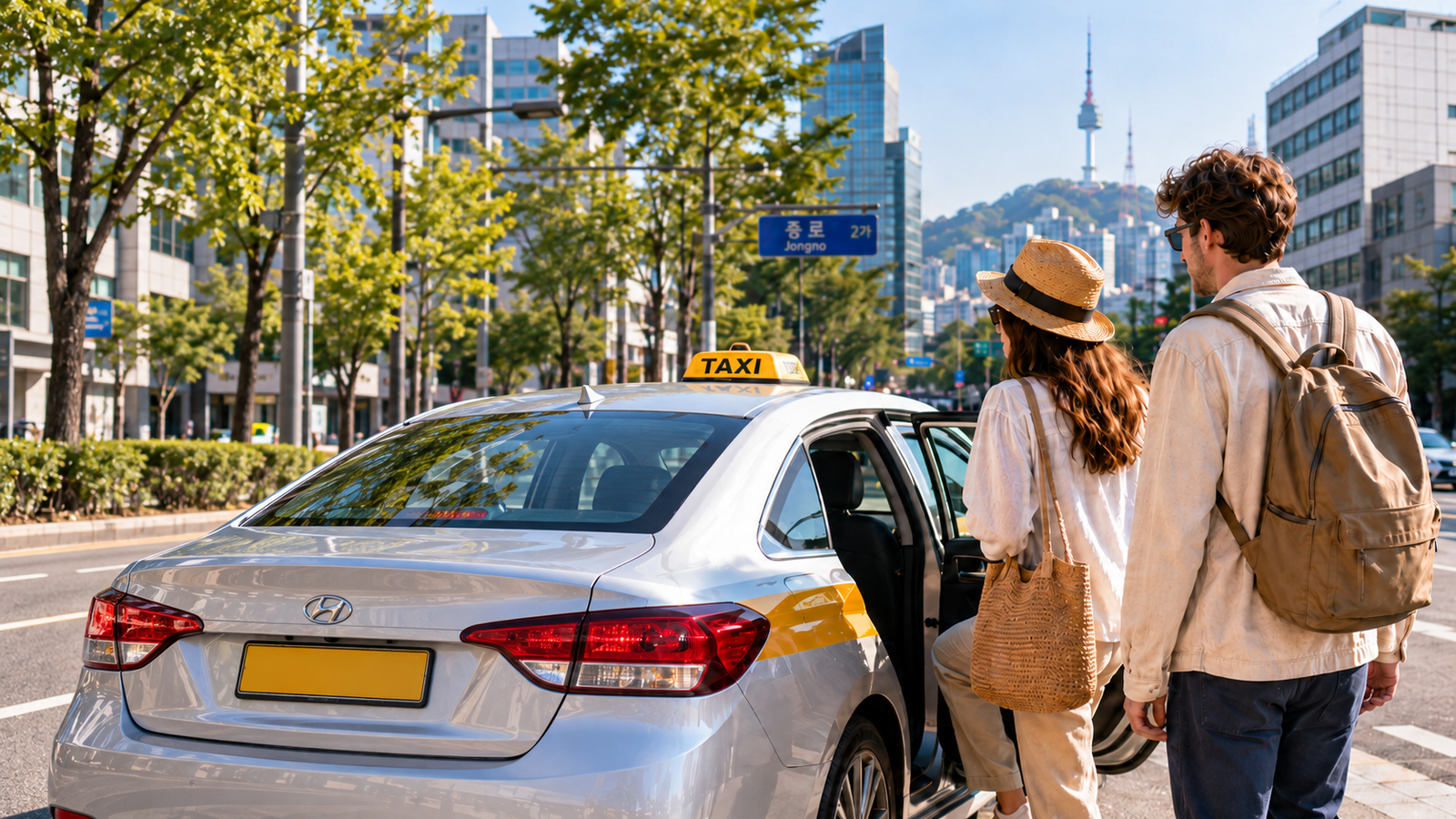
Taking a taxi in Korea is usually easier than first-time visitors expect. Taxis use meters, card payment is common, and tipping is not required.
But there is one thing I would tell a first-time visitor before talking about apps or fares:
Where you stand matters.
In Korea, a taxi is already moving with traffic. If the driver has just passed your pickup point and you are standing behind the taxi, the driver may not be able to come back for you. There are usually cars right behind, so reversing is often impossible.
I care more about choosing a good pickup point than which taxi app I use. If the taxi can approach you naturally, on the correct side of the road and in the direction of traffic, the whole ride starts much more smoothly.
Your Pickup Point Matters More Than the App
Taxi apps are useful in Korea, especially if you do not speak Korean. They show the driver, license plate, route, estimated fare, and payment information, and they can also help if you leave something behind.
For most international visitors, k.ride is one of the easiest options to start with. It is operated by Kakao Mobility and is designed for international travelers, with multilingual search, translated driver messages, estimated fares, and in-app payment. Uber Taxi is also useful if you already have an Uber account, while Kakao T offers broader options but is generally more familiar to residents and repeat visitors.
Grab does not operate its ride-hailing service in South Korea. If you normally use Grab in Southeast Asia, k.ride or Uber Taxi are the closest alternatives for calling a taxi in Korea.
But even with the right app, a badly chosen pickup pin can make things unnecessarily difficult.
On a wide road, check which side you are standing on before confirming the ride. If your taxi would need to cross several lanes, make a U-turn, or come back after already passing you, moving the pickup point a little may save both you and the driver several minutes.
At large train stations, malls, and hotels, I also look at the entrance or exit rather than simply entering the building name.
A pickup pin is not just a point on a map. It should be a place where a car can realistically stop for you.
If you are unsure about the surrounding roads, a Korean map app can be useful for checking entrances and road direction before calling the taxi.
You Can Still Take a Taxi Without an App
Street taxis are still common.
Look near the windshield for:
빈차 (bincha) — available
예약 (yeyak) — reserved
If you see 빈차, you can usually raise your hand to hail the taxi. 예약 means the taxi has already been booked, even if there is no passenger inside yet.
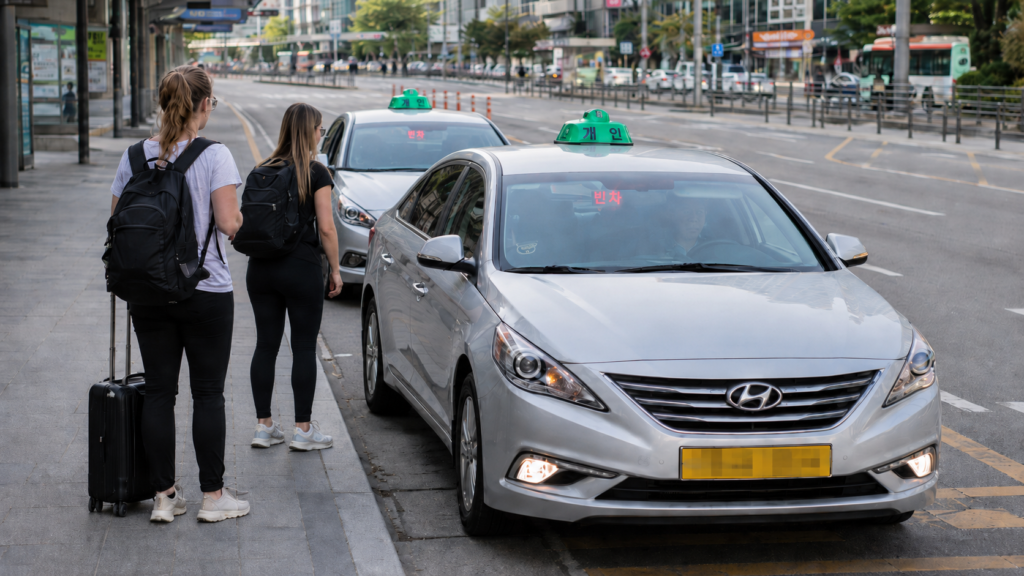
At airports, train stations, and major bus terminals, using the designated taxi stand is often easier than trying to hail one from the road.
Late at night, however, an app can be more convenient because many taxis may already be on their way to another passenger.
Save Your Destination in Korean
English ability varies from driver to driver.
Before getting into a taxi, I recommend saving:
- the Korean name of your destination
- the full Korean address
- the phone number
- a nearby landmark or subway station if useful
A screenshot is worth keeping too. If your mobile connection suddenly disappears, you can still show the driver where you need to go.
This is especially useful with hotels or buildings that have several entrances. Sometimes the difference between a convenient drop-off and a long walk with luggage is simply which side of the building the taxi approaches.
How Much Do Taxis Cost in Seoul?
For a standard Seoul taxi, the daytime base fare is KRW 4,800 for the first 1.6 kilometers.
After that, the daytime meter adds KRW 100 per 131 meters. Below 15.72 km/h, a time charge of KRW 100 per 30 seconds also applies. That means two trips of roughly the same distance can cost differently if one gets stuck in traffic.
For a standard Seoul taxi in daytime, these distance-only estimates exclude slow-traffic time charges and other extras:
| Distance | Approximate Meter Fare |
|---|---|
| Up to 1.6 km | KRW 4,800 |
| About 3 km | KRW 5,900 |
| About 5 km | KRW 7,400 |
| About 10 km | KRW 11,300 |
These are only estimates. Traffic, waiting time, tolls, app fees, late-night surcharges, and the taxi type can change the final price.
For current rates, check the official Seoul taxi fare information before your trip.
Why Can the Same Taxi Ride Cost More at Night?
Regular taxis in Seoul apply a late-night surcharge.
The current late-night surcharge periods are:
- 10 p.m.–11 p.m.: 20%
- 11 p.m.–2 a.m.: 40%
- 2 a.m.–4 a.m.: 20%
A 20% out-of-city surcharge may also apply when a Seoul taxi travels outside the city, and expressway or bridge tolls are charged separately. Some app bookings may also include service fees.
So if a taxi ride costs noticeably more at midnight than it did during the afternoon, that does not automatically mean something went wrong.
Check the meter, time, route, tolls, and taxi type first.
Paying Is Usually Easy, but Check the App Before Paying Again
Most Korean taxis accept cash, credit cards, and transportation cards such as T-money. Tipping is not required. Major international cards are commonly accepted, although a foreign card can occasionally be declined.
I would still carry one backup payment method.
The mistake visitors are more likely to make is paying twice.
Before paying in the taxi, check whether your booking is set to automatic payment or payment to the driver. If automatic payment is selected, check the app with the driver before paying separately by card, T-money, or cash.
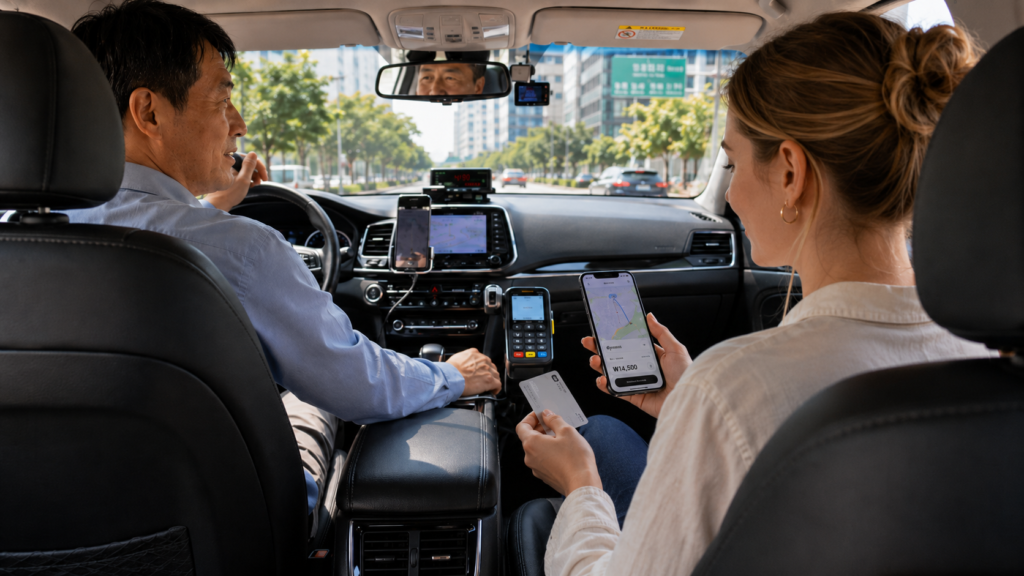
If you are unsure, show the payment screen to the driver and ask:
결제됐어요?
Gyeolje dwaesseoyo?
“Has it already been paid?”
Keep the app receipt or card record until you are sure the payment looks correct.
Think About Your Luggage, Not Just the Number of Passengers
A regular taxi is usually enough for one or two travelers with ordinary luggage.
The problem often appears when a group thinks only about the seats.
Four passengers may technically fit in a regular taxi. Four passengers plus four large suitcases may not.
Deluxe taxis cost more, but the label alone does not tell you whether all your luggage will fit. For a larger vehicle, check the passenger and luggage capacity before booking. International taxis provide foreign-language assistance and can be useful for airport transfers.
For an airport trip, I would compare:
- one larger taxi
- two regular taxis
- the amount of luggage you actually have
rather than choosing only by passenger count.
Travel becomes tiring surprisingly quickly when everyone is holding bags on their lap.
At Incheon Airport, Follow the Official Taxi Signs
After collecting your luggage at Incheon Airport, follow the official Taxi signs to the designated stands outside the arrivals area.
The pickup location differs depending on:
- Terminal 1 or Terminal 2
- regular taxi
- deluxe or jumbo taxi
- international taxi
- pre-booked service
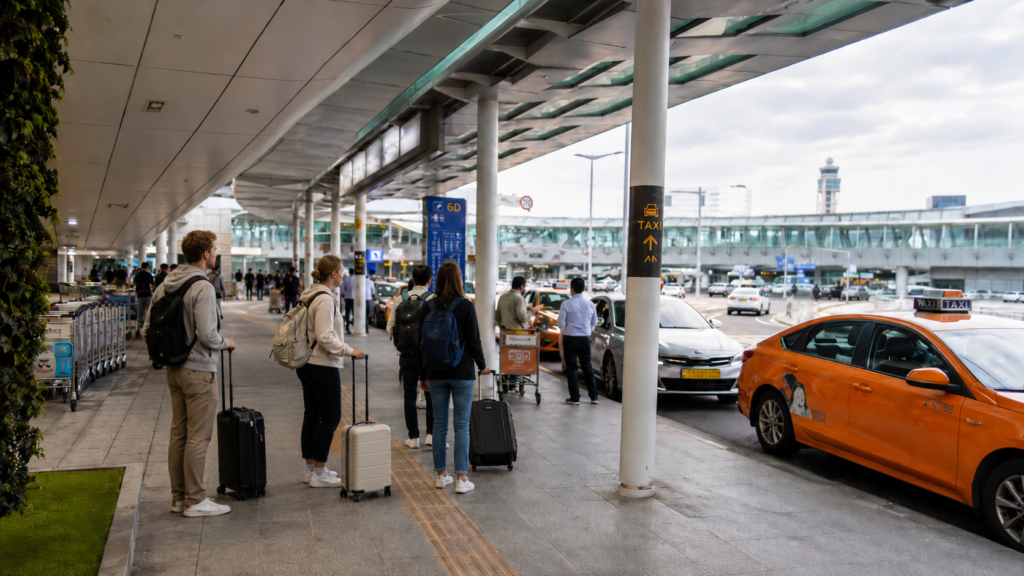
Do not follow someone inside the terminal simply because they offer you a ride. Incheon Airport warns travelers about illegal solicitation and call vans posing as taxis that may charge excessive fares.
Regular taxis traveling from Incheon Airport to Seoul normally use the meter, with tolls and applicable late-night surcharges added separately. Incheon Airport is a joint operating area, so this airport-to-Seoul trip does not carry a boundary surcharge.
International taxis can offer foreign-language assistance and fixed-rate airport-to-Seoul service depending on the destination area. If you plan to use one, check the current details on the official International Taxi website.
If your flight lands after trains and buses stop running, our Incheon Airport late-night arrival guide explains the wider transport and overnight options.
If you are tired after a long flight and the taxi area feels confusing, I would simply ask an airport information desk. There is no reason to make the first hour of your Korea trip harder than it needs to be.
Keep the Receipt Until You Know You Have Everything
If you book through an app, your ride history usually gives you a record of the taxi and trip.
If you take a street taxi, ask for a receipt:
영수증 주세요.
Yeongsujeung juseyo.
“Please give me a receipt.”
That small piece of paper can be very useful if you realize later that your phone, wallet, or bag is still in the taxi.
A card or T-money transaction may also help identify the ride. If you lose something, Seoul’s official Lost and Found guide explains where to report or search for lost property, including Korea’s National Police Agency LOST112 service.
Before closing the door, I usually think it is worth taking two seconds to look at the seat, floor, and door pocket.
That is much easier than trying to track down a taxi afterward.
The Taxi App Is Only Part of the Trip
For a first taxi ride in Korea, you do not need to memorize every taxi type or Korean phrase.
Save your destination in Korean, know how you will pay, and check that the license plate matches the car you booked.
But above all, look at the road before choosing your pickup point.
A taxi app can tell the driver where you are. It cannot make a taxi reverse through traffic after it has already passed you.
Once you start thinking about where the taxi can actually reach you—not just where the map pin happens to be—taking taxis in Korea becomes much easier.